
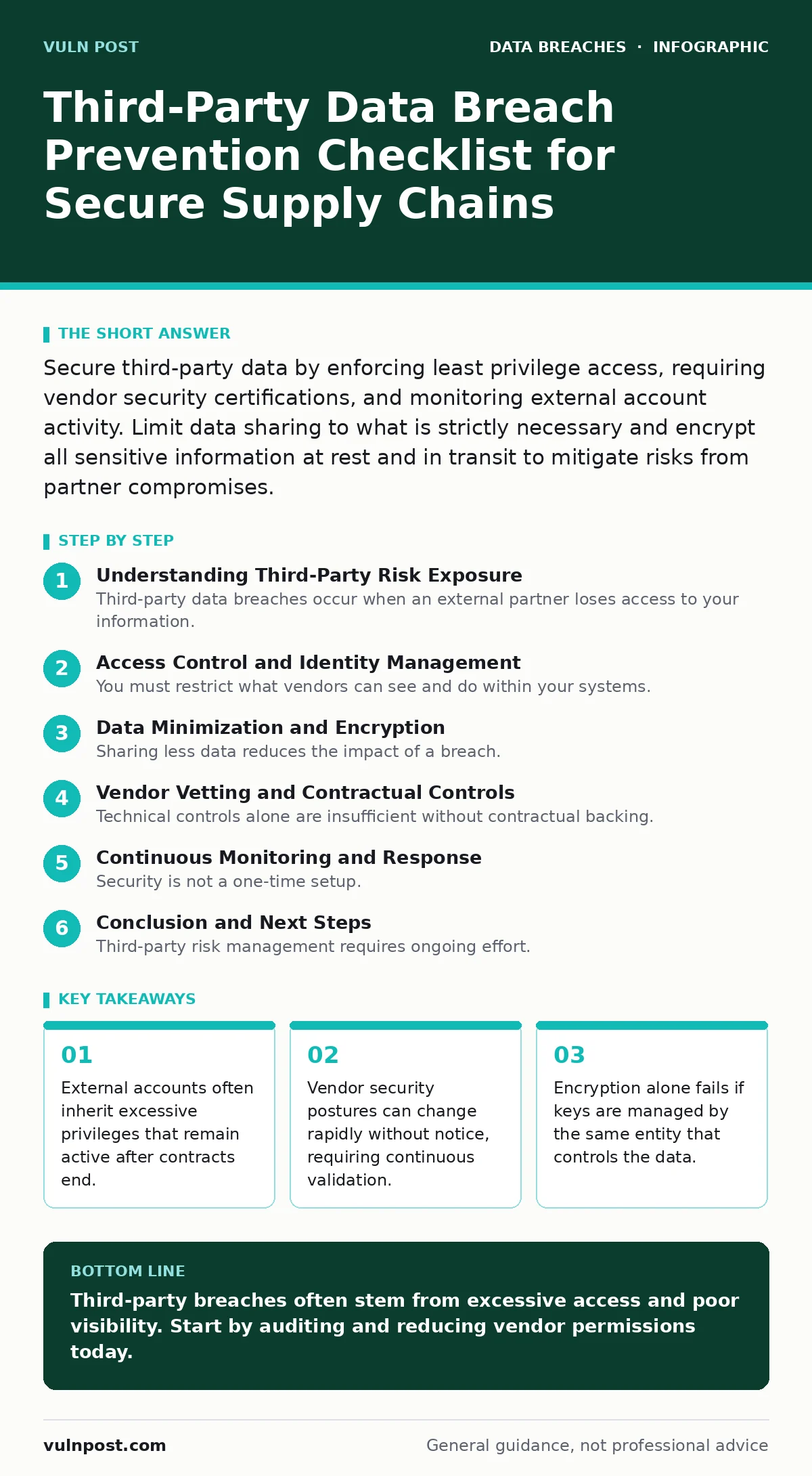
Secure third-party data by enforcing least privilege access, requiring vendor security certifications, and monitoring external account activity. Limit data sharing to what is strictly necessary and encrypt all sensitive information at rest and in transit to mitigate risks from partner compromises.
Understanding Third-Party Risk Exposure
Third-party data breaches occur when an external partner loses access to your information. Your organization shares data with vendors for payroll, cloud hosting, or customer support. These partners become extensions of your attack surface. If a vendor suffers a breach, your data is often exposed alongside theirs. You cannot control their internal security practices directly. You must control how much data they hold and how they access it.
The risk is not just the vendor’s negligence. It is the trust you place in their systems. That trust must be verified through technical controls and contractual obligations. You need a structured approach to manage these relationships. This checklist provides specific actions to reduce exposure. It focuses on access, data handling, and continuous monitoring. Implementing these steps reduces the likelihood of cascading failures.
Access Control and Identity Management
You must restrict what vendors can see and do within your systems. Default access is often too permissive. You need to define specific roles for each vendor interaction.
- Implement role-based access control: Limit vendor access to only the resources required for their specific contract. This prevents lateral movement if their account is compromised.
- Enforce multi-factor authentication: Require strong second-factor verification for all external accounts. This stops attackers from using stolen passwords alone.
- Set automated expiration dates: Ensure temporary access credentials expire automatically. This eliminates the risk of forgotten accounts remaining active.
- Monitor login anomalies: Alert on logins from unusual locations or times. This helps detect compromised vendor accounts before data is exfiltrated.
- Conduct regular employee offboarding security reviews: Ensure access is revoked immediately when staff changes occur. This prevents former employees from retaining access through vendor channels.
Data Minimization and Encryption
Sharing less data reduces the impact of a breach. You should only provide the information necessary for the vendor to perform their function. Full datasets are rarely required for routine tasks.
- Mask sensitive fields: Replace identifiable information with placeholders where possible. This ensures that even if data is stolen, it cannot be linked to individuals.
- Encrypt data at rest: Use strong encryption algorithms for stored files. This protects data from physical theft or unauthorized database access.
- Encrypt data in transit: Require TLS for all communications. This prevents interception of data moving between your systems and the vendor.
- Manage encryption key management separately: Keep keys distinct from the data they protect. This ensures that a vendor breach does not automatically decrypt your archives.
- Avoid storing backup data exposure risks: Ensure vendors do not retain copies of your data longer than necessary. This limits the window of opportunity for attackers.
Vendor Vetting and Contractual Controls
Technical controls alone are insufficient without contractual backing. You need legal recourse and clear security expectations. Vendors must prove their security posture before you share data.
- Require SOC 2 reports: Verify that vendors undergo independent security audits. This provides evidence of their control environment and operational rigor.
- Define breach notification timelines: Contractually mandate immediate reporting of incidents. This allows you to respond quickly before damage spreads.
- Specify data retention policies: Dictate how long vendors keep your data. This prevents unnecessary accumulation of sensitive information.
- Audit rights inclusion: Reserve the right to inspect vendor security practices. This ensures ongoing compliance with your security standards.
- Review sub-processor chains: Identify who else has access to your data. This prevents hidden exposure through secondary vendors.
Continuous Monitoring and Response
Security is not a one-time setup. Vendor environments change, and so do threats. You must continuously verify that controls remain effective. Assume that a breach will happen eventually. Your goal is to detect it early and limit the damage.
- Monitor for data scraping attempts: Watch for automated tools accessing your data through vendor portals. This indicates reconnaissance or unauthorized harvesting.
- Test incident response plans: Simulate a vendor breach scenario regularly. This ensures your team knows how to isolate and remediate quickly.
- Check for medical identity theft risks: If handling health data, verify specific HIPAA compliance measures. This addresses the unique sensitivity of personal health information.
- Review user activity logs: Analyze vendor account behavior for unusual patterns. This helps detect insider threats or compromised credentials.
- Validate patch management: Ensure vendors apply security updates promptly. This reduces the attack surface of known vulnerabilities.
See also: Misdirected Email Myths: Why Common Fixes Fail to Stop Data Leaks · SOC 2 Report: What It Is, Why It Matters, and How to Pass
Conclusion and Next Steps
Third-party risk management requires ongoing effort. You cannot delegate security responsibility entirely to vendors. You must maintain visibility into their access and practices. Regular reviews and strict access controls are your best defense. Start by auditing your current vendor access lists. Identify accounts with excessive permissions. Remove unnecessary access immediately. Then, update your contracts to include stronger security clauses. This proactive approach significantly reduces your exposure to third-party data breaches.
Key takeaways
- External accounts often inherit excessive privileges that remain active after contracts end.
- Vendor security postures can change rapidly without notice, requiring continuous validation.
- Encryption alone fails if keys are managed by the same entity that controls the data.
Third-party breaches often stem from excessive access and poor visibility. Start by auditing and reducing vendor permissions today.
Frequently asked questions
How often should I review third-party access?
Review access rights at least quarterly. Immediate reviews are also necessary after any contract change or security incident.
What if a vendor refuses to share security reports?
Do not share sensitive data with vendors who refuse transparency. Seek alternative partners or limit data sharing to non-sensitive information.
Can encryption prevent all third-party breaches?
No. Encryption protects data at rest and in transit. It does not prevent unauthorized access if keys are compromised or if data is manipulated in memory.
How do I know if a vendor has been breached?
Monitor security news and use services like Have I Been Pwned. Also, require vendors to notify you immediately of any security incidents.
How this guide was produced: written by the Vuln Post editorial team with AI assistance, checked against the public references listed below, and reviewed when the facts change. See our editorial policy or report an error.