
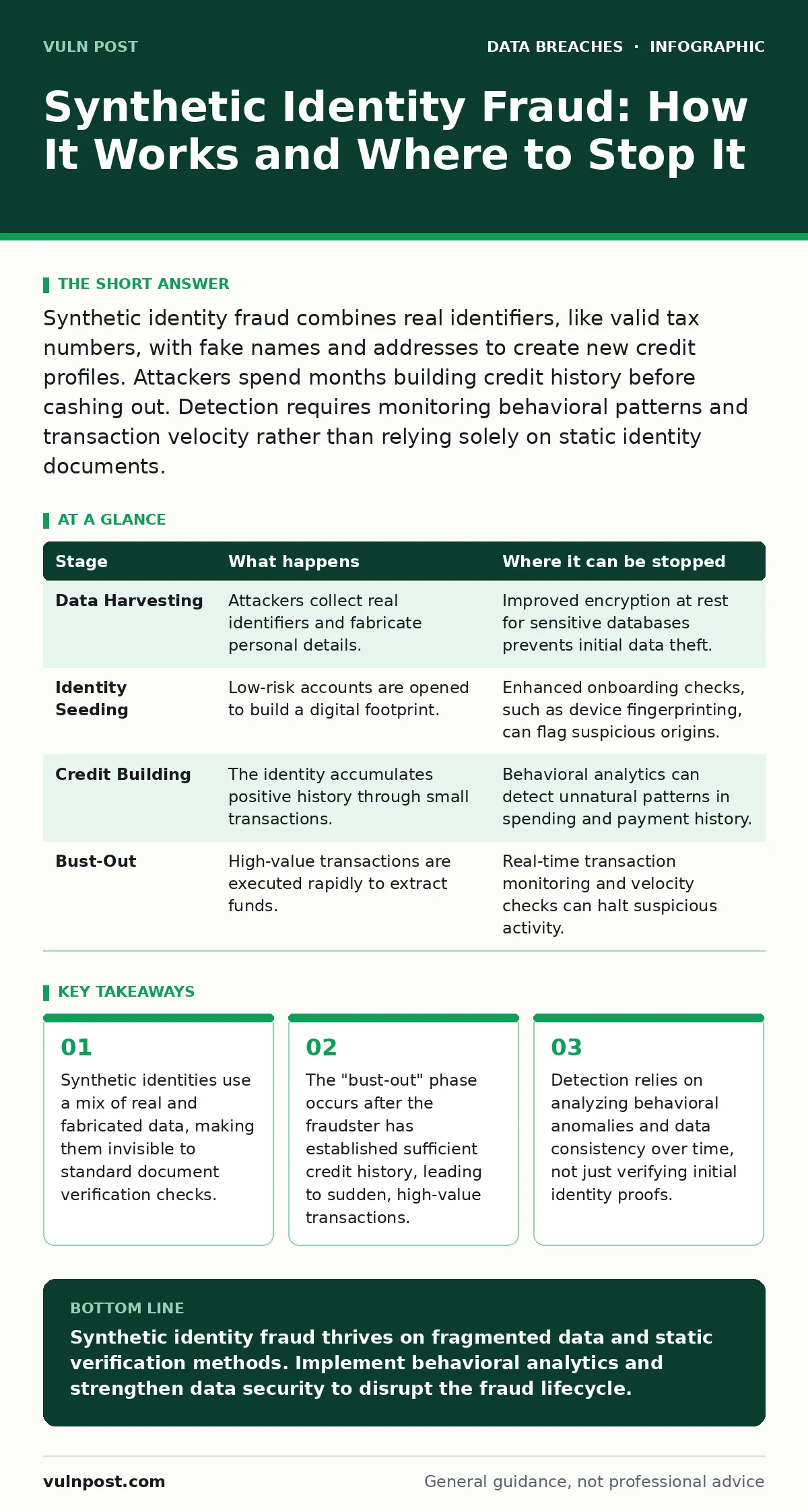
Synthetic identity fraud combines real identifiers, like valid tax numbers, with fake names and addresses to create new credit profiles. Attackers spend months building credit history before cashing out. Detection requires monitoring behavioral patterns and transaction velocity rather than relying solely on static identity documents.
The Anatomy of a Fabricated Persona
Synthetic identity fraud differs from traditional identity theft because it does not target an existing victim with a full credit history. Instead, attackers construct a new identity from scratch. They combine real elements, such as a valid taxpayer identification number, with fabricated details like a false name, address, and date of birth. This hybrid nature allows the identity to pass basic verification checks while remaining invisible to standard fraud detection systems that look for known stolen records.
The core mechanism relies on the fragmentation of personal data. Attackers often harvest real identifiers from data breaches or dark web marketplaces. They then pair these valid numbers with invented biographical data. Because no single real person matches the complete profile, traditional background checks return clean results. The system sees a new applicant with no negative history, which is precisely what the attacker intends.
### Stage 1: Data Harvesting and Assembly
The process begins with the acquisition of raw materials. Attackers need a valid government-issued identifier to anchor the synthetic identity. In many jurisdictions, this is a social security or tax identification number. These numbers are often obtained from large-scale data breaches where personal information was exposed. The attacker does not need the full profile of the person associated with the number, only the identifier itself.
Once the identifier is secured, the attacker fabricates the remaining details. They generate a plausible name, a residential address, and a phone number. The address may be real, belonging to a random household, or it may be a virtual mailbox service. The goal is to create a profile that looks statistically normal. If the data points are too perfect or too random, automated screening tools may flag them. The attacker seeks the middle ground of plausibility.
### Stage 2: Identity Seeding
With the profile assembled, the attacker must establish a digital footprint. This phase is known as seeding. The attacker applies for low-risk financial products, such as prepaid debit cards or secured credit cards. These products often have lax underwriting requirements and do not require a deep credit history. The attacker may also open utility accounts or mobile phone plans in the synthetic name.
Each successful application adds a layer of legitimacy to the synthetic identity. The attacker ensures that the account is used sparingly and paid on time. This builds a positive credit score and a transaction history. Financial institutions view this behavior as responsible credit management. The attacker is essentially renting trust from the financial system by mimicking the behavior of a low-risk consumer.
This stage requires patience. It can take months or even years to build sufficient creditworthiness. During this time, the synthetic identity remains dormant in terms of large transactions. The attacker avoids drawing attention by keeping spending patterns consistent and modest. The goal is to make the identity look like a real person who is gradually building financial stability.
### Stage 3: Credit Building and Maturation
As the synthetic identity matures, the attacker expands its financial footprint. They apply for unsecured credit cards and small personal loans. These products carry more risk for the lender but offer higher credit limits. The attacker continues to make small, regular payments to maintain a high credit score. This phase is critical because it determines the maximum value the attacker can extract in the final stage.
The attacker may also use the identity to rent property or lease vehicles. These actions further embed the synthetic persona into the real world. Landlords and leasing companies perform their own checks, which, if passed, add another layer of perceived legitimacy. The synthetic identity now has multiple references and a history of meeting financial obligations.
At this point, the identity is nearly indistinguishable from a real person with a thin file. Traditional fraud detection systems struggle here because there is no negative history to flag. The attacker has successfully groomed the identity to appear low-risk. The financial institutions holding these accounts believe they are dealing with a trustworthy customer.
### Stage 4: The Bust-Out
The final stage is the bust-out. Once the credit limits are high enough, the attacker executes a rapid series of high-value transactions. They may max out multiple credit cards, take out large loans, or purchase expensive goods that can be quickly resold. The goal is to extract as much value as possible before the fraud is detected.
This phase is characterized by a sudden change in behavior. Transaction velocity spikes, and spending patterns deviate sharply from the historical norm. The attacker may close accounts or change contact information to hinder recovery efforts. Once the cash-out is complete, the synthetic identity is abandoned. The attacker moves on to the next fabricated persona.
Financial institutions often realize they have been defrauded only after the fact. The charge-offs and losses mount as the synthetic identity vanishes. The real person whose identifier was used may remain unaware of the fraud for years, as they do not have a credit history to monitor.
See also: Third-Party Data Breach Prevention Checklist for Secure Supply Chains
### Stage 5: Detection and Disruption
Detecting synthetic identity fraud requires looking beyond static data. Traditional checks verify that a name matches an identifier, but they cannot verify that the person behind the data is real. Behavioral analytics are necessary to identify the subtle inconsistencies in how the identity is used.
One effective method is to analyze the consistency of data over time. Real people have stable patterns in their spending, location, and communication. Synthetic identities often exhibit erratic behavior or data points that do not align with demographic norms. For instance, a young synthetic identity with a high income and no employment history is a red flag.
Another approach is to monitor for rapid credit building. Accounts that show a sudden increase in credit limits followed by immediate high-value transactions are suspicious. Machine learning models can be trained to recognize these patterns across large datasets. By correlating data points from multiple sources, institutions can identify anomalies that single-point checks miss.
| Stage | What happens | Where it can be stopped |
|---|---|---|
| Data Harvesting | Attackers collect real identifiers and fabricate personal details. | Improved encryption at rest for sensitive databases prevents initial data theft. |
| Identity Seeding | Low-risk accounts are opened to build a digital footprint. | Enhanced onboarding checks, such as device fingerprinting, can flag suspicious origins. |
| Credit Building | The identity accumulates positive history through small transactions. | Behavioral analytics can detect unnatural patterns in spending and payment history. |
| Bust-Out | High-value transactions are executed rapidly to extract funds. | Real-time transaction monitoring and velocity checks can halt suspicious activity. |
The Hidden Cost of Fragmentation
The root cause of synthetic identity fraud is the fragmentation of identity data. Personal information is scattered across thousands of databases, many of which have weak security. When one database is breached, the data becomes available for reuse in creating synthetic identities. This is why protecting data at the source is critical.
Organizations must adopt a zero-trust approach to data access. Not all employees need access to full identity records. Limiting access reduces the risk of insider threats and external breaches. Additionally, regular audits of log retention policies ensure that any unauthorized access is detected and investigated promptly.
The fight against synthetic identity fraud is not just about detection; it is about prevention. By securing the data that attackers use to build these personas, organizations can disrupt the supply chain of fraud. This requires a holistic view of data security, from encryption key management to strict access controls.
Integrating Defense Strategies
To effectively combat synthetic identity fraud, organizations must integrate multiple defense layers. Start by strengthening the security of your data repositories. Ensure that sensitive personal information is encrypted and access is strictly controlled. This reduces the likelihood of data breaches that fuel the creation of synthetic identities.
Next, enhance your onboarding and transaction monitoring processes. Use behavioral analytics to identify anomalies in how accounts are used. Look for patterns that deviate from the norm, such as rapid credit building or sudden changes in spending behavior. These signals can help you detect fraud before it results in significant losses.
Finally, collaborate with industry partners and regulatory bodies. Sharing information about known fraud patterns and techniques can help improve detection capabilities across the sector. By working together, organizations can stay ahead of evolving fraud tactics and protect their customers from harm.
Key takeaways
- Synthetic identities use a mix of real and fabricated data, making them invisible to standard document verification checks.
- The "bust-out" phase occurs after the fraudster has established sufficient credit history, leading to sudden, high-value transactions.
- Detection relies on analyzing behavioral anomalies and data consistency over time, not just verifying initial identity proofs.
Synthetic identity fraud thrives on fragmented data and static verification methods. Implement behavioral analytics and strengthen data security to disrupt the fraud lifecycle.
Frequently asked questions
How is synthetic identity fraud different from identity theft?
Identity theft involves stealing the identity of a real person with an existing credit history. Synthetic identity fraud creates a new, fake identity using a mix of real and fabricated data, so no single victim is directly targeted.
Why is it hard to detect synthetic identity fraud?
It is hard to detect because the identity passes standard verification checks. The data is often valid, and the credit history is clean. Detection requires analyzing behavioral patterns and data consistency over time, which is more complex than simple document verification.
What role does data breaches play in this fraud?
Data breaches provide the real identifiers, such as tax numbers, that attackers use to anchor synthetic identities. Without access to this stolen data, attackers would have to fabricate all elements, making the identity easier to detect.
How can businesses protect themselves?
Businesses can protect themselves by implementing behavioral analytics, enhancing onboarding checks, and securing their data repositories. Regular audits of access controls and **secure file sharing** practices also help prevent data leaks.
How this guide was produced: written by the Vuln Post editorial team with AI assistance, checked against the public references listed below, and reviewed when the facts change. See our editorial policy or report an error.