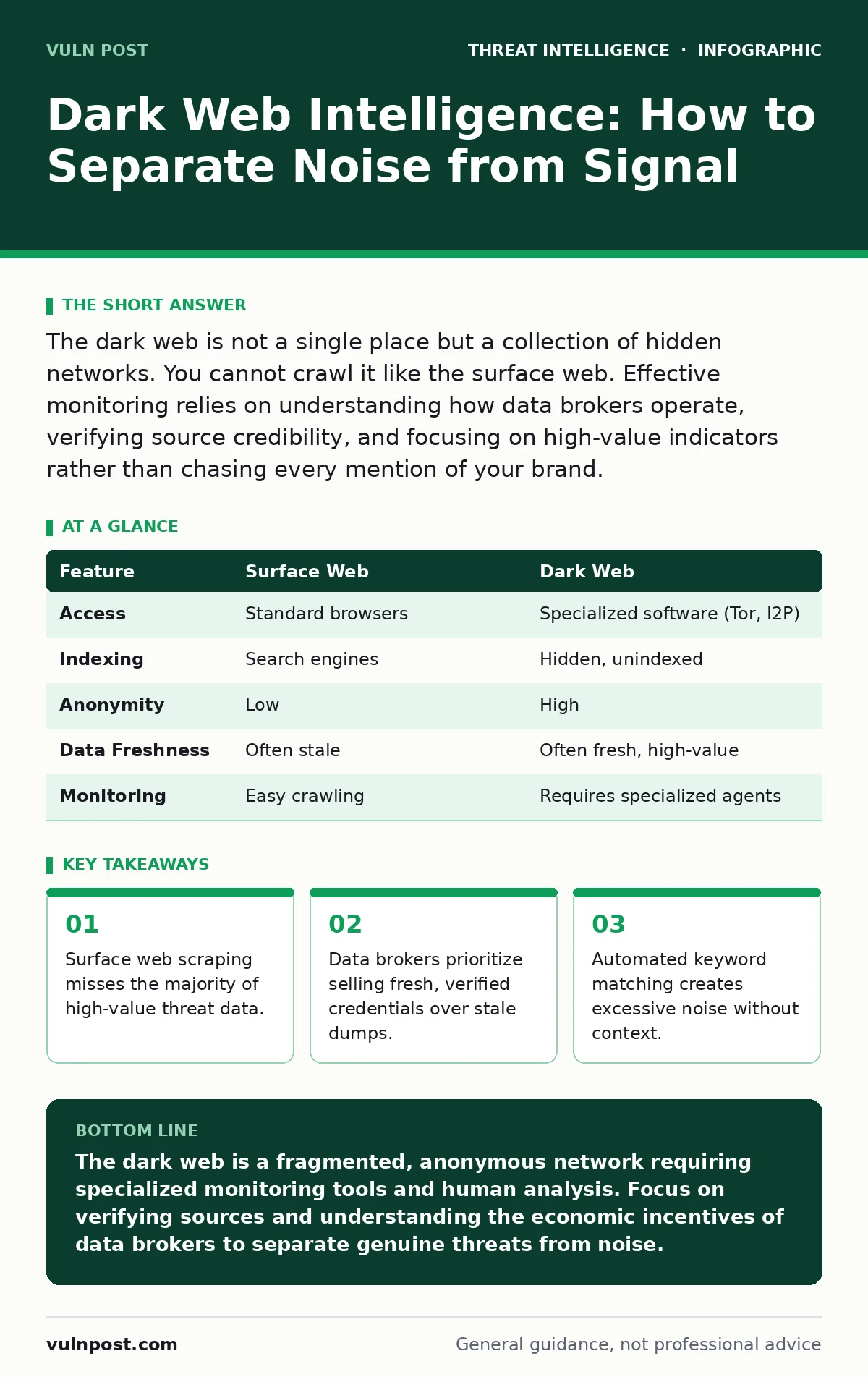
The dark web is not a single place but a collection of hidden networks. You cannot crawl it like the surface web. Effective monitoring relies on understanding how data brokers operate, verifying source credibility, and focusing on high-value indicators rather than chasing every mention of your brand.
What exactly is the dark web?
The dark web consists of websites that reside on anonymized networks and are not indexed by standard search engines. These sites require specific software, such as Tor or I2P, to access because they route traffic through multiple layers of encryption to hide the user's location. Unlike the deep web, which includes private databases and login-protected content, the dark web is intentionally hidden. This distinction matters because standard web crawlers cannot reach dark web content. You must use specialized tools that understand these routing protocols.
Why can I not use standard web crawlers?
Standard crawlers like those used by search engines rely on hyperlinks and public DNS records to discover pages. Dark web sites use encrypted addresses that change frequently and do not resolve through the public Domain Name System. These addresses are often long strings of characters designed to be mathematically unique and unguessable. Attempting to map this space with traditional tools yields empty results. You need agents that speak the specific protocols of these hidden networks.
Is the dark web only for criminals?
No, the dark web hosts both illicit marketplaces and legitimate privacy-focused services. Whistleblowers, journalists, and activists use these networks to communicate securely without surveillance. However, the anonymity also attracts black markets for stolen data, malware, and illegal goods. For security teams, the challenge is separating the signal from the noise. You must focus on infrastructure that indicates malicious intent rather than assuming all hidden services are threats.
How do data brokers operate?
Data brokers collect, verify, and sell stolen information such as credentials, credit card numbers, and personal records. They operate like retailers, competing on price, freshness, and verification of the data. A broker who sells unverified data quickly loses reputation and customers. This economic pressure means that high-quality data is expensive and rare. Monitoring these channels reveals what attackers are willing to pay for.
Why is keyword monitoring insufficient?
Simple keyword matching generates thousands of false positives because attackers often use generic terms or your brand name in unrelated contexts. This approach leads to alert fatigue, where analysts ignore warnings due to volume. You need context-aware monitoring that understands the structure of dark web forums and marketplaces. Analyzing the reputation of the poster and the nature of the discussion provides better signal. This reduces noise and highlights genuine threats.
See also: Threat Actor Naming Conventions: What Small Teams Need to Know · Domain Fronting Mistakes: 6 Ways Your Network Gets Bypassed
How do I verify the source of intelligence?
Verification requires checking the consistency of the data across multiple sources and timeframes. A single mention of your domain in a forum is often a false flag or spam. Corroborating evidence from independent brokers or forums increases confidence. You should also assess the historical accuracy of the source. Some actors post fake data to waste your resources. Building a baseline of trusted sources takes time but improves accuracy.
What is the role of automated monitoring?
Automated tools can scan known forums and marketplaces for specific indicators of compromise. They save time by processing large volumes of data quickly. However, they lack the nuanced understanding required to interpret context. Automation should feed into human analysis, not replace it. Analysts must review alerts to determine relevance and potential impact. This hybrid approach balances speed with accuracy.
| Feature | Surface Web | Dark Web |
|---|---|---|
| Access | Standard browsers | Specialized software (Tor, I2P) |
| Indexing | Search engines | Hidden, unindexed |
| Anonymity | Low | High |
| Data Freshness | Often stale | Often fresh, high-value |
| Monitoring | Easy crawling | Requires specialized agents |
How does this relate to internal threats?
External dark web monitoring complements internal detection efforts. If you see credentials for sale, you can correlate this with internal logs for suspicious login attempts. This external context helps prioritize internal alerts. It also informs your detection use cases by providing real-world examples of how attackers operate. Integrating external intelligence with internal telemetry creates a more complete picture.
What are the limitations of dark web intelligence?
The dark web is not a single, unified network. Data is fragmented across many hidden forums and private groups. Some high-value discussions happen in closed, invite-only channels that are inaccessible to outsiders. This means you will never have complete visibility. You must accept that some threats will remain hidden until they act. Focus on the data you can access and analyze it thoroughly.
How do I build a monitoring strategy?
Start by defining the specific indicators you care about, such as email domains, IP addresses, or specific file hashes. Identify the most relevant forums and marketplaces where this data is likely to appear. Use automated tools to collect data, but ensure human analysts review the findings. Integrate this intelligence into your broader security operations. This includes updating your detection rules and informing incident response procedures. Regularly review and refine your sources to maintain accuracy.
This approach helps mitigate risks associated with privilege escalation attacks by providing early warning of compromised credentials. It also supports defense evasion techniques by revealing how attackers attempt to hide their tracks. Understanding these dynamics allows you to adjust your monitoring focus accordingly.
Key takeaways
- Surface web scraping misses the majority of high-value threat data.
- Data brokers prioritize selling fresh, verified credentials over stale dumps.
- Automated keyword matching creates excessive noise without context.
The dark web is a fragmented, anonymous network requiring specialized monitoring tools and human analysis. Focus on verifying sources and understanding the economic incentives of data brokers to separate genuine threats from noise.
Frequently asked questions
Can I access the dark web with a regular browser?
No, you need specialized software like Tor or I2P that routes traffic through encrypted layers to access hidden services.
Can dark web monitoring prevent breaches?
It can provide early warning of compromised data, allowing you to take preventive measures like forcing password resets.
How this guide was produced: written by the Vuln Post editorial team with AI assistance, checked against the public references listed below, and reviewed when the facts change. See our editorial policy or report an error.