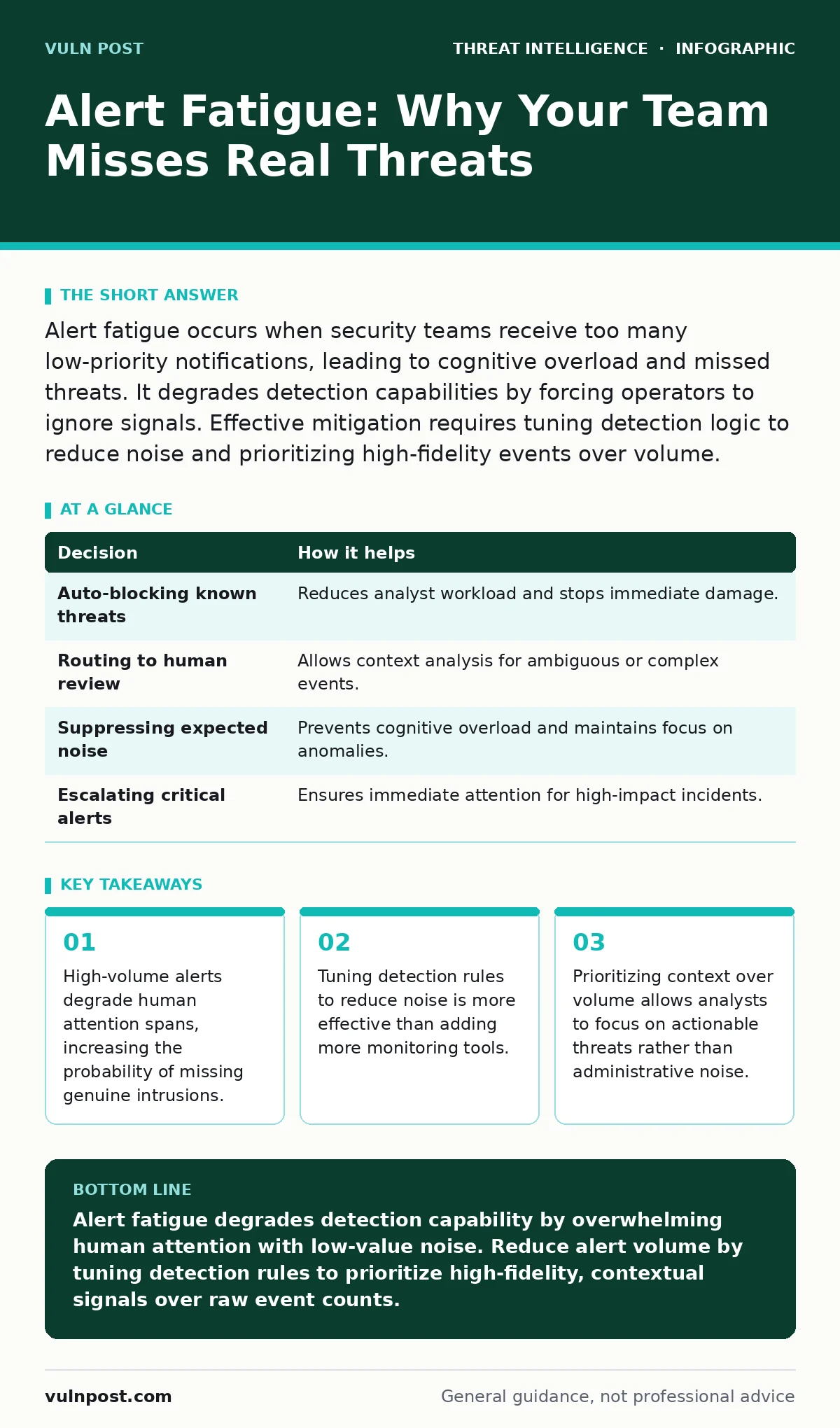
Alert fatigue occurs when security teams receive too many low-priority notifications, leading to cognitive overload and missed threats. It degrades detection capabilities by forcing operators to ignore signals. Effective mitigation requires tuning detection logic to reduce noise and prioritizing high-fidelity events over volume.
The Cost of Constant Noise
Security monitoring generates data at a rate that exceeds human processing capacity. When a system flags every minor anomaly, the signal-to-noise ratio collapses. You face a deluge of notifications that appear urgent but require little action. This volume creates a psychological barrier known as habituation. Your brain learns to ignore the alert sound because it rarely indicates a genuine crisis.
This desensitization is dangerous. It is not merely an inconvenience; it is a structural failure of the detection pipeline. When every event looks like an emergency, nothing is. The operator’s attention becomes a scarce resource, spent on false positives rather than genuine threats. This erosion of focus allows attackers to operate in plain sight.
How Teams Use Alert Data
Effective security operations rely on triage. Teams use alerts to decide which events warrant deep investigation. The goal is not to read every notification but to identify the few that indicate compromise. This process requires clear criteria for escalation. Without these criteria, analysts waste time on benign activity.
Consider the difference between two approaches. One team treats every firewall drop as a potential breach. The other team filters out expected traffic patterns and focuses on anomalous behavior. The latter approach preserves mental energy for complex analysis. This distinction determines whether the team detects an intrusion or misses it entirely.
Decisions Informed by Alert Quality
The quality of your alerts dictates the speed and accuracy of your response. Poor quality forces guesswork. High quality provides context. You must decide which alerts trigger automated responses and which require human review. This decision depends on the confidence level of the detection rule.
Automated blocking works well for known malware signatures. Human review is necessary for complex behaviors, such as defense evasion techniques that mimic legitimate activity. Misclassifying an alert leads to either blocked business operations or unchecked attacker progress. Getting this balance right requires continuous refinement of your detection logic.
| Decision | How it helps |
|---|---|
| Auto-blocking known threats | Reduces analyst workload and stops immediate damage. |
| Routing to human review | Allows context analysis for ambiguous or complex events. |
| Suppressing expected noise | Prevents cognitive overload and maintains focus on anomalies. |
| Escalating critical alerts | Ensures immediate attention for high-impact incidents. |
What Goes Wrong Without Tuning
Without regular tuning, detection rules become obsolete. Attackers change their tactics, but static rules remain fixed. This gap creates blind spots. You might detect old attack patterns while missing new ones. The volume of alerts increases as legacy rules continue to fire on benign activity.
This accumulation of noise leads to alert fatigue. Analysts begin to skip reviews. They assume the system is handling routine issues. This assumption is often false. A genuine pass-the-hash attack might look like a routine authentication event if the detection logic is too broad. The alert fires, but no one looks closely enough to see the anomaly.
The Hidden Cost of Complexity
Adding more tools often increases noise rather than reducing it. Each new sensor introduces its own set of false positives. Integrating these sources requires correlation logic that is difficult to maintain. The complexity grows exponentially. You spend more time managing the monitoring stack than analyzing threats.
This hidden cost drains resources. Engineers spend hours tuning rules instead of hunting for attackers. The team becomes reactive, chasing alerts rather than proactively seeking threats. This shift in focus weakens the overall security posture. You are busy, but not effective.
See also: Sigma Rules: Fix 6 Common Misunderstandings in Detection Logic · Detection Use Cases: Turning Raw Telemetry into Actionable Security Signals
Prioritizing High-Fidelity Signals
High-fidelity alerts contain enough context to confirm a threat. They reduce the need for secondary investigation. You achieve this by correlating multiple data points. A single login failure is noise. A login failure followed by privilege escalation and data exfiltration is a signal.
Focus on building detection use cases that link these behaviors. This approach reduces volume while increasing accuracy. It requires understanding normal user and system behavior. Deviations from this baseline are more likely to be genuine threats. This method aligns with the principles of effective detection use cases.
Integrating Threat Intelligence
Threat intelligence adds context to alerts. It helps you identify which alerts are relevant to your specific environment. Generic alerts lack this specificity. Intelligence feeds can highlight indicators of compromise that are currently active. This allows you to prioritize alerts that match known threat actor behavior.
However, raw intelligence data can also add noise. You must filter intelligence based on relevance. Not every indicator applies to your infrastructure. Integrating intelligence requires careful curation. This process ensures that alerts reflect real-world threats rather than theoretical risks. It complements your internal detection logic by adding external context.
Managing Cognitive Load
Human attention is finite. You cannot sustain high focus for long periods. Alert fatigue exploits this limitation. Designing workflows that respect cognitive limits is essential. Batch similar alerts. Provide clear summaries. Reduce the number of clicks required to investigate an event.
These small changes reduce friction. They allow analysts to process information more efficiently. The goal is to make the right action the easiest action. When the workflow supports quick decision-making, fatigue decreases. Detection accuracy improves. The team remains sharp and responsive.
The Role of Automation
Automation can reduce the burden on analysts. It can handle repetitive tasks like initial triage and enrichment. However, automation must be carefully designed. Poorly configured automation can suppress genuine alerts or create new noise. You must validate automated actions regularly.
Use automation to augment human analysis, not replace it. Humans provide context and intuition that machines lack. Machines provide speed and consistency. Combining these strengths creates a resilient detection pipeline. This balance is key to managing alert fatigue effectively.
Key takeaways
- High-volume alerts degrade human attention spans, increasing the probability of missing genuine intrusions.
- Tuning detection rules to reduce noise is more effective than adding more monitoring tools.
- Prioritizing context over volume allows analysts to focus on actionable threats rather than administrative noise.
Alert fatigue degrades detection capability by overwhelming human attention with low-value noise. Reduce alert volume by tuning detection rules to prioritize high-fidelity, contextual signals over raw event counts.
Frequently asked questions
How do you measure alert fatigue?
Measure the ratio of false positives to true positives. Track the time analysts spend triaging non-actionable alerts. High ratios and long triage times indicate fatigue.
Can automation solve alert fatigue?
Automation can reduce manual triage work. It must be carefully configured to avoid suppressing genuine threats. It complements but does not replace human analysis.
What is the best way to reduce noise?
Tune detection rules to correlate multiple data points. Focus on high-fidelity alerts that provide context. Regularly review and update rules to reflect current threats.
Does adding more tools help with alert fatigue?
Adding tools often increases noise. It requires more integration and tuning. Focus on optimizing existing tools before adding new ones.
How this guide was produced: written by the Vuln Post editorial team with AI assistance, checked against the public references listed below, and reviewed when the facts change. See our editorial policy or report an error.