
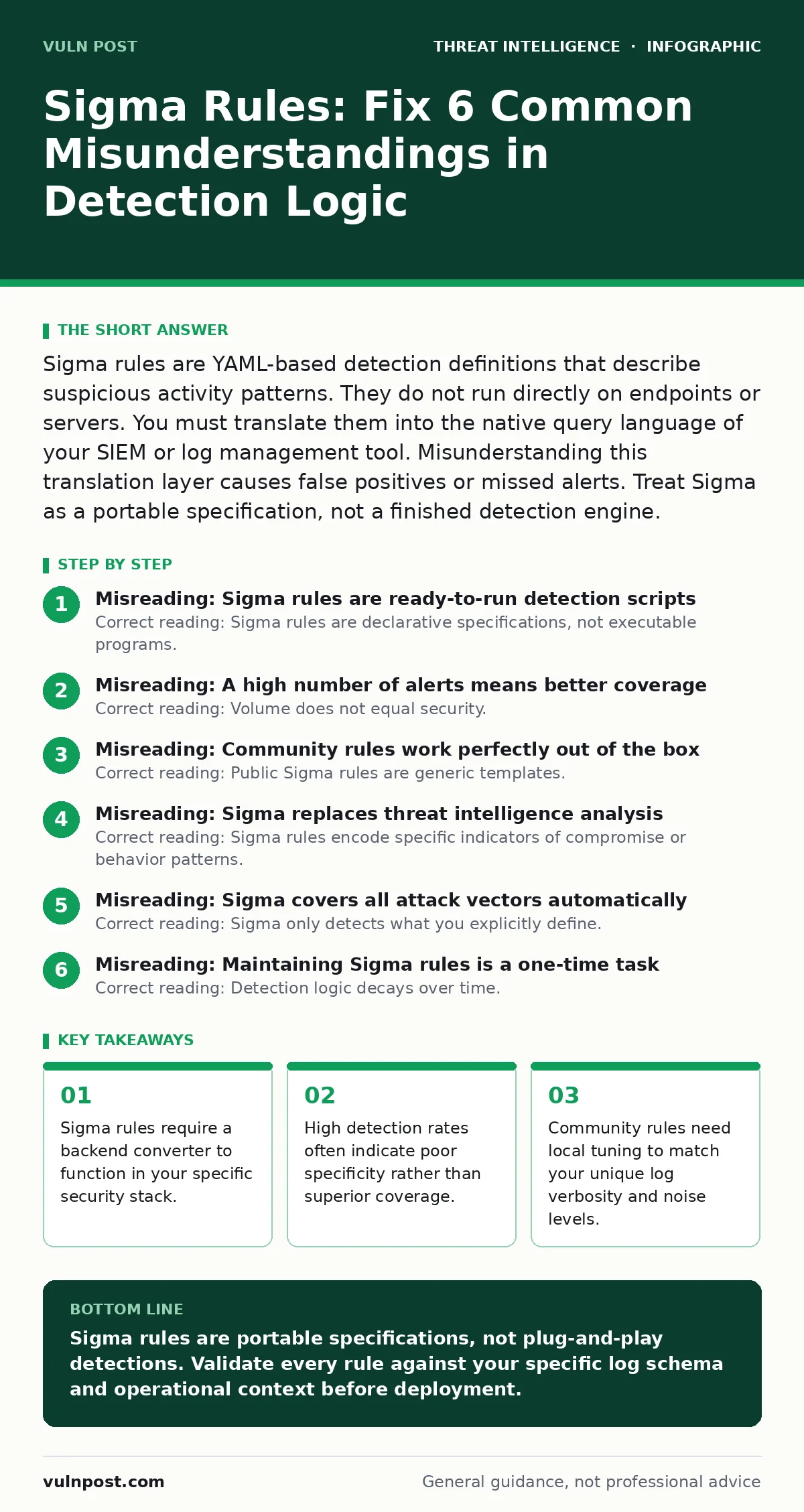
Sigma rules are YAML-based detection definitions that describe suspicious activity patterns. They do not run directly on endpoints or servers. You must translate them into the native query language of your SIEM or log management tool. Misunderstanding this translation layer causes false positives or missed alerts. Treat Sigma as a portable specification, not a finished detection engine.
Misreading: Sigma rules are ready-to-run detection scripts
Correct reading: Sigma rules are declarative specifications, not executable programs. They describe what suspicious activity looks like using a standardized YAML syntax. They contain no logic to query databases, parse logs, or trigger alerts. You must use a converter tool to translate the Sigma definition into the native query language of your Security Information and Event Management (SIEM) system. This translation step is where most failures occur. If the converter does not support your specific SIEM version or data schema, the rule produces no output. Do not copy a Sigma rule into a script editor expecting it to execute. It is a blueprint, not the building.
Misreading: A high number of alerts means better coverage
Correct reading: Volume does not equal security. A rule that triggers on every login event generates massive alert fatigue. Security operations teams drown in noise when they prioritize quantity over precision. A single well-tuned rule that catches a specific privilege escalation attempt provides more value than 50 rules that fire on benign administrative actions. You must measure effectiveness by the ratio of true positives to total alerts. Disable or refine rules that lack specificity. Precision prevents alert fatigue and ensures analysts focus on genuine threats.
Misreading: Community rules work perfectly out of the box
Correct reading: Public Sigma rules are generic templates. They assume a standard log format that rarely exists in production environments. Your organization likely has custom applications, modified default settings, or unique data retention policies. A rule written for a standard Windows Event Log may fail if your logs are forwarded through a syslog collector that strips certain fields. You must validate every imported rule against your actual log data. Check if the required log source exists in your environment. Verify that the field names match your schema. Generic rules serve as a starting point for detection engineering, not a finished product.
Misreading: Sigma replaces threat intelligence analysis
Correct reading: Sigma rules encode specific indicators of compromise or behavior patterns. They do not contain the context of why those patterns matter. Threat intelligence provides the narrative behind the data. You need to understand the adversary’s intent to prioritize responses. For example, a rule might detect a specific PowerShell command. Without context, you do not know if this is part of a routine administrative task or a lateral movement technique. Integrating Sigma with broader detection use cases helps you prioritize alerts based on risk. Rules are the sensors; intelligence is the map. You need both to navigate the threat environment effectively.
Misreading: Sigma covers all attack vectors automatically
Correct reading: Sigma only detects what you explicitly define. It cannot infer intent from unstructured data or detect novel techniques that lack known signatures. If an adversary uses a new tool or a modified script, a static Sigma rule will miss it. You must combine signature-based detection with behavioral analysis.
Techniques like user and entity behavior analytics help identify anomalies that static rules miss. Sigma is excellent for known threats. It is blind to zero-day exploits or sophisticated fileless attacks that leave no distinct log footprint. Relying solely on Sigma creates a false sense of security. You need layered defenses that include behavioral monitoring and endpoint detection.
See also: Detection Use Cases: Turning Raw Telemetry into Actionable Security Signals · Alert Fatigue: Why Your Team Misses Real Threats
Misreading: Maintaining Sigma rules is a one-time task
Correct reading: Detection logic decays over time. Operating systems update, applications change, and adversaries adapt. A rule that worked last year may trigger false positives today due to a software update. You must regularly review and retire rules that no longer align with your environment. This process requires continuous testing. Run your rules in a simulation mode to check for false positives. Update rules to reflect changes in your infrastructure. Treat detection engineering as an ongoing maintenance cycle, not a one-off deployment. Neglecting this maintenance leads to stale rules that waste analyst time and miss evolving threats.
Misreading: Sigma rules are vendor-neutral and universal
Correct reading: While Sigma aims for portability, the underlying data sources vary wildly. A rule targeting Windows Event ID 4688 works only if your system logs process creation. If your endpoint detection solution does not forward this event to your SIEM, the rule is useless. The neutrality lies in the syntax, not the data availability. You must audit your log collection infrastructure to ensure it captures the necessary events. Gaps in logging render even the best Sigma rules ineffective. Ensure your data ingestion pipeline supports the log sources required by your detection strategy.
Misreading: Sigma eliminates the need for custom detection logic
Correct reading: Sigma provides a common language, but unique business logic often requires custom rules. Your organization may have proprietary applications or specific compliance requirements that generic rules do not address. You must write custom Sigma rules for these edge cases. Do not rely solely on public repositories. Tailor your detection strategy to your specific risk profile. This might involve monitoring for specific database queries or unusual API calls. Custom rules ensure you protect your unique assets. Generic rules protect common targets. You need both to cover your full attack surface.
Key takeaways
- Sigma rules require a backend converter to function in your specific security stack.
- High detection rates often indicate poor specificity rather than superior coverage.
- Community rules need local tuning to match your unique log verbosity and noise levels.
Sigma rules are portable specifications, not plug-and-play detections. Validate every rule against your specific log schema and operational context before deployment.
Frequently asked questions
How do I convert Sigma rules to my SIEM format?
Use a community-maintained converter tool that supports your specific SIEM platform. These tools translate the YAML syntax into native query languages like SPL, KQL, or Lucene.
Can Sigma rules detect fileless malware?
Sigma can detect behaviors associated with fileless malware, such as PowerShell execution or WMI usage. It cannot detect the malware itself unless specific behavioral indicators are logged and defined in the rule.
How often should I update my Sigma rules?
Review your rules quarterly. Update them to reflect changes in your infrastructure, new threat intelligence, and to retire rules that generate excessive false positives.
Is Sigma free to use?
Yes, Sigma is an open standard. The rules and the specification are freely available. You do not need a commercial license to use Sigma rules in your detection engineering workflow.
How this guide was produced: written by the Vuln Post editorial team with AI assistance, checked against the public references listed below, and reviewed when the facts change. See our editorial policy or report an error.