Look for synthetic traffic patterns, static IP sources, and known vulnerability signatures. Verify network segmentation and isolate ranges from production. Check for hardcoded credentials and unencrypted data flows. Implement strict egress controls to prevent range traffic from leaking into operational networks.
Identifying Obvious Training Artifacts
The most visible sign of a cyber range is the presence of synthetic traffic that does not match organizational behavior. Real users exhibit irregular timing, varied session lengths, and diverse application usage. Training environments generate uniform, repetitive patterns designed to test specific detection rules.
You notice this when logs show identical request intervals or identical payload sizes across thousands of events. This uniformity stands out against the chaotic nature of legitimate network activity. Analysts often flag these anomalies as potential botnet activity before realizing they are internal training exercises. The traffic lacks the subtle variations inherent in human interaction or complex malware propagation.
Detecting Static and Predictable Sources
Training platforms often operate from a limited set of source IP addresses. These addresses may be static or rotate within a predictable sequence. Production environments typically show traffic from a wide variety of external and internal sources. When you see repeated connections from the same small subnet, especially during off-hours, it suggests a controlled environment. The ports used may also be restricted to those relevant to the specific training scenario. This narrow scope contrasts with the broad port usage seen in real-world scanning or exploitation attempts. Monitoring source diversity helps distinguish between genuine threats and scheduled training activities.
Recognizing Known Vulnerability Signatures
Cyber ranges rely on known vulnerabilities to simulate attacks. These simulations use standardized payloads that match public signatures. Security tools often alert on these known signatures, creating noise. You identify this when alerts reference common CVEs in a high volume, yet no actual compromise occurs. The payloads are often clean and lack the obfuscation techniques used by real adversaries. Real attackers modify their tools to evade detection, while training platforms use textbook examples. This difference in sophistication is a key indicator of a training environment rather than a live threat.
Overlooking Subtle Network Misconfigurations
Easy-to-miss signs include subtle network misconfigurations that allow range traffic to leak. These leaks may not trigger immediate alerts but degrade overall security posture. You might see slight increases in baseline noise or unexpected connections to non-targeted systems. The range may share DNS servers or authentication services with production, causing cross-contamination. This sharing creates false positives that are difficult to trace. Analysts waste time investigating alerts that originate from training scenarios. The lack of clear segmentation allows training traffic to mimic production behavior, making it harder to distinguish.
Missing Data Flow Anomalies
Training platforms often generate data flows that do not align with business logic. You might see large data transfers between systems that should not communicate. These transfers may involve sensitive data types, even if the data is synthetic. The volume and direction of these flows can indicate a misconfigured range. Real business processes follow predictable data paths. Deviations from these paths, especially during non-business hours, suggest training activity. Monitoring data flow patterns helps identify ranges that are not properly isolated from production networks.
See also: Domain Fronting Mistakes: 6 Ways Your Network Gets Bypassed · Why Malware Families Matter for Incident Response and Detection
The Cost of False Positives
False positives from training ranges contribute to alert fatigue. Analysts become desensitized to alerts that turn out to be training exercises. This desensitization reduces the effectiveness of security operations. You see this when response times to genuine incidents increase. The noise from training ranges masks real threats, making detection harder. Reducing this noise requires clear separation between training and production environments. Implementing strict controls prevents training traffic from interfering with operational security. This separation ensures that alerts remain actionable and relevant.
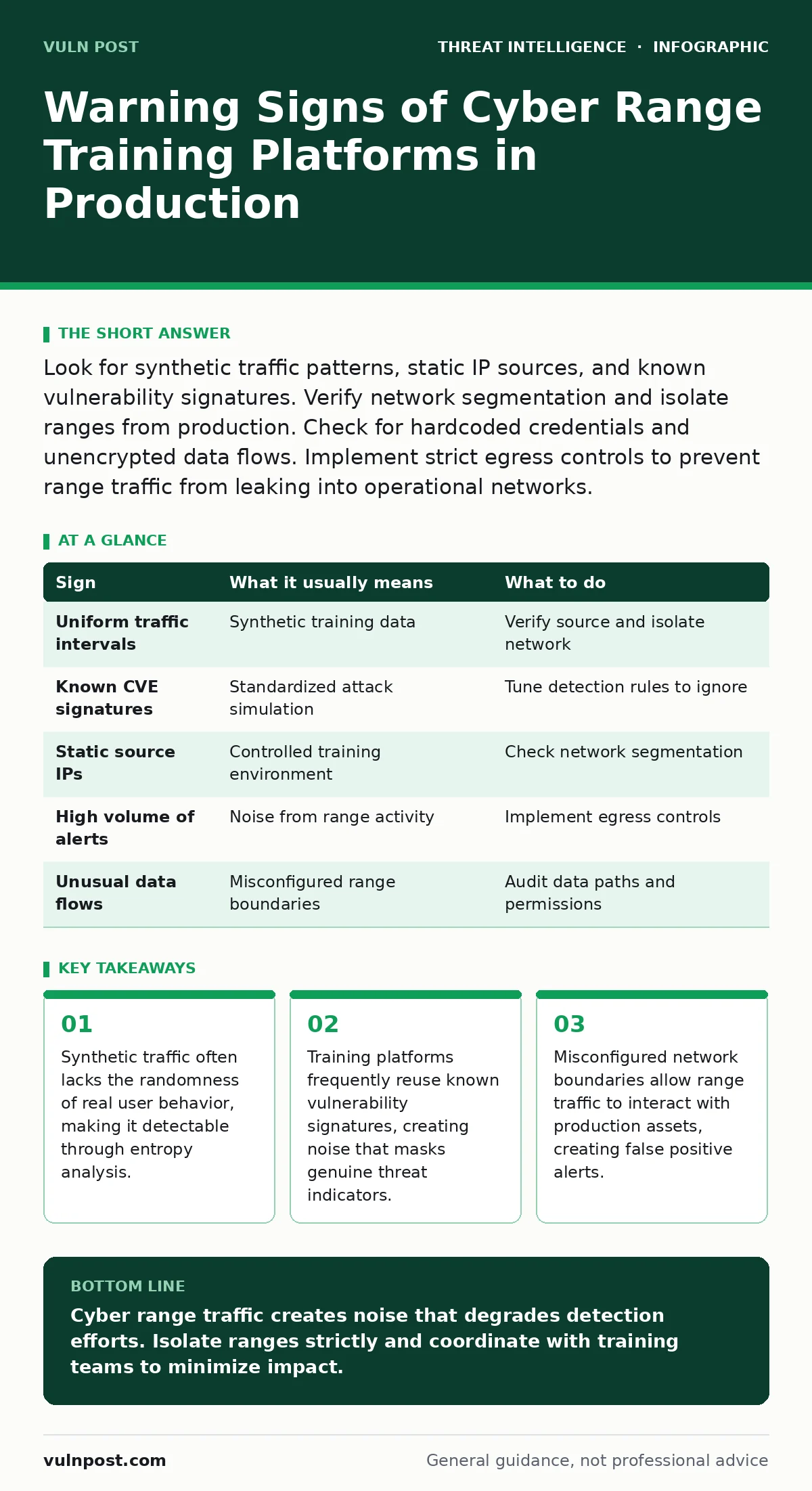
| Sign | What it usually means | What to do |
|---|---|---|
| Uniform traffic intervals | Synthetic training data | Verify source and isolate network |
| Known CVE signatures | Standardized attack simulation | Tune detection rules to ignore |
| Static source IPs | Controlled training environment | Check network segmentation |
| High volume of alerts | Noise from range activity | Implement egress controls |
| Unusual data flows | Misconfigured range boundaries | Audit data paths and permissions |
Implementing Effective Mitigation Strategies
Mitigating the impact of cyber ranges requires strict network segmentation. You must ensure that training environments cannot communicate with production assets. Use firewalls and access control lists to enforce this separation. Monitor egress traffic from the range to prevent leaks. Implement logging and monitoring specific to the range environment. This allows you to identify and address misconfigurations quickly. Regular audits of network boundaries help maintain this separation. Training platforms should operate in isolated networks with no direct path to production systems.
Integrating Training with Detection Engineering
Training platforms can support detection engineering if managed correctly. You can use range traffic to test and validate detection rules. This ensures that rules work as expected without generating false positives. Coordinate with the training team to schedule exercises. Communicate the expected traffic patterns and payloads. This coordination allows you to tune detection rules appropriately. Use the range to simulate new threat techniques and validate responses. This proactive approach improves detection capabilities while minimizing noise.
Key takeaways
- Synthetic traffic often lacks the randomness of real user behavior, making it detectable through entropy analysis.
- Training platforms frequently reuse known vulnerability signatures, creating noise that masks genuine threat indicators.
- Misconfigured network boundaries allow range traffic to interact with production assets, creating false positive alerts.
Cyber range traffic creates noise that degrades detection efforts. Isolate ranges strictly and coordinate with training teams to minimize impact.
Frequently asked questions
How do I distinguish training traffic from real attacks?
Look for uniform patterns, known signatures, and static source IPs. Real attacks show more variability and obfuscation.
Can training ranges cause security incidents?
Yes, if misconfigured, they can leak traffic or interact with production systems, creating false positives or actual exposure.
What is the best way to isolate a cyber range?
Use strict network segmentation, firewalls, and access controls. Ensure no direct communication paths to production assets.
How do I reduce alert fatigue from training ranges?
Tune detection rules to exclude range traffic. Coordinate with training teams to schedule exercises and communicate expected patterns.
How this guide was produced: written by the Vuln Post editorial team with AI assistance, checked against the public references listed below, and reviewed when the facts change. See our editorial policy or report an error.