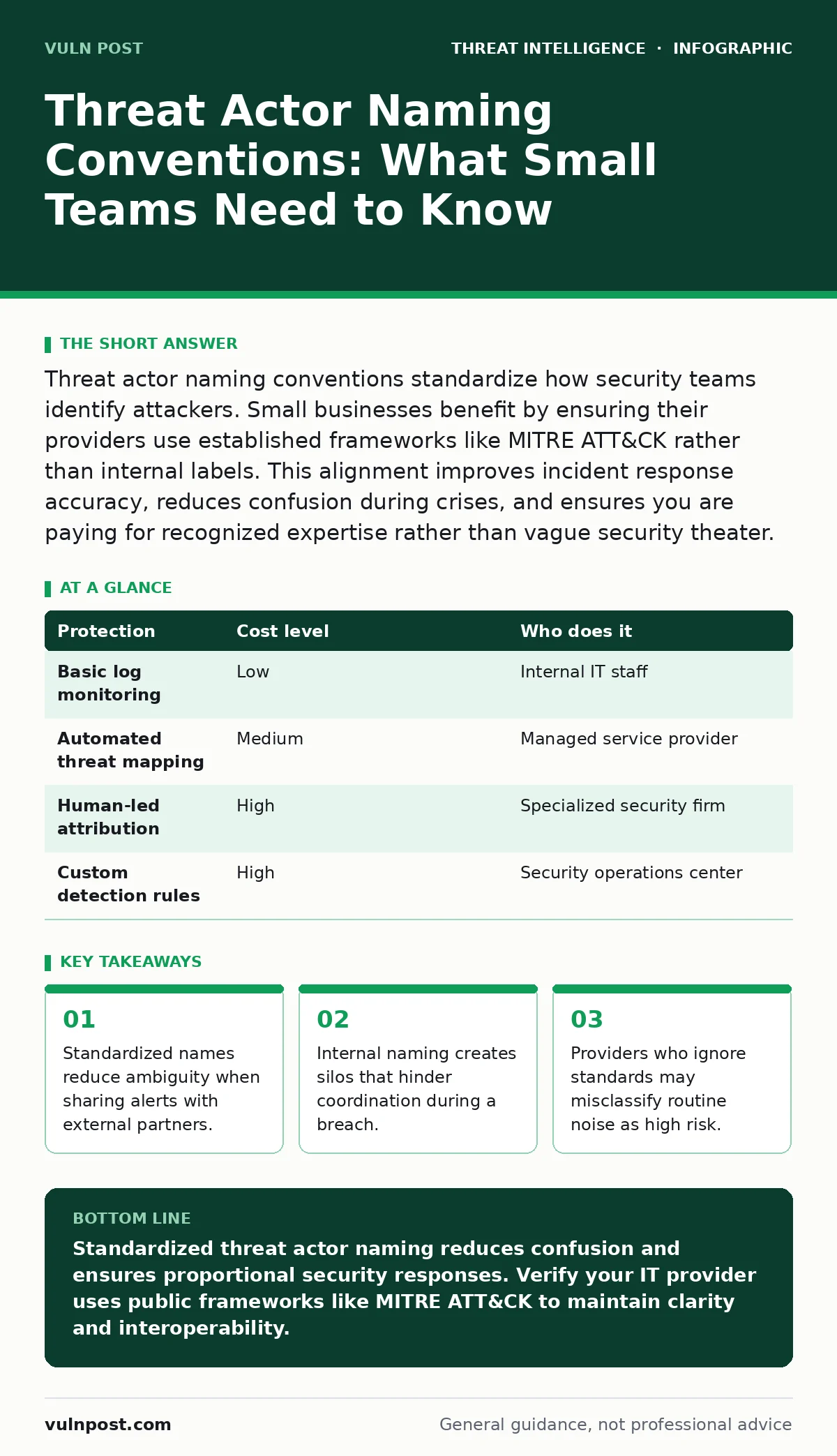
Threat actor naming conventions standardize how security teams identify attackers. Small businesses benefit by ensuring their providers use established frameworks like MITRE ATT&CK rather than internal labels. This alignment improves incident response accuracy, reduces confusion during crises, and ensures you are paying for recognized expertise rather than vague security theater.
Why Naming Matters at Small Scale
Threat actor naming conventions provide a shared language for describing adversaries. When every organization uses unique labels, correlation becomes impossible. A small business operates with limited resources. Ambiguity in threat identification wastes time that should be spent on containment. Standardized names allow you to compare your incident against public data. This comparison reveals whether the attack is novel or routine. Routine attacks often have known mitigations. Novel attacks require immediate, expensive attention. The distinction saves budget and reduces downtime.
Using non-standard names creates a hidden cost in training. New staff must learn internal jargon instead of industry terms. This jargon does not transfer to other roles or tools. When you switch providers, the knowledge base does not move with you. You lose context about past incidents. The new provider must start from zero. This reset period leaves systems exposed to repeat attacks. Standardized naming ensures continuity regardless of personnel changes.
The Mechanics of Standardization
Established frameworks assign identifiers based on behavior rather than speculation. Groups are often named after their initial access vector or a distinctive tool. This approach focuses on observable facts. It avoids political or geographical assumptions that can be incorrect. For example, a group might be named for a specific ransomware variant they deploy. This label stays relevant as long as the tool remains in use. It allows defenders to track the evolution of the attack method.
Some naming systems include versioning or sub-group identifiers. These details help distinguish between affiliates and the main organization. Affiliates may share tools but operate independently. Treating them as a single entity can lead to incorrect attribution. Incorrect attribution causes you to prepare for the wrong tactics. You might focus on defending against nation-state cyber attacks when the actual threat is a financially motivated criminal group. The resource mismatch leaves gaps in your defense.
Practical Application in Daily Operations
You do not need to name every attacker yourself. Your IT provider should handle this classification. Their job is to translate raw logs into actionable intelligence. They should map observed behaviors to known actors using public data. This mapping allows you to understand the severity of an alert. A match with a high-profile group demands immediate action. A match with a low-sophistication script kiddie requires standard remediation. The naming convention drives the response speed.
When reviewing incident reports, look for consistency. The same group should carry the same identifier across multiple documents. Inconsistency suggests a lack of rigorous analysis. It may indicate that the provider is copying alerts without verification. Verified alerts include references to open-source intelligence. These references allow you to check the work independently. Independent verification builds trust in the provider’s capabilities.
What to Ask Your IT Provider
Your provider’s approach to threat intelligence reflects their overall maturity. Ask specific questions about their methodology. Do not accept vague answers about "monitoring threats." You need to know how they classify and prioritize. The following questions help assess their rigor.
- How do you map observed indicators to known threat actors?
- Which public frameworks or taxonomies do you use for classification?
- Can you provide examples of how naming changes affected response times?
- How do you handle false positives in attribution?
- Do you update your threat feeds based on community contributions?
- How do you distinguish between opportunistic attacks and targeted campaigns?
These questions reveal whether the provider relies on automated tools or human analysis. Automated tools often lack context. Human analysts can interpret nuances that algorithms miss. The best approach combines both. The provider should explain how they validate automated suggestions. Validation prevents alert fatigue. Alert fatigue causes teams to ignore critical warnings.
The Cost of Poor Attribution
Incorrect naming leads to incorrect defense strategies. If a provider labels a routine spam campaign as a sophisticated intrusion, you waste money on advanced monitoring. You might implement user and entity behavior analytics when a simple rule-based filter would suffice. This over-engineering drains your budget. It also creates complexity that introduces new failure points. Complex systems are harder to manage and audit.
Conversely, underestimating a threat because of poor naming is dangerous. If a provider dismisses an attack as low-level noise, you miss early warning signs. The attacker gains foothold and performs privilege escalation attacks. By the time you notice the damage, data is already exfiltrated. The delay turns a minor incident into a major breach. Accurate naming ensures proportional response. Proportional response balances cost and risk.
See also: Domain Fronting Mistakes: 6 Ways Your Network Gets Bypassed · Why Malware Families Matter for Incident Response and Detection
Integration with Broader Security Measures
Threat actor naming works best when integrated with other security practices. It informs your incident response plan. It guides your detection rules. It helps you prioritize patches. For instance, if a known group is exploiting a specific vulnerability, you patch that vulnerability first. You do not wait for a general update cycle. This targeted approach reduces the window of exposure.
Consider how naming affects your communication with clients. If you suffer a breach, you must explain what happened. Using standard names helps clients understand the risk. It shows you are part of a global security community. It builds credibility. Vague internal names confuse clients and partners. They may question your competence. Clear communication maintains business relationships.
| Protection | Cost level | Who does it |
|---|---|---|
| Basic log monitoring | Low | Internal IT staff |
| Automated threat mapping | Medium | Managed service provider |
| Human-led attribution | High | Specialized security firm |
| Custom detection rules | High | Security operations center |
Avoiding Common Pitfalls
One common pitfall is assuming a name implies capability. A group named after a sophisticated tool may have evolved or declined. Their current tactics might be simple. You must verify current behavior, not just historical reputation. Another pitfall is ignoring the source of the name. Some sources are biased or inaccurate. Cross-reference multiple sources to confirm attribution. This step adds time but increases accuracy.
Finally, remember that naming is not a solution. It is a diagnostic tool. It helps you understand the problem. It does not fix the problem. You still need strong controls. You still need regular backups. You still need employee training. Naming simply ensures you are fighting the right enemy. Fighting the wrong enemy is a waste of time and money. Accurate intelligence allows you to focus your efforts where they matter most.
Key takeaways
- Standardized names reduce ambiguity when sharing alerts with external partners.
- Internal naming creates silos that hinder coordination during a breach.
- Providers who ignore standards may misclassify routine noise as high risk.
Standardized threat actor naming reduces confusion and ensures proportional security responses. Verify your IT provider uses public frameworks like MITRE ATT&CK to maintain clarity and interoperability.
Frequently asked questions
Why can't I just use the names from news headlines?
News headlines often use speculative or sensational names. Security frameworks use behavior-based identifiers that are more stable and accurate for technical analysis.
How often should threat actor names change?
Names change when the group’s tactics, techniques, or procedures shift significantly. Minor updates do not require a new name, but major changes do.
Is there a single global list of threat actors?
No single list exists, but frameworks like MITRE ATT&CK provide standardized mappings that most reputable providers follow.
Can small businesses afford dedicated threat intelligence?
Small businesses should rely on their IT provider to handle intelligence. Ask them to demonstrate how they use standardized naming in their reports.
How this guide was produced: written by the Vuln Post editorial team with AI assistance, checked against the public references listed below, and reviewed when the facts change. See our editorial policy or report an error.