
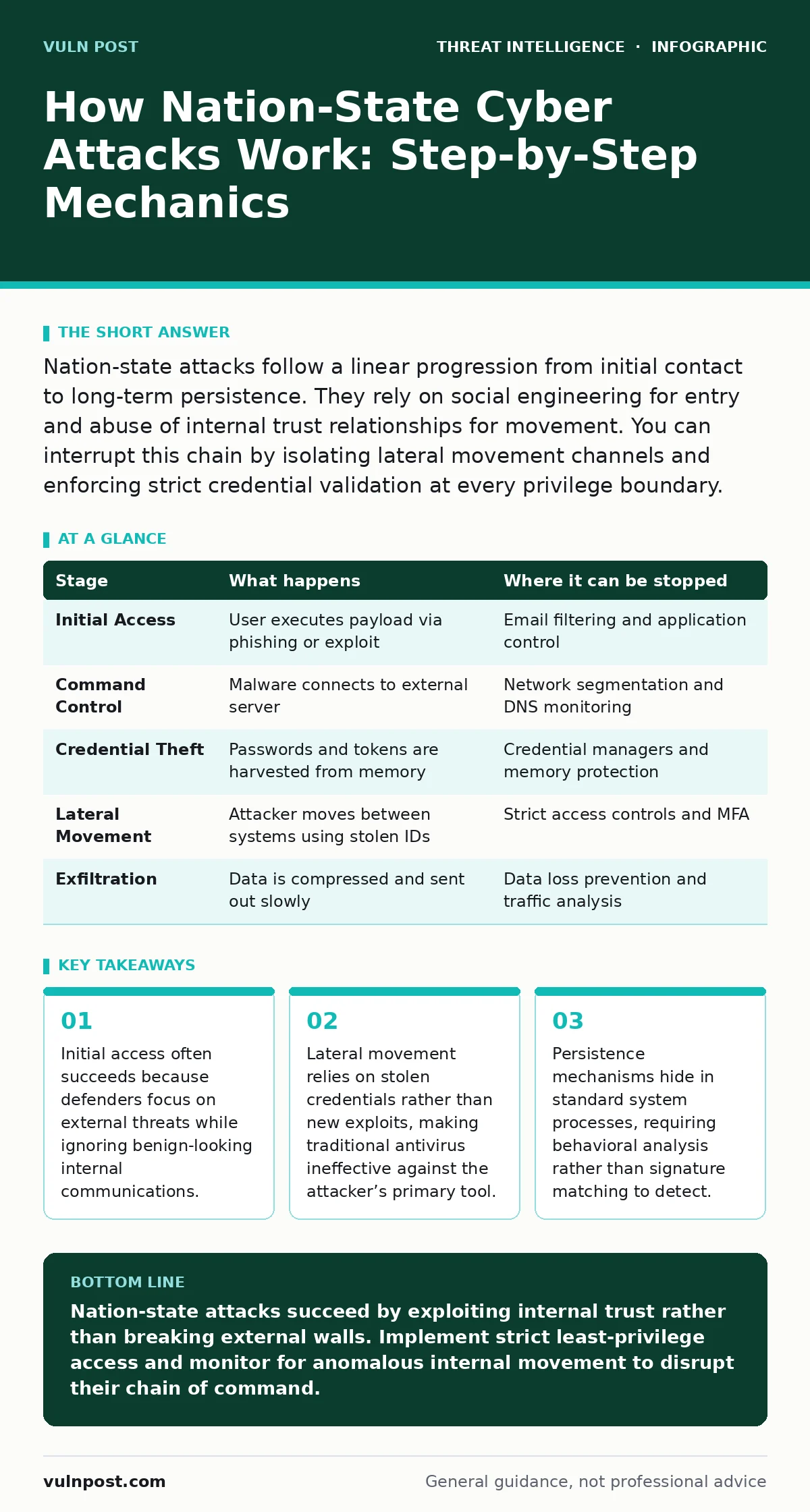
Nation-state attacks follow a linear progression from initial contact to long-term persistence. They rely on social engineering for entry and abuse of internal trust relationships for movement. You can interrupt this chain by isolating lateral movement channels and enforcing strict credential validation at every privilege boundary.
The Strategy Behind State-Sponsored Intrusions
State-sponsored cyber operations differ from criminal hacking in their patience and resource allocation. Criminal groups seek immediate financial gain, often using automated tools that generate noise. State actors prioritize long-term intelligence gathering or strategic disruption. They accept months or years of silent preparation. This patience allows them to map internal networks without triggering alarms.
The core advantage of these groups is their ability to develop custom tools. They do not rely on publicly available exploits. Instead, they invest in zero-day vulnerabilities, which are flaws unknown to the vendor. This investment creates a high barrier to entry but ensures that initial access bypasses standard defenses. You must assume that perimeter security is merely a delay, not a barrier.
Initial Access and the Human Vector
The attack begins with establishing contact. While technical exploits exist, the most reliable entry point is human error. Attackers use social engineering to trick employees into executing malicious code. This often takes the form of spear phishing, where emails are tailored to the recipient’s role. The attachment or link mimics a legitimate business document.
Once the user clicks, the payload executes. This payload is often a dropper, a small program that downloads the main toolkit. The dropper checks for virtual machines or analysis sandboxes. If it detects a testing environment, it remains dormant. This evasion technique ensures that security teams do not analyze the full malware suite before it reaches the target.
Establishing Footprints and Command Control
After execution, the malware establishes communication with the command and control server. This channel allows attackers to send instructions and receive data. The traffic is often encrypted and disguised as normal web browsing. It may use domain generation algorithms to create random domains if the primary server is blocked.
The attacker now has a remote shell. This shell provides limited access, usually with the privileges of the user who clicked the link. The immediate goal is not to steal data but to stabilize the connection. The malware installs persistence mechanisms to survive reboots. These mechanisms often register as legitimate scheduled tasks or services. Disabling these requires identifying the specific registration method, not just killing the process.
Credential Harvesting and Identity Theft
With a stable foothold, the attacker seeks higher privileges. They do this by stealing credentials. Tools scan memory for passwords, keys, or tokens. They may also capture keystrokes or screenshots. The goal is to obtain administrative rights. Without these rights, movement is restricted.
This stage highlights a critical flaw in many security models. Perimeter defenses are strong, but internal trust is weak. Once an attacker has one valid credential, they can access any resource that user can access. This is why pass-the-hash attacks are common in these scenarios. The attacker uses the hashed password to authenticate to other systems without ever knowing the plain-text password. Defending against this requires disabling legacy authentication protocols.
Lateral Movement and Network Mapping
The attacker now moves laterally across the network. They map the infrastructure, identifying servers, databases, and backup systems. They use the stolen credentials to log into adjacent machines. This movement is often slow and careful. They avoid high-traffic servers to reduce the chance of detection.
During this phase, the attacker looks for privilege escalation opportunities. They may exploit misconfigurations in Active Directory attacks to gain domain admin rights. This allows control over the entire environment. The attacker also looks for isolated segments. Jumping between network segments requires finding bridges, such as servers with multiple network interfaces. Each jump increases the risk of detection, so attackers often wait for off-hours to move.
See also: Threat Actor Naming Conventions: What Small Teams Need to Know · Domain Fronting Mistakes: 6 Ways Your Network Gets Bypassed
Defense Evasion and Log Manipulation
To maintain access, the attacker must hide. This is the phase of defense evasion. They delete log files that record their activity. They may alter timestamps to make files appear older. Some tools inject code into legitimate processes, a technique known as process hollowing. This makes the malicious activity look like normal system behavior.
This stage creates significant alert fatigue for security operations teams. The noise from normal system activity masks the subtle anomalies of the attacker. The attacker relies on this noise. They know that security analysts cannot investigate every alert. By blending in, they buy time. Detecting this requires establishing a baseline of normal behavior and looking for deviations, not just known threats.
Exfiltration and Long-Term Persistence
The final stage is data extraction. The attacker compresses and encrypts the stolen data. They transfer it in small chunks to avoid triggering data loss prevention tools. The transfer may take weeks. Once the data is out, the attacker may remain in the network. They do not wipe their tracks immediately.
This persistence allows them to return if the network is rebuilt. They may install backdoors in firmware or boot loaders. These golden ticket attacks create a permanent administrative token that cannot be revoked without rebuilding the domain. Removing such persistence requires a complete audit of trust relationships. It is not enough to change passwords. You must verify that no unauthorized certificates or tokens exist.
| Stage | What happens | Where it can be stopped |
|---|---|---|
| Initial Access | User executes payload via phishing or exploit | Email filtering and application control |
| Command Control | Malware connects to external server | Network segmentation and DNS monitoring |
| Credential Theft | Passwords and tokens are harvested from memory | Credential managers and memory protection |
| Lateral Movement | Attacker moves between systems using stolen IDs | Strict access controls and MFA |
| Exfiltration | Data is compressed and sent out slowly | Data loss prevention and traffic analysis |
The Cost of Trust
The fundamental lesson is that internal trust is the vulnerability. External attacks are loud and visible. Internal trust abuse is silent and valid. The attacker uses your own security mechanisms against you. They use valid passwords, valid certificates, and valid network paths.
To defend against this, you must treat every authentication event as suspicious. Implement least privilege access. Ensure that no single account has excessive power. Monitor for impossible travel, where a user logs in from two distant locations simultaneously. These behavioral indicators are more reliable than signature-based detection.
The goal is not to prevent every attempt. The goal is to increase the cost and time required for the attacker. If you can detect the lateral movement phase, you can contain the breach. If you detect the exfiltration, you can limit the damage. The stages are sequential. Interrupting any one stage breaks the chain.
Key takeaways
- Initial access often succeeds because defenders focus on external threats while ignoring benign-looking internal communications.
- Lateral movement relies on stolen credentials rather than new exploits, making traditional antivirus ineffective against the attacker’s primary tool.
- Persistence mechanisms hide in standard system processes, requiring behavioral analysis rather than signature matching to detect.
Nation-state attacks succeed by exploiting internal trust rather than breaking external walls. Implement strict least-privilege access and monitor for anomalous internal movement to disrupt their chain of command.
Frequently asked questions
How long can an attacker stay undetected in a network?
State-sponsored actors can remain undetected for months or years by moving slowly and using legitimate credentials to avoid triggering standard alerts.
Does multi-factor authentication stop these attacks?
MFA significantly raises the barrier for credential theft, but it does not stop attackers who already have a valid session or who use token theft techniques.
What is the difference between this and ransomware?
Ransomware demands payment for access to your data. Nation-state attacks typically seek intelligence or strategic advantage, operating silently without demanding money.
How do I know if I have been compromised?
Look for unusual login times, unexpected privilege changes, or data transfers to unknown external IPs, as these behaviors deviate from normal baseline activity.
How this guide was produced: written by the Vuln Post editorial team with AI assistance, checked against the public references listed below, and reviewed when the facts change. See our editorial policy or report an error.