
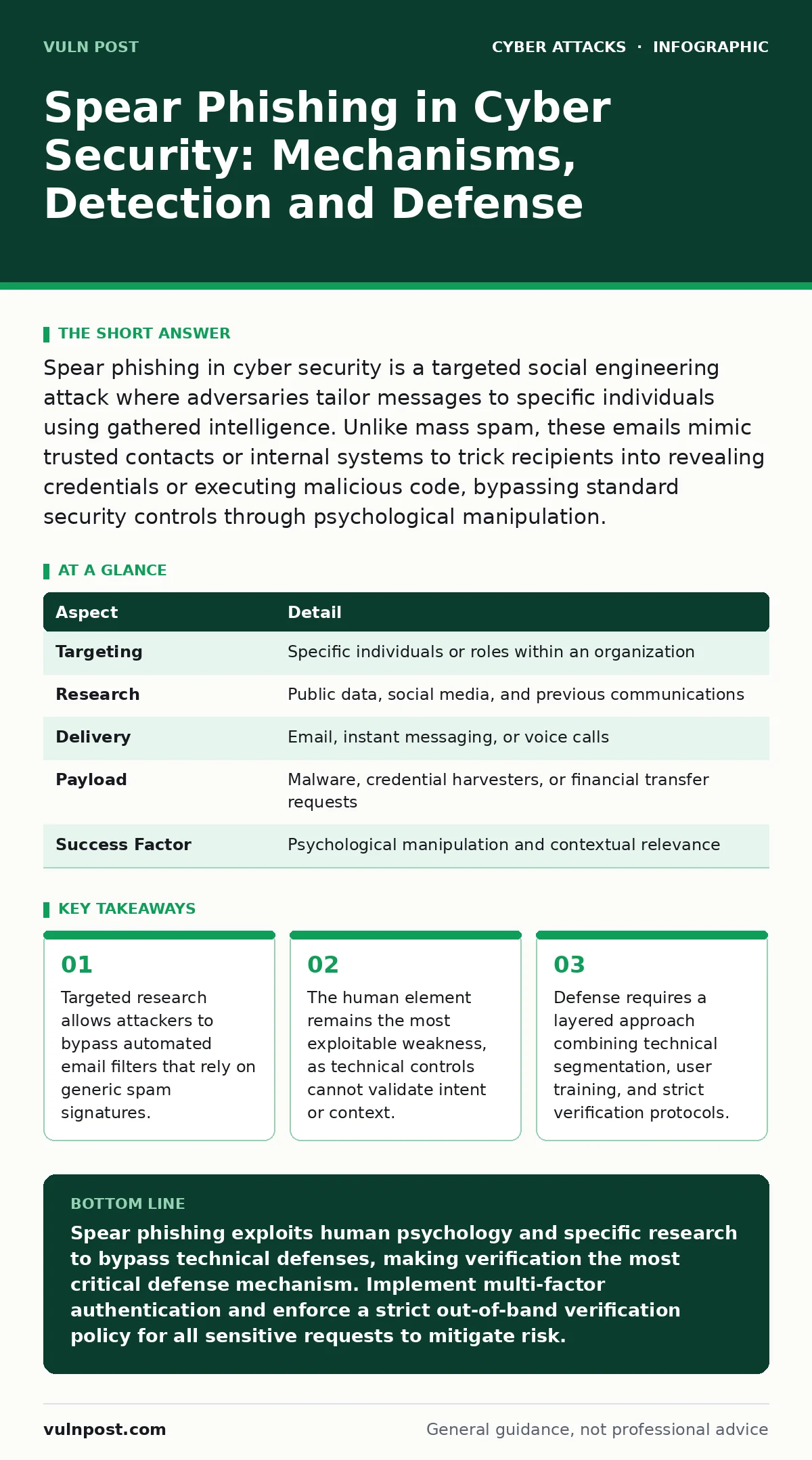
Spear phishing in cyber security is a targeted social engineering attack where adversaries tailor messages to specific individuals using gathered intelligence. Unlike mass spam, these emails mimic trusted contacts or internal systems to trick recipients into revealing credentials or executing malicious code, bypassing standard security controls through psychological manipulation.
Understanding the Core Mechanism
Spear phishing in cyber security differs from bulk spam because it relies on precision rather than volume. An attacker selects a specific individual or small group and crafts a message that appears legitimate based on prior research. This research often involves public social media profiles, corporate directories, or previous email correspondence. The goal is to establish immediate trust.
The message usually contains a sense of urgency or a request for action that aligns with the recipient’s daily responsibilities. Because the content is highly relevant, automated filters frequently miss it. The attack succeeds when the recipient acts without verifying the source through an out-of-band channel. This method exploits the natural human tendency to help colleagues or respond to authority figures quickly.
| Aspect | Detail |
|---|---|
| Targeting | Specific individuals or roles within an organization |
| Research | Public data, social media, and previous communications |
| Delivery | Email, instant messaging, or voice calls |
| Payload | Malware, credential harvesters, or financial transfer requests |
| Success Factor | Psychological manipulation and contextual relevance |
How Targeted Research Enables Success
Attackers invest time in gathering intelligence before sending a single message. This phase is known as reconnaissance. They analyze LinkedIn profiles to understand job titles, reporting lines, and recent projects. They review company news releases to find upcoming events or mergers that create urgency. They may even read public forum posts to learn about technical challenges the target faces. This data allows the attacker to write an email that references specific projects or colleagues.
The subject line might mention a shared document or an urgent deadline. The body text mimics the writing style of a known contact. This level of detail makes the message indistinguishable from legitimate internal communication. The attacker does not need to hack the system initially. They only need to convince the user to open a link or download an attachment. This approach mirrors how a thief might study a home’s routine before attempting a break-in.
The Role of Psychological Triggers
Human psychology drives the success of these attacks. Attackers exploit cognitive biases that lead to quick decision-making. Authority bias makes recipients comply with requests from perceived superiors. Urgency bias causes users to skip verification steps when a deadline is mentioned. Reciprocity bias leads users to help someone who appears to have helped them previously. Familiarity bias reduces suspicion when the message comes from a known name or domain.
These triggers work because they bypass logical analysis. The brain processes emotional cues faster than factual inconsistencies. A message claiming a server outage triggers immediate concern for system stability. A request from a CEO triggers immediate compliance. The attacker designs the message to trigger one of these responses. The recipient focuses on the emotional content rather than the technical details. This creates a window of opportunity for the attack to succeed.
Technical Execution and Delivery Methods
The technical execution involves more than just writing a convincing email. Attackers often use domain spoofing to make the sender address appear legitimate. They may register a domain that looks similar to the target company’s domain. This is known as typosquatting. They also use legitimate cloud services to host malicious links or files. These services have good reputations with email filters, reducing the chance of blocking.
The payload might be a malicious document that exploits a vulnerability in the office suite software. It might also be a link to a fake login page that harvests credentials. Some attacks use malicious macros in spreadsheets. The user must enable the macro for the attack to work. This adds a layer of interaction required from the victim. The attacker relies on the user’s willingness to enable content to view the document. This method shifts the burden of security onto the user’s judgment.
What Security Teams Usually Get Wrong
Many organizations focus too heavily on technical controls and ignore the human factor. They assume that advanced email filtering will stop all attacks. This assumption fails because spear phishing messages are unique and lack known malicious signatures. Another common mistake is treating security as a one-time training event. Awareness does not last without regular reinforcement and realistic simulations. Teams also often rely on email headers for verification.
Attackers can spoof headers easily, making this method unreliable. A significant error is failing to segment network access. If a user’s account is compromised, lateral movement allows the attacker to access other systems. Without strict access controls, a single successful phishing attempt can lead to a full network breach. Organizations must recognize that technical tools are insufficient without a culture of verification and least privilege.
See also: Medical Identity Theft How Can It Occur and How to Stop It
Building Effective Defense Strategies
Defense against spear phishing requires a multi-layered approach. Technical controls must be combined with user education and process changes. Implement multi-factor authentication to protect accounts even if credentials are stolen. Use email authentication standards to reduce spoofing, though they are not foolproof. Train users to recognize suspicious elements such as mismatched URLs or unusual requests.
Encourage a culture where verifying requests through secondary channels is standard practice. Segment network access to limit the damage of a compromised account. Monitor for unusual login patterns or data access. Regularly update software to patch vulnerabilities that malicious documents might exploit. Review and update security policies to reflect current threats. Test defenses with simulated attacks to identify weaknesses. Continuous improvement is necessary as attackers evolve their tactics.
Integrating Related Security Concepts
Understanding spear phishing requires knowledge of related attack vectors. Attackers often use initial access techniques to gain a foothold before expanding their presence. They may combine phishing with brute force attacks if they obtain partial credentials. In some cases, they exploit API abuse to move data laterally within the network. Recognizing these connections helps in building a holistic defense strategy.
For instance, strong login alerts can detect unusual activity resulting from a successful phishing attempt. Understanding how botnet attacks operate can help identify compromised devices that might be used for further attacks. While DDoS protection is a different domain, the principle of resilience applies to all security efforts. Cyber attacks on railways and transport operators highlight the real-world impact of successful compromises. Integrating these concepts ensures a robust security posture.
Conclusion on Targeted Threats
Spear phishing remains a persistent threat because it exploits human nature rather than technical flaws. No amount of filtering can completely eliminate the risk. Organizations must accept that some attacks will bypass technical controls. The goal is to reduce the success rate and limit the impact. This requires ongoing investment in user training, technical controls, and process improvements. Security is a continuous process, not a final destination. By understanding the mechanisms and psychology behind these attacks, teams can build more effective defenses. The key is to verify, validate, and verify again. Trust but verify should be the guiding principle for all communications.
Key takeaways
- Targeted research allows attackers to bypass automated email filters that rely on generic spam signatures.
- The human element remains the most exploitable weakness, as technical controls cannot validate intent or context.
- Defense requires a layered approach combining technical segmentation, user training, and strict verification protocols.
Spear phishing exploits human psychology and specific research to bypass technical defenses, making verification the most critical defense mechanism. Implement multi-factor authentication and enforce a strict out-of-band verification policy for all sensitive requests to mitigate risk.
Frequently asked questions
How do I verify if an email is a spear phishing attempt?
Check the sender’s email address carefully for subtle typos or mismatched domains. Hover over links to see the actual destination URL. Contact the sender through a different communication channel, such as a phone call or instant message, to confirm the request. Do not reply to the email directly.
Can multi-factor authentication stop spear phishing?
Multi-factor authentication significantly reduces the risk by requiring a second form of verification. Even if an attacker obtains your password through phishing, they cannot access the account without the second factor. However, some advanced attacks attempt to bypass this through real-time interception or SIM swapping, so it is not a complete solution.
What is the difference between spear phishing and whaling?
Spear phishing targets specific individuals within an organization, often mid-level employees. Whaling is a subset of spear phishing that specifically targets high-level executives like CEOs or CFOs. The tactics are similar, but whaling attacks often involve more extensive research and higher stakes, such as large financial transfers.
Should I report a suspected spear phishing email?
Yes, always report suspected phishing emails to your security team. Reporting helps the team analyze the threat, block similar messages, and update security controls. It also provides data for training and awareness programs. Most organizations have a specific email address or button for reporting phishing attempts.
How this guide was produced: written by the Vuln Post editorial team with AI assistance, checked against the public references listed below, and reviewed when the facts change. See our editorial policy or report an error.