
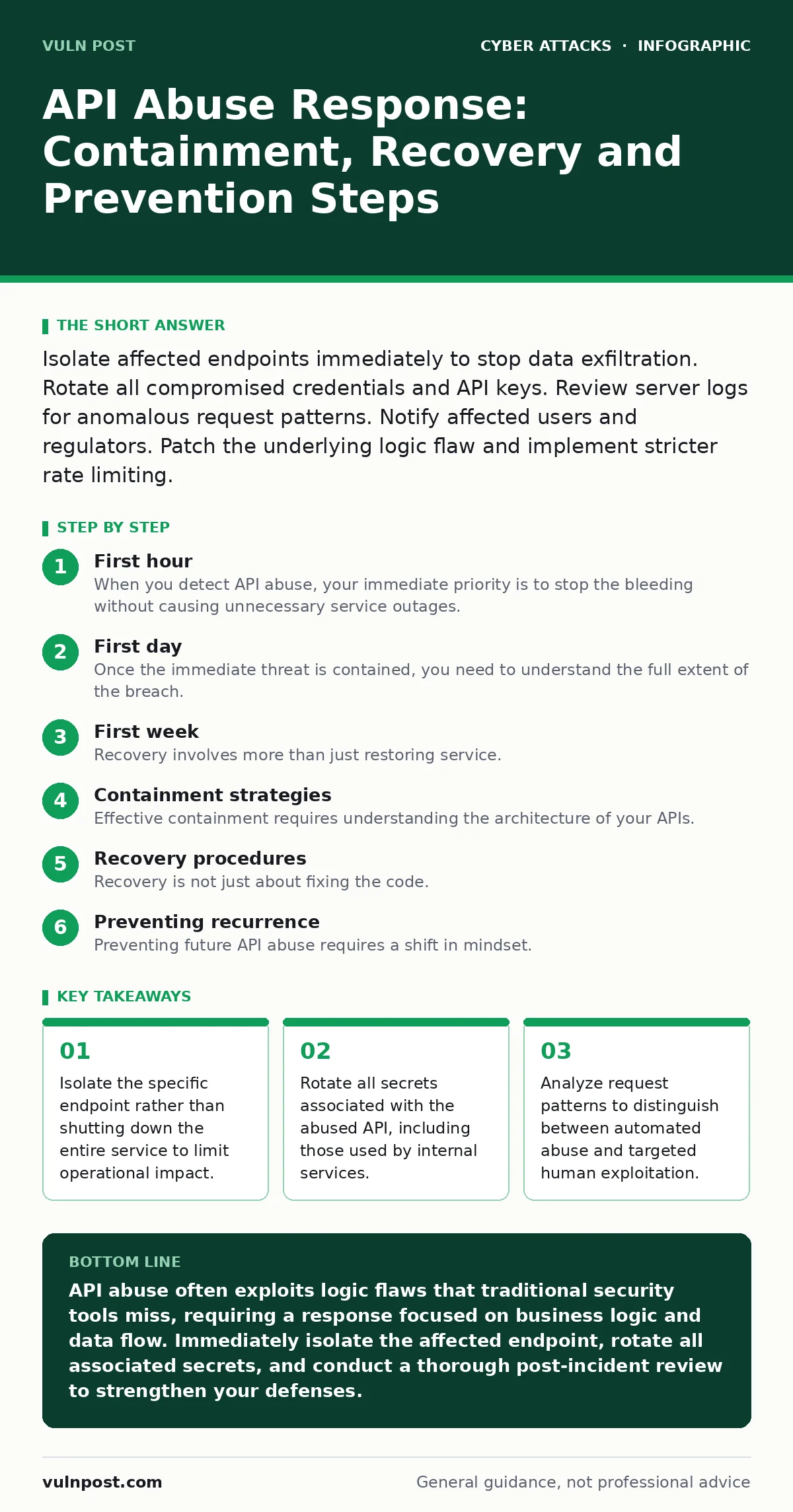
Isolate affected endpoints immediately to stop data exfiltration. Rotate all compromised credentials and API keys. Review server logs for anomalous request patterns. Notify affected users and regulators. Patch the underlying logic flaw and implement stricter rate limiting.
First hour
When you detect API abuse, your immediate priority is to stop the bleeding without causing unnecessary service outages. API abuse often exploits business logic flaws rather than known vulnerabilities, meaning standard signature-based detection may have missed the attack entirely. You must act quickly to contain the damage while preserving evidence for later analysis.
- Identify the specific API endpoint and the nature of the abuse. Is it unauthorized data access, broken object level authorization, or excessive data exposure?
- Isolate the affected endpoint. Block traffic to the specific URL path using your web application firewall or load balancer. Avoid blocking the entire application unless the compromise is systemic.
- Disable compromised API keys and tokens. Revoke access for any user accounts or service accounts that show suspicious activity.
- Preserve logs. Ensure access logs, application logs, and network traffic captures are securely stored and immutable.
- Confirm the scope of the abused endpoint
- Block traffic to the specific endpoint
- Revoke compromised credentials
- Secure and archive relevant logs
First day
Once the immediate threat is contained, you need to understand the full extent of the breach. API abuse can be subtle, allowing attackers to scrape data slowly over time. You must analyze the logs to determine what data was accessed and whether any sensitive information was exfiltrated.
Review the request patterns for the abused endpoint. Look for high-frequency requests, unusual query parameters, or access from unexpected geographic locations. This helps distinguish between automated bot attacks and targeted human exploitation. Understanding the method of abuse informs your recovery strategy.
Assess the blast radius of the compromise. Determine which other systems or databases the abused API connects to. If the API accesses multiple microservices, you may need to isolate those services as well. This step is critical because API abuse often serves as an entry point for deeper network penetration.
Coordinate with your cyber incident response team to ensure all stakeholders are informed. This includes legal, compliance, and communications teams. They need accurate information to assess regulatory obligations and customer notification requirements.
First week
Recovery involves more than just restoring service. You must address the root cause of the abuse to prevent recurrence. This often requires changes to your application code and security architecture.
Patch the underlying logic flaw. If the abuse exploited broken object level authorization, implement strict checks to ensure users can only access resources they own. If it was excessive data exposure, modify the API response to return only necessary fields.
Implement stricter rate limiting and anomaly detection. Standard rate limiting may not catch sophisticated API abuse that stays within normal thresholds. Consider implementing behavioral analysis that flags unusual request patterns, such as sequential ID enumeration or bulk data retrieval.
Rotate all secrets. Even if you believe only specific keys were compromised, assume all secrets associated with the affected service are exposed. This includes database credentials, internal service tokens, and third-party API keys.
Notify affected parties. If personal data was accessed, you are likely required to notify users and regulators. Be transparent about what happened and what steps you are taking to prevent future incidents. This builds trust and demonstrates accountability.
Containment strategies
Effective containment requires understanding the architecture of your APIs. Microservices architectures can make containment difficult because a single abused endpoint may have access to multiple services.
Use network segmentation to limit lateral movement. Ensure that API servers can only communicate with the specific databases and services they need. This limits the damage if an attacker gains access to the API server.
Implement mutual TLS for internal API communication. This ensures that only trusted services can communicate with each other. It adds an extra layer of security that prevents attackers from impersonating internal services.
Monitor for anomalous traffic patterns. Look for sudden spikes in traffic, unusual query parameters, or access from new IP ranges. Automated monitoring can help detect abuse in real-time, allowing you to respond faster.
Recovery procedures
Recovery is not just about fixing the code. It is about restoring trust and ensuring the system is resilient to future attacks.
Conduct a thorough post-incident review. Analyze what went wrong and why your existing controls failed. This helps you identify gaps in your security posture and improve your detection capabilities.
Update your security policies and procedures. Ensure that your development team follows secure coding practices for APIs. This includes input validation, output encoding, and proper error handling.
Train your team on API security. Many developers are not aware of the specific risks associated with APIs, such as broken object level authorization and mass assignment. Regular training can help prevent these mistakes.
Implement continuous monitoring. API abuse is an ongoing threat. You need to continuously monitor your APIs for signs of abuse and adjust your defenses accordingly.
See also: Log Retention: How Long to Keep Records and Why It Matters
Preventing recurrence
Preventing future API abuse requires a shift in mindset. Security must be integrated into the development lifecycle from the start.
Adopt a zero trust architecture. Assume that any request, whether internal or external, is malicious until proven otherwise. This means verifying every request, enforcing least privilege access, and monitoring all traffic.
Use automated security testing. Integrate security testing into your CI/CD pipeline to catch vulnerabilities early. This includes static analysis, dynamic analysis, and interactive application security testing.
Conduct regular penetration testing. Hire external experts to test your APIs for vulnerabilities. They can identify issues that your internal team may have missed.
Stay informed about emerging threats. The API security landscape is constantly evolving. New attack techniques emerge regularly. Staying informed helps you adapt your defenses to new threats.
Communication and reporting
Effective communication is critical during an API abuse incident. You need to keep stakeholders informed and provide accurate information.
Establish a clear communication plan. Define who needs to be notified, when, and how. This includes internal teams, customers, regulators, and the media.
Be transparent and honest. Acknowledge the incident and explain what you are doing to address it. Avoid technical jargon and focus on the impact on users.
Provide regular updates. As you learn more about the incident, provide updates to stakeholders. This helps maintain trust and demonstrates your commitment to resolving the issue.
Document the incident. Keep detailed records of all actions taken, decisions made, and communications sent. This documentation is valuable for post-incident review and regulatory compliance.
Long-term resilience
Building long-term resilience against API abuse requires a holistic approach to security.
Invest in security training. Ensure that all team members, from developers to operations staff, understand API security risks and best practices.
Implement a bug bounty program. Encourage external security researchers to report vulnerabilities in your APIs. This helps you identify and fix issues before attackers exploit them.
Regularly review and update your security architecture. As your application evolves, your security architecture must evolve with it. Regular reviews help ensure that your defenses remain effective.
Learn from every incident. Each API abuse incident is an opportunity to learn and improve. Analyze what went wrong and implement changes to prevent similar incidents in the future.
Key takeaways
- Isolate the specific endpoint rather than shutting down the entire service to limit operational impact.
- Rotate all secrets associated with the abused API, including those used by internal services.
- Analyze request patterns to distinguish between automated abuse and targeted human exploitation.
API abuse often exploits logic flaws that traditional security tools miss, requiring a response focused on business logic and data flow. Immediately isolate the affected endpoint, rotate all associated secrets, and conduct a thorough post-incident review to strengthen your defenses.
Frequently asked questions
How do I know if my API is being abused?
Look for unusual traffic patterns, such as high-frequency requests, sequential ID enumeration, or access from unexpected geographic locations. Monitor for errors and anomalies in your application logs.
What is the difference between API abuse and a standard breach?
API abuse often exploits business logic flaws, such as broken object level authorization, rather than known vulnerabilities. It can be harder to detect because the requests may appear legitimate.
Should I shut down my entire API if I suspect abuse?
No, isolate the specific endpoint that is being abused. Shutting down the entire API causes unnecessary service disruption and may hinder your ability to investigate the incident.
How often should I rotate API keys?
Rotate API keys regularly, especially after any security incident. Implement a policy for automatic expiration and rotation to reduce the risk of compromised keys being used.
How this guide was produced: written by the Vuln Post editorial team with AI assistance, checked against the public references listed below, and reviewed when the facts change. See our editorial policy or report an error.