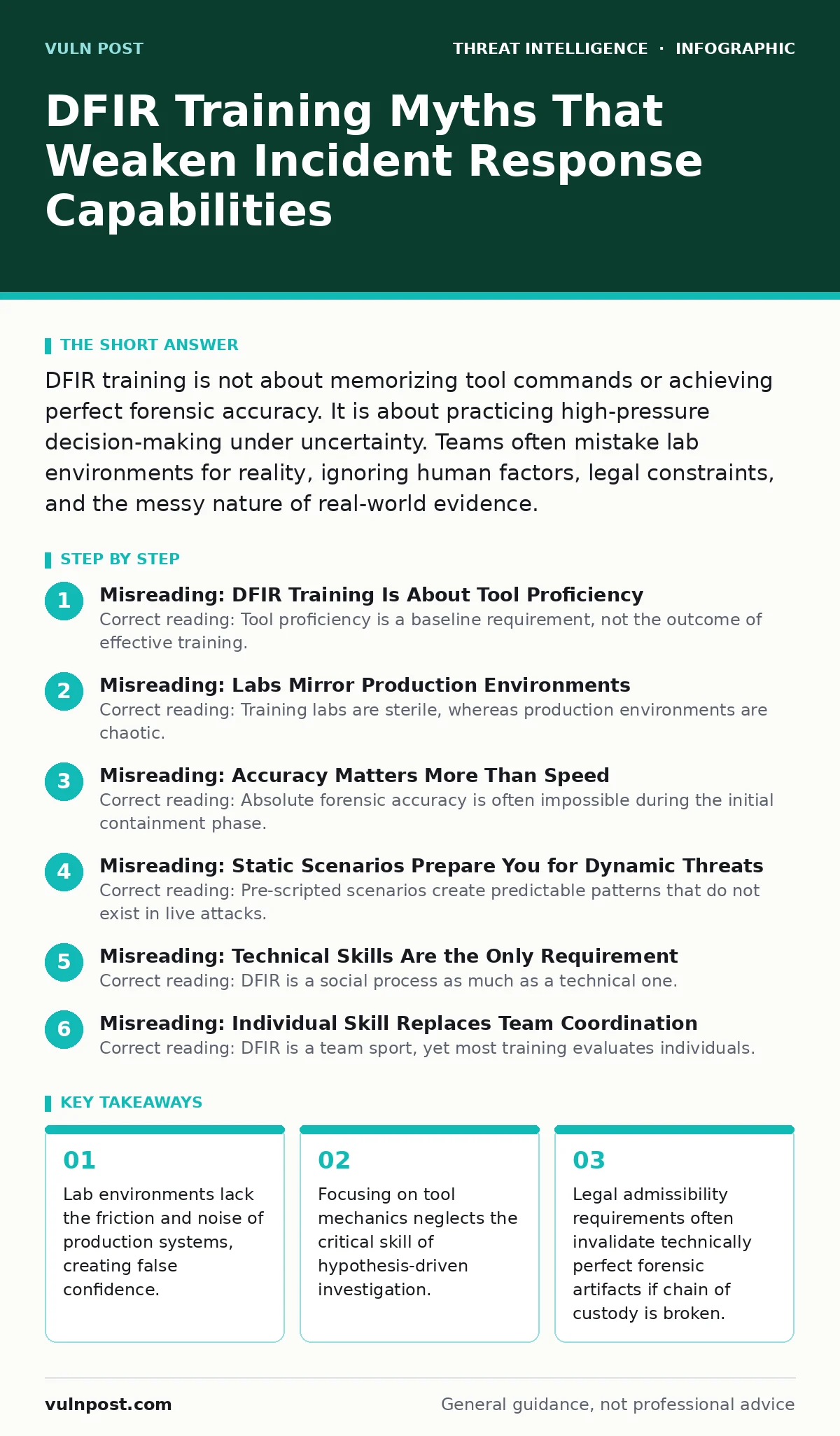
DFIR training is not about memorizing tool commands or achieving perfect forensic accuracy. It is about practicing high-pressure decision-making under uncertainty. Teams often mistake lab environments for reality, ignoring human factors, legal constraints, and the messy nature of real-world evidence.
Misreading: DFIR Training Is About Tool Proficiency
Correct reading: Tool proficiency is a baseline requirement, not the outcome of effective training. Security operations often invest heavily in learning specific forensic suites, assuming that knowing every button leads to faster resolution. This approach fails because tools change faster than methodologies. A responder who knows how to run a memory dump analysis in one suite will struggle when the vendor updates the interface or when the incident requires a different data source entirely.
The real value lies in understanding the data structures the tools extract. You must know what a process handle looks like in raw memory, regardless of the visualization layer. When you focus on the underlying operating system behavior rather than the software wrapper, you retain skills across platform updates. This prevents obsolescence when commercial tools are retired or replaced.
Misreading: Labs Mirror Production Environments
Correct reading: Training labs are sterile, whereas production environments are chaotic. Imagine a controlled environment where every log is present, every timestamp is synchronized, and no unrelated background processes interfere with your investigation. This scenario rarely exists in reality. Production systems suffer from clock skew, missing logs due to disk space limits, and interference from other security agents.
This discrepancy creates a dangerous gap in confidence. Responders trained in clean labs often freeze when faced with incomplete data. You must introduce artificial friction into your exercises. Introduce noise by running unrelated scripts during simulations. Break log aggregation pipelines to force manual collection. This teaches you to operate when the ideal data path is unavailable, which is the standard state of most incidents.
Misreading: Accuracy Matters More Than Speed
Correct reading: Absolute forensic accuracy is often impossible during the initial containment phase. The pressure to stop an active breach forces responders to make decisions with partial information. Waiting for perfect data analysis while a threat actor exfiltrates data causes business damage. The goal of early DFIR is containment, not court-ready evidence.
This trade-off creates a hidden cost: legal risk. Actions taken to stop an attacker may destroy volatile evidence if not handled with care. You must distinguish between containment actions and forensic preservation. Snapshotting a running system for later analysis often yields better forensic results than shutting it down immediately, but this requires specific technical knowledge that many teams lack. See how pass-the-hash attacks exploit this window of vulnerability during the chaos of initial response.
Misreading: Static Scenarios Prepare You for Dynamic Threats
Correct reading: Pre-scripted scenarios create predictable patterns that do not exist in live attacks. Most training modules follow a linear path: attacker enters, performs action A, then action B. Real adversaries adapt when they detect monitoring. They may pause, change techniques, or use legitimate administrative tools to blend in.
Static training fails to teach adaptive thinking. You need exercises where the scenario changes based on your actions. If you isolate a host, the attacker might pivot to a different network segment. If you block a domain, they might switch to domain fronting to bypass your filters. This unpredictability forces you to develop hypotheses and test them dynamically, rather than following a checklist. This approach mirrors the reality of facing organized adversaries who actively evade detection.
Misreading: Technical Skills Are the Only Requirement
Correct reading: DFIR is a social process as much as a technical one. A responder who identifies malware but cannot communicate the risk to executive leadership fails the incident. Legal teams need specific language for privilege protection. Public relations teams need clear timelines to manage external communications. Technical findings are useless if they cannot be translated into business impact.
Many training programs ignore this human element. They focus on command-line interfaces and ignore the chain of custody documentation or the interview techniques needed to gather information from confused employees. You must practice writing incident reports that explain technical events in plain language. Failure to do so leads to poor decision-making at the leadership level and potential regulatory penalties. See how user and entity behavior analytics helps bridge the gap between raw data and human-readable insights.
See also: Log Retention: How Long to Keep Records and Why It Matters · Backup Data Exposure: Immediate Response and Recovery Steps
Misreading: Individual Skill Replaces Team Coordination
Correct reading: DFIR is a team sport, yet most training evaluates individuals. In a real incident, multiple analysts work simultaneously on different aspects of the breach. One team handles network traffic, another handles host forensics, and a third handles legal coordination. If they do not share context, their findings contradict each other.
Individual labs do not teach conflict resolution or information sharing. You must practice working in shifts and handoffs. A responder working the night shift must leave notes that are immediately useful to the morning team. Ambiguity in handoff notes leads to duplicated work and missed indicators. Structured communication protocols, such as using the MITRE ATT&CK Navigator to track techniques, provide a shared language that reduces confusion across shift changes.
Misreading: Certification Equals Competence
Correct reading: Certifications validate knowledge of a specific curriculum, not the ability to handle unknown threats. A certificate proves you can answer questions correctly in a controlled exam environment. It does not prove you can remain calm under pressure or make ethical decisions when legal advice is conflicting.
Real competence is demonstrated through repeated practice in ambiguous situations. You must seek out exercises that have no single correct answer. Cyber range training platforms often offer these dynamic environments, allowing you to fail safely and learn from mistakes. The goal is to build muscle memory for decision-making, not just to pass a test. Regular participation in community-driven exercises provides more value than a one-time certification exam.
Misreading: Forensics Is Only for Aftermath
Correct reading: Forensic techniques are necessary for detection, not just post-incident analysis. Many detection rules rely on forensic concepts, such as understanding process injection or file system artifacts. If you do not understand how these artifacts appear in logs, you cannot write effective detection logic.
Integrating forensic knowledge into your monitoring improves your ability to catch threats early. You can identify suspicious behavior before it escalates into a full breach. This proactive approach reduces the volume of alerts you must investigate. See how detection use cases benefit from a deep understanding of forensic artifacts to reduce false positives.
Misreading: Legal Constraints Are a Distraction
Correct reading: Legal constraints shape every step of the investigation. Ignoring them can render your findings inadmissible in court or lead to regulatory fines. Privacy laws restrict how you handle personal data found during an investigation. You must know which data you can collect, how you can store it, and who can access it.
This adds complexity to the technical process. You cannot simply image every drive you find. You must prioritize based on legal relevance and business criticality. This prioritization requires close coordination with legal counsel from the start of the incident. Failure to plan for this upfront leads to delays and potential evidence spoliation.
Key takeaways
- Lab environments lack the friction and noise of production systems, creating false confidence.
- Focusing on tool mechanics neglects the critical skill of hypothesis-driven investigation.
- Legal admissibility requirements often invalidate technically perfect forensic artifacts if chain of custody is broken.
- Static scenarios fail to prepare responders for the dynamic behavior of modern threat actors.
Frequently asked questions
How do I validate my team's DFIR skills without expensive labs?
Use tabletop exercises that focus on decision-making under uncertainty. Introduce constraints like limited tools or missing data to force creative problem-solving.
Should I prioritize network or host forensics in training?
Prioritize based on your environment's attack surface. Most modern breaches involve lateral movement across hosts, so host forensics is often more critical for containment.
How often should we refresh DFIR training?
Refresh skills quarterly with new techniques and threat actor behaviors. Annual training is insufficient due to the rapid evolution of attack methods.
Can automated tools replace human DFIR training?
No. Automation handles repetitive tasks, but humans are needed for hypothesis generation, context interpretation, and complex decision-making under ambiguity.
How this guide was produced: written by the Vuln Post editorial team with AI assistance, checked against the public references listed below, and reviewed when the facts change. See our editorial policy or report an error.