
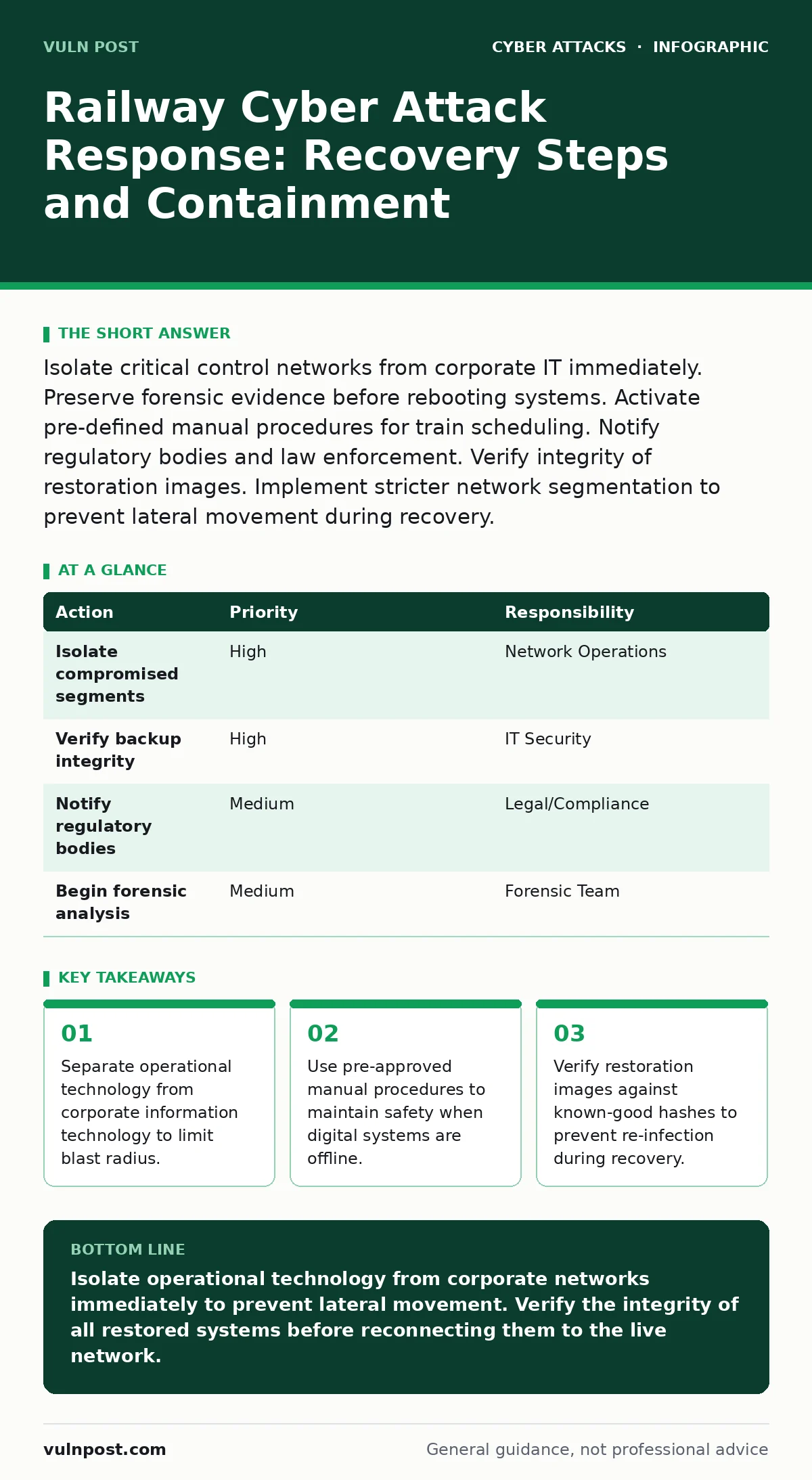
Isolate critical control networks from corporate IT immediately. Preserve forensic evidence before rebooting systems. Activate pre-defined manual procedures for train scheduling. Notify regulatory bodies and law enforcement. Verify integrity of restoration images. Implement stricter network segmentation to prevent lateral movement during recovery.
First hour
The initial response determines whether the incident remains a contained software failure or becomes a physical safety hazard. You must isolate the affected systems immediately. Disconnect the operational technology network from the corporate information technology network. This prevents lateral movement from compromised workstations to safety-critical controllers. Do not power off devices unless they pose an immediate physical danger. Power cycling destroys volatile memory evidence that forensic analysts need to reconstruct the attack timeline.
Identify the scope of the compromise. Check if the intrusion affects only ticketing systems or extends to signaling and train control. Use out-of-band monitoring tools to assess network traffic. If the attack involves initial access via phishing or credential theft, force a password reset for all administrative accounts. If the attack vector is external, verify that your DDoS protection mechanisms are not masking the true nature of the intrusion.
- Isolate operational technology from corporate networks
- Preserve volatile memory evidence
- Identify affected safety-critical systems
- Activate incident response team
First day
Stabilize the environment by containing the threat. You must determine if the attacker has established persistent access. Check for unauthorized changes to system configurations, user accounts, and scheduled tasks. Use network segmentation to isolate compromised segments. If the attack involves supply chain attacks, verify that all third-party software and firmware updates are genuine. Do not trust updates from vendors until you have independently verified their integrity.
Begin the recovery process by restoring systems from known-good backups. Verify that these backups are clean and complete. Test restored systems in an isolated environment before connecting them to the live network. This prevents the reintroduction of malware. Document every action taken during containment and recovery. This documentation is critical for post-incident analysis and regulatory reporting.
| Action | Priority | Responsibility |
|---|---|---|
| Isolate compromised segments | High | Network Operations |
| Verify backup integrity | High | IT Security |
| Notify regulatory bodies | Medium | Legal/Compliance |
| Begin forensic analysis | Medium | Forensic Team |
First week
Recovery involves more than restoring data. You must restore full operational capability while maintaining security. Gradually reconnect isolated systems to the network. Monitor for signs of re-infection. Implement additional security controls to prevent similar attacks. Review and update incident response plans based on lessons learned. Conduct a thorough post-incident review to identify gaps in detection and response capabilities.
Communicate with stakeholders transparently. Provide regular updates on the status of recovery efforts. Address concerns from customers, employees, and regulatory bodies. If the attack involved insider threats, review access logs and user behavior analytics. Identify any suspicious activity that may have been missed during the initial response. Implement stricter access controls and monitoring for privileged users.
| Phase | Duration | Key Activities |
|---|---|---|
| Containment | 24-48 hours | Isolate systems, preserve evidence |
| Eradication | 3-5 days | Remove malware, patch vulnerabilities |
| Recovery | 1-2 weeks | Restore systems, verify integrity |
| Post-Incident | Ongoing | Review plans, update controls |
Who to tell
Notification requirements vary by jurisdiction and industry. You must notify regulatory bodies within the specified timeframe. Provide detailed information about the incident, including the scope, impact, and response actions taken. Notify law enforcement if criminal activity is suspected. Cooperate with investigators to provide evidence and support.
Inform affected customers and partners. Provide clear and concise information about the incident and its impact on services. Offer support and assistance to affected individuals. If the attack involved API abuse, review and update API security controls. Implement rate limiting, authentication, and authorization mechanisms to prevent unauthorized access.
How to stop a repeat
Prevention requires a multi-layered approach. Implement network segmentation to limit lateral movement. Use intrusion detection and prevention systems to monitor for suspicious activity. Regularly update and patch systems to address known vulnerabilities. Conduct regular security assessments and penetration testing to identify weaknesses.
Train employees on security awareness and incident response procedures. Simulate attack scenarios to test response capabilities. If the attack involved brute force attacks, implement account lockout policies and multi-factor authentication. Monitor for failed login attempts and block suspicious IP addresses.
| Control | Purpose | Implementation |
|---|---|---|
| Network Segmentation | Limit lateral movement | VLANs, firewalls |
| Intrusion Detection | Monitor for threats | IDS/IPS systems |
| Patch Management | Address vulnerabilities | Regular updates |
| Security Training | Raise awareness | Regular drills |
See also: Backup Data Exposure: Immediate Response and Recovery Steps · Incident Response Best Practices for Faster Containment
Technical verification
Verify the integrity of all restored systems. Use cryptographic hashes to compare restored files with known-good versions. Check for unauthorized changes to system configurations and user accounts. Review logs for signs of re-infection. If the attack involved botnet attacks, monitor for command-and-control traffic. Block known malicious IP addresses and domains.
Conduct a thorough review of access controls. Ensure that only authorized users have access to critical systems. Implement least privilege principles. Regularly review and update access permissions. If the attack involved IP spoofing, implement ingress and egress filtering. Verify the source of incoming traffic to prevent spoofed packets from reaching critical systems.
Operational continuity
Maintain operational continuity during recovery. Implement manual procedures for critical functions. Train staff on these procedures to ensure they can operate safely without digital systems. Regularly test manual procedures to ensure they are effective. If the attack disrupts train scheduling, use manual timetables and communication methods to coordinate operations.
Review and update business continuity plans. Ensure that plans address cyber incidents specifically. Include procedures for communication, resource allocation, and recovery. Conduct regular drills to test these plans. Identify single points of failure and implement redundancies. Ensure that critical systems have backup power and connectivity.
Key takeaways
- Separate operational technology from corporate information technology to limit blast radius.
- Use pre-approved manual procedures to maintain safety when digital systems are offline.
- Verify restoration images against known-good hashes to prevent re-infection during recovery.
Isolate operational technology from corporate networks immediately to prevent lateral movement. Verify the integrity of all restored systems before reconnecting them to the live network.
Frequently asked questions
How do I know if my backups are clean?
Verify backups using cryptographic hashes against known-good versions. Check for unauthorized changes or malware signatures before restoring.
What if the attacker has persistent access?
Assume all systems are compromised. Rebuild systems from scratch using verified clean media. Do not attempt to clean infected systems in place.
How do I handle regulatory notifications?
Follow local laws and industry regulations. Notify regulatory bodies within the required timeframe. Provide detailed incident reports and response actions.
Can I prevent all cyber attacks?
No. Focus on reducing risk through segmentation, monitoring, and rapid response. Assume breach and plan for containment and recovery.
How this guide was produced: written by the Vuln Post editorial team with AI assistance, checked against the public references listed below, and reviewed when the facts change. See our editorial policy or report an error.