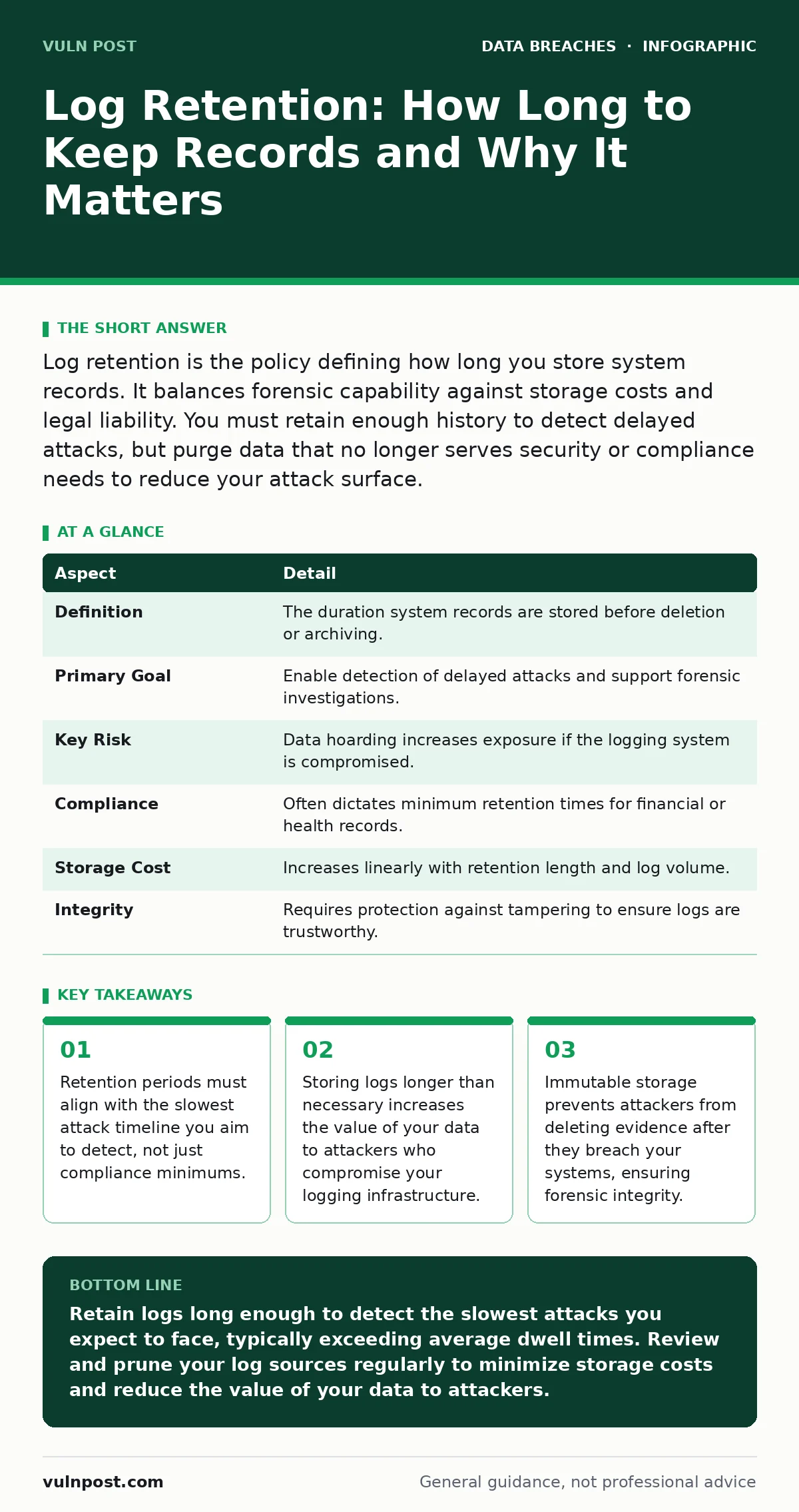
Log retention is the policy defining how long you store system records. It balances forensic capability against storage costs and legal liability. You must retain enough history to detect delayed attacks, but purge data that no longer serves security or compliance needs to reduce your attack surface.
The Library of Broken Glass
Imagine a bank vault where the security cameras only record for five minutes. If a thief breaks in, waits an hour, steals the gold, and leaves, the camera footage shows nothing unusual. You have a record of the vault being closed, but no record of the theft. Log retention is the policy that determines how long you keep those camera tapes. It is not just about storage; it is about the window of visibility you maintain for past events.
In cybersecurity, logs are the digital equivalent of that footage. They record who accessed what, when, and from where. Without a retention strategy, you are flying blind. You cannot investigate an incident if the evidence has already been deleted by routine cleanup processes. The goal is to keep enough history to reconstruct an attack, without keeping so much that you drown in noise or create a massive target for attackers.
| Aspect | Detail |
|---|---|
| Definition | The duration system records are stored before deletion or archiving. |
| Primary Goal | Enable detection of delayed attacks and support forensic investigations. |
| Key Risk | Data hoarding increases exposure if the logging system is compromised. |
| Compliance | Often dictates minimum retention times for financial or health records. |
| Storage Cost | Increases linearly with retention length and log volume. |
| Integrity | Requires protection against tampering to ensure logs are trustworthy. |
The Problem of Delayed Detection
Most security teams focus on real-time alerts. They want to know about an intrusion the second it happens. This is a noble goal, but it is rarely achievable. Sophisticated attackers often move slowly. They may gain initial access, establish persistence, and then wait weeks or months before exfiltrating data. This is known as dwell time. If your logs are deleted after thirty days, and an attacker waits sixty days to steal data, you have no record of their initial entry.
This is where dwell time becomes a critical metric. Dwell time is the period between initial compromise and detection. If your retention period is shorter than the attacker's dwell time, you are effectively invisible to them. You cannot detect what you do not record. Therefore, your retention policy must be driven by the longest dwell time you realistically expect to face. For most organizations, this means retaining logs for at least nine months to a year, though this varies by industry risk.
The Mechanics of Retention Policy
A retention policy is not a single number. It is a set of rules that govern the lifecycle of log data. The first part is the retention period. This is the length of time logs are kept in active storage. Active storage allows for quick searching and analysis. The second part is the archival strategy. After the active period, logs may be moved to cheaper, slower storage. This is called cold storage. It is useful for long-term compliance but not for rapid incident response.
The third part is the deletion mechanism. When logs reach the end of their lifecycle, they must be destroyed securely. Simple deletion is often insufficient because data can be recovered. You must use methods that overwrite or cryptographically erase the data. This is particularly important for data encryption logs, which may contain keys or metadata that are highly sensitive. If you do not securely delete old logs, they become a liability. An attacker who gains access to your storage can recover deleted logs and use them to map your network history.
Integration with Other Defences
Log retention does not exist in a vacuum. It works with other security controls to provide depth. For example, encryption at rest protects your logs from being read if the storage media is stolen. However, encryption does not prevent an attacker with legitimate access from reading the logs. You still need access controls. Employee offboarding security is another critical link. When an employee leaves, their access credentials must be revoked immediately. If their credentials remain active, and they have access to logs, they can delete evidence of their own malicious activity or that of others.
Consider backup data exposure. Backups often contain logs. If your backup system is not secured, it becomes a secondary target. Attackers know that backups are often less protected than primary systems. They may compromise the backup infrastructure to access historical logs. These logs can reveal patterns of behavior, user habits, and system configurations. This information is valuable for planning future attacks. Therefore, your retention policy must extend to backups. You must ensure that backed-up logs are retained for the same duration and protected with the same rigor.
What People Usually Get Wrong
The most common mistake is treating retention as a compliance checkbox. Organizations often set retention periods to meet the minimum legal requirement and then ignore the security implications. This is dangerous. Compliance minimums are often lower than what is needed for security. For example, a regulation might require six months of logs, but your threat model might suggest that attackers in your sector typically have a dwell time of eight months. If you only keep six months, you are vulnerable.
Another mistake is retaining everything forever. This is known as data hoarding. It creates a massive attack surface. Every log entry is a piece of data that could be exfiltrated. If an attacker compromises your logging system, they can steal years of history. This data can be used to build a detailed map of your organization. It can reveal sensitive information about employees, customers, and operations. This is a form of data scraping on your own infrastructure. You are essentially handing the attacker a blueprint.
See also: Backup Data Exposure: Immediate Response and Recovery Steps · Incident Response Best Practices for Faster Containment
The Hidden Cost of Visibility
Keeping logs has a cost that is not always obvious. It is not just the storage fees. It is the operational overhead. Large volumes of logs require significant processing power to search and analyze. This can slow down your security operations. It can also lead to alert fatigue. When you have too much data, it is harder to find the signal in the noise. You may miss critical alerts because they are buried in irrelevant data.
This is why log filtering is important. You should not log everything. You should log what is necessary for security and compliance. This requires careful planning. You must decide which events are valuable and which are noise. For example, logging every successful login may be useful for auditing, but it may also generate massive volumes of data. Logging failed login attempts is more valuable for detecting brute-force attacks. You must balance the need for visibility with the need for efficiency.
Balancing Act
Log retention is a balancing act. You must keep enough data to detect and investigate incidents. But you must not keep so much that you create unnecessary risk and cost. The key is to align your retention policy with your threat model. Understand how attackers operate in your sector. Estimate their dwell time. Then set your retention period to exceed that time.
You must also consider the legal and compliance requirements. These may dictate minimum retention periods. But they should not dictate maximum periods. You should delete logs as soon as they are no longer needed for security or legal purposes. This reduces your attack surface and your liability. Remember that synthetic identity fraud and other advanced threats often rely on historical data. The more history you keep, the more material you provide for such attacks.
Key takeaways
- Retention periods must align with the slowest attack timeline you aim to detect, not just compliance minimums.
- Storing logs longer than necessary increases the value of your data to attackers who compromise your logging infrastructure.
- Immutable storage prevents attackers from deleting evidence after they breach your systems, ensuring forensic integrity.
Retain logs long enough to detect the slowest attacks you expect to face, typically exceeding average dwell times. Review and prune your log sources regularly to minimize storage costs and reduce the value of your data to attackers.
Frequently asked questions
How do I determine the right retention period for my organization?
Analyze the dwell time of threats relevant to your industry. Add a buffer to that time to ensure you capture the full attack chain. Consult legal counsel for compliance minimums, but prioritize security needs.
Should I store logs in the cloud or on-premises?
Both options have trade-offs. Cloud storage offers scalability and often better security features. On-premises storage gives you more control. Choose based on your security requirements and budget.
Can I use log retention to meet compliance requirements?
Yes, but compliance is only one factor. Ensure your retention policy also addresses security needs. Compliance minimums are often insufficient for detecting sophisticated attacks.
What happens if I lose my logs during an incident?
You may be unable to fully investigate the incident. This can lead to incomplete remediation and increased risk of future breaches. Ensure you have backups of your logs and that they are protected.
How this guide was produced: written by the Vuln Post editorial team with AI assistance, checked against the public references listed below, and reviewed when the facts change. See our editorial policy or report an error.