
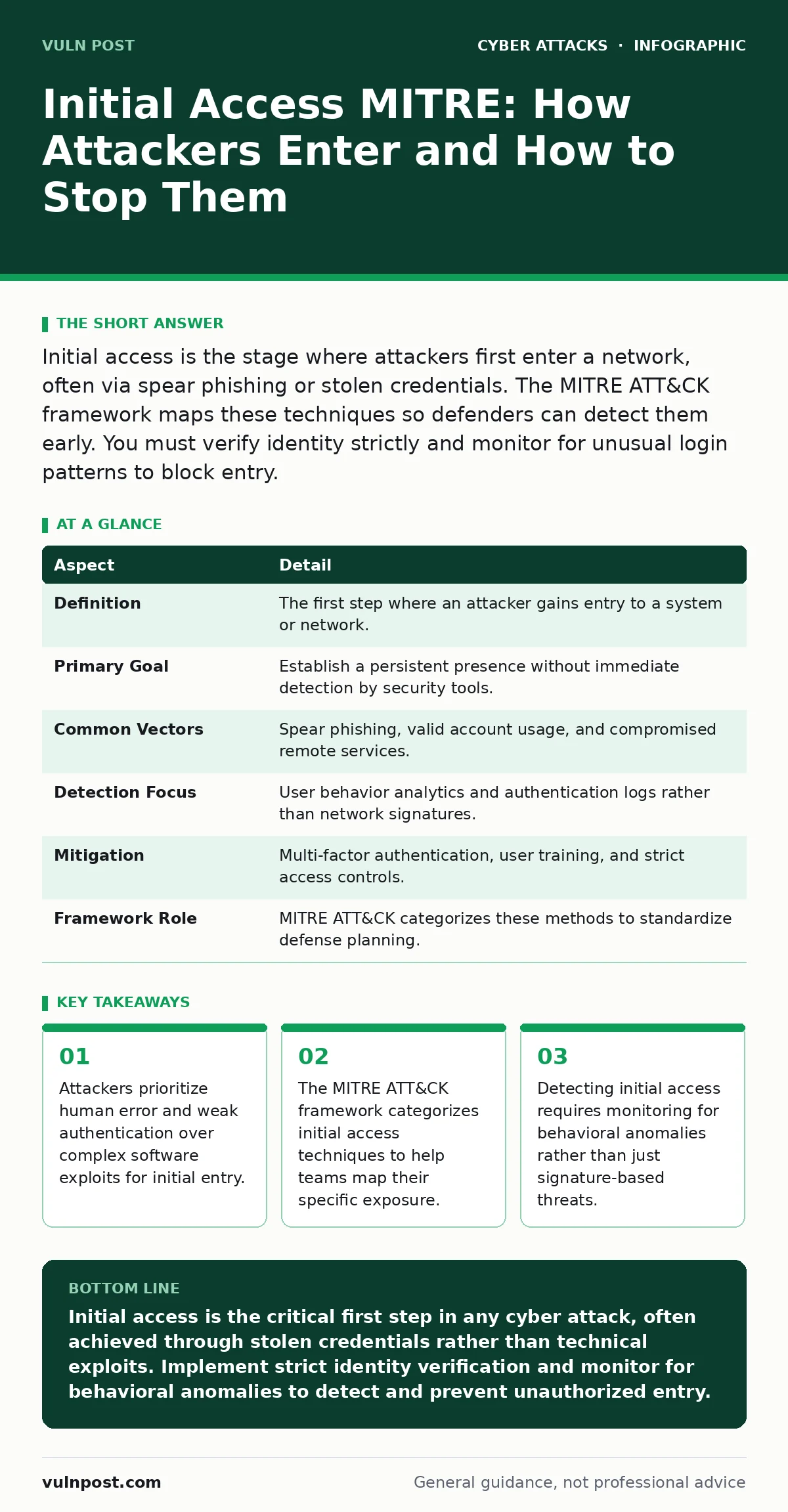
Initial access is the stage where attackers first enter a network, often via spear phishing or stolen credentials. The MITRE ATT&CK framework maps these techniques so defenders can detect them early. You must verify identity strictly and monitor for unusual login patterns to block entry.
The Front Door Analogy
Imagine a high-security bank with vault doors made of titanium. Security teams spend millions reinforcing those doors against drills and explosives. Meanwhile, the night janitor keeps the side entrance unlocked because he forgets to engage the deadbolt. Attackers do not need to break the vault. They simply wait for the janitor to leave the side door open. Initial access works the same way in digital environments. Defenders often fortify the external firewall while ignoring the human entry points that remain wide open.
What Is Initial Access MITRE?
Initial access is the technique an adversary uses to get their first foothold inside a target network. It is the starting point of every successful cyber attack. The MITRE ATT&CK framework describes this phase as a specific collection of techniques that adversaries use to bypass security controls and gain a presence in the environment. Understanding these techniques allows security teams to predict how attackers will enter.
| Aspect | Detail |
|---|---|
| Definition | The first step where an attacker gains entry to a system or network. |
| Primary Goal | Establish a persistent presence without immediate detection by security tools. |
| Common Vectors | Spear phishing, valid account usage, and compromised remote services. |
| Detection Focus | User behavior analytics and authentication logs rather than network signatures. |
| Mitigation | Multi-factor authentication, user training, and strict access controls. |
| Framework Role | MITRE ATT&CK categorizes these methods to standardize defense planning. |
How Initial Access Works
Attackers rarely guess passwords randomly. They use targeted methods to obtain valid credentials or exploit trust relationships. Spear phishing remains the dominant method. An attacker sends a carefully crafted message that appears to come from a trusted source. The message contains a link to a fake login page or a malicious attachment. When the victim enters their credentials, the attacker captures them instantly. This method bypasses technical controls because the credentials are legitimate.
Another common method involves valid accounts. Attackers purchase or steal credentials from previous data breaches. They then use these valid credentials to log in normally. To a security operations center, this looks like legitimate user activity. The traffic matches expected patterns. The firewall allows it through. The intrusion detection system sees no malicious payload. The attacker is already inside, moving laterally before anyone notices.
Who Initial Access Affects
Every organization with a digital presence is a target. Small businesses are attractive because they often lack dedicated security staff. Large enterprises are attractive because they hold valuable data. The size of the organization does not determine susceptibility. The quality of the security hygiene determines susceptibility.
Remote work has expanded the attack surface. Employees connect from home networks, cafes, and hotels. These connections are less secure than corporate networks. Attackers exploit this by targeting remote access services. They scan for exposed remote desktop protocols or weak VPN configurations. When they find a weak point, they enter the network. The location of the user no longer provides security through obscurity.
What People Usually Get Wrong
Many teams believe that a strong firewall stops initial access. This is incorrect. Firewalls filter traffic based on rules. If an attacker uses a valid credential, the traffic is allowed. The firewall cannot distinguish between a legitimate employee and an attacker using stolen credentials. Relying solely on perimeter defense leaves the organization vulnerable to credential theft.
Another common mistake is assuming that multi-factor authentication eliminates risk. While MFA significantly reduces the chance of success, it is not foolproof. Attackers use MFA fatigue attacks. They send repeated push notifications to the user’s phone until the user approves one out of annoyance. Attackers also use session hijacking. They steal the authentication token after MFA is completed. The attacker then uses the token to access the system without triggering MFA again.
Detecting Initial Access
Detection requires monitoring user behavior, not just network traffic. Look for logins from unusual locations or at unusual times. If a user typically logs in from New York during business hours, a login from Moscow at 3 AM is suspicious. Implement identity and access management solutions that flag these anomalies.
Monitor for failed login attempts followed by a successful login. This pattern often indicates a brute-force attack or credential stuffing. Alert when a user accesses resources they do not normally use. A finance employee accessing the engineering server is a red flag. These behavioral indicators are more reliable than signature-based detection.
Mitigating Initial Access Risks
Start with strict identity verification. Enforce multi-factor authentication for all users, especially those with privileged access. Use phishing-resistant MFA methods like hardware tokens or FIDO2 keys. These methods are harder to bypass than SMS codes or push notifications.
Reduce the attack surface by disabling unnecessary remote access services. If remote desktop is not required, turn it off. Restrict access to VPNs and cloud applications to known IP ranges. Implement least privilege access. Users should only have access to the data they need to do their jobs. This limits the damage if an attacker gains initial access.
Regularly review user accounts. Disable accounts for employees who have left the organization. Remove unnecessary permissions. Conduct regular security awareness training. Teach employees to recognize spear phishing attempts. Human error is the weakest link. Strengthening that link reduces the likelihood of initial access.
Moving Beyond Initial Access
Initial access is just the beginning. Once inside, attackers move laterally, escalate privileges, and exfiltrate data. Understanding the initial access phase helps you stop the attack early. But you must also prepare for the next stages. Monitor for privilege escalation and data exfiltration. Use endpoint detection and response tools to catch malicious activity on devices.
Integrate your security tools. SIEM platforms should correlate identity logs with network logs. This provides a complete view of the attack. Share threat intelligence with other organizations. Knowing which tactics are currently popular helps you adjust your defenses. Stay ahead of the attackers by understanding their methods.
Key takeaways
- Attackers prioritize human error and weak authentication over complex software exploits for initial entry.
- The MITRE ATT&CK framework categorizes initial access techniques to help teams map their specific exposure.
- Detecting initial access requires monitoring for behavioral anomalies rather than just signature-based threats.
- Valid accounts provide attackers with legitimate-looking traffic that evades standard perimeter security tools.
Initial access is the critical first step in any cyber attack, often achieved through stolen credentials rather than technical exploits. Implement strict identity verification and monitor for behavioral anomalies to detect and prevent unauthorized entry.
Frequently asked questions
How does initial access differ from exploitation?
Initial access is the act of entering the network, often using social engineering or stolen credentials. Exploitation involves taking advantage of a software vulnerability to gain access or elevate privileges.
Can multi-factor authentication stop all initial access attempts?
MFA significantly reduces risk but cannot stop all attempts. Attackers may use session hijacking or MFA fatigue to bypass it. Phishing-resistant MFA methods provide the strongest protection.
What is the most common initial access technique?
Spear phishing is currently the most common technique. Attackers trick users into revealing credentials or downloading malware. Valid account usage is also very common due to credential stuffing.
How can I detect initial access if I have no SIEM?
Monitor authentication logs for unusual login patterns. Look for logins from new devices, unusual locations, or at odd hours. Alert on multiple failed login attempts followed by success.
How this guide was produced: written by the Vuln Post editorial team with AI assistance, checked against the public references listed below, and reviewed when the facts change. See our editorial policy or report an error.