
Most teams misconfigure behavioral analytics by ignoring baseline drift, treating alerts as facts, and neglecting entity relationships. Correct usage requires continuous baseline updates, context from related logs, and a focus on process chains rather than single anomalous events to reduce noise and improve detection accuracy.
Misreading: Baselines Are Static Truths
Correct reading: Baselines are dynamic models that decay without continuous recalibration. You establish a baseline by observing normal activity over a defined period. This model assumes that future behavior will resemble past behavior. Business changes, software updates, and seasonal workflows shift this normalcy. If you do not update the baseline, the system flags legitimate changes as anomalies. This creates alert fatigue. You must schedule regular reviews to adjust thresholds. A static baseline becomes a liability. It misses new attack patterns that mimic the old normal.
You need a feedback loop. Analysts must validate alerts. Validated alerts should refine the model. This keeps the detection logic aligned with reality. Ignoring drift leads to missed detections. The system stops learning. It becomes a rigid filter. You lose visibility into subtle changes. Regular tuning is not optional. It is the core maintenance task. Without it, the analytics engine degrades. You are monitoring a ghost of past operations. The current environment is invisible to the tool. You must treat the baseline as a living document. It requires constant attention. Neglect leads to operational blindness.
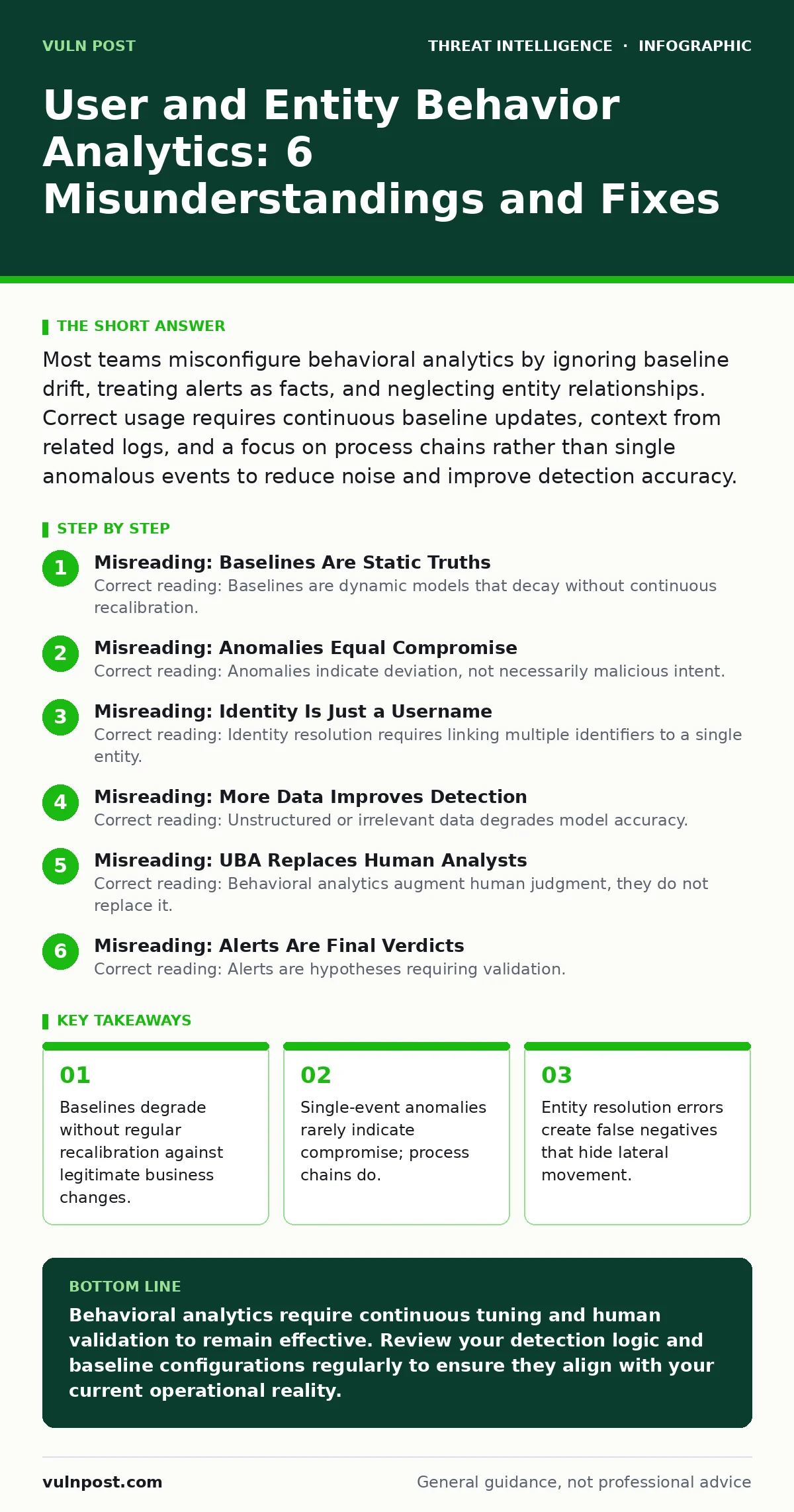
Misreading: Anomalies Equal Compromise
Correct reading: Anomalies indicate deviation, not necessarily malicious intent. A user logging in at 3 AM is an anomaly. It is not proof of a breach. The user might be working late. The system might have a clock error. You must correlate the anomaly with other signals. Look for process execution chains. Check for data exfiltration volumes. A single outlier is often noise. A cluster of anomalies suggests a pattern. You need context to determine risk. Is the user accessing sensitive files? Is the device isolated? You cannot act on a single data point.
You must build a case. This reduces false positives. It focuses your team on high-risk events. Treating every anomaly as an attack wastes resources. It trains your team to ignore alerts. You lose trust in the platform. You must define risk scores. These scores weigh the likelihood of compromise. They consider the asset value. They consider the user role. This prioritizes your response. You address the most dangerous deviations first. You ignore the benign ones. This distinction is critical. It separates signal from noise. It ensures you catch real threats. You avoid chasing ghosts.
Misreading: Identity Is Just a Username
Correct reading: Identity resolution requires linking multiple identifiers to a single entity. A username changes. Email addresses rotate. IP addresses are dynamic. You must map these to a persistent identity. This process is called entity resolution. It groups logs by the actual user or device. Without this, you see fragmented activity. You miss the full picture. An attacker might reuse a service account. You must track the account lifecycle. You must monitor privilege changes. You must link login events to file access. This creates a cohesive view. It reveals lateral movement.
It shows how an attacker pivots. You cannot detect complex attacks with fragmented data. You need a unified identity graph. This graph connects users, devices, and applications. It shows relationships. It highlights unusual connections. You must invest in this mapping. It is foundational. It enables accurate behavioral analysis. It prevents blind spots. You must verify the accuracy of this graph. Errors here propagate through the entire system. You get false negatives. You miss the attacker. You must maintain this data rigorously. It is the backbone of your detection.
Misreading: More Data Improves Detection
Correct reading: Unstructured or irrelevant data degrades model accuracy. You might ingest every log available. This increases noise. It obscures true signals. The model struggles to find patterns. It becomes computationally expensive. You experience slower query times. You face higher storage costs. You must curate your data sources. Focus on high-fidelity logs. These include authentication events. They include process creations. They include network connections. You must filter out low-value noise. This includes routine health checks. It includes benign application logs.
You must define clear data requirements. You must align data with your use cases. You must test the data quality. Poor data leads to poor models. You cannot fix a bad model with more data. You must improve the quality. You must ensure consistency. You must standardize formats. This makes analysis easier. It improves model performance. It reduces costs. It speeds up investigations. You must be selective. You must prioritize relevance. You must discard the rest. This focus sharpens your detection. It highlights what matters. It removes the clutter. You see the threat clearly.
Misreading: UBA Replaces Human Analysts
Correct reading: Behavioral analytics augment human judgment, they do not replace it. The system identifies statistical outliers. It cannot determine intent. It cannot understand business context. It cannot assess risk nuance. You need analysts to investigate alerts. You need them to validate findings. You need them to refine models. The tool provides candidates. The analyst makes the call. This human-in-the-loop approach is vital. It ensures accuracy. It prevents automated errors. It maintains accountability. You must train analysts to interpret results.
They must know the limitations. They must ask the right questions. The tool is a force multiplier. It handles scale. It processes volume. It finds patterns humans miss. But it lacks intuition. It lacks creativity. It lacks empathy. You need both. You need the machine’s speed. You need the human’s wisdom. You must integrate them. You must define clear workflows. You must assign roles. You must measure effectiveness. This partnership drives success. It balances automation with oversight. It ensures reliable operations. It builds trust in the system. You rely on the combination. Not just the tool.
See also: Threat Actor Naming Conventions: What Small Teams Need to Know
Misreading: Alerts Are Final Verdicts
Correct reading: Alerts are hypotheses requiring validation. An alert suggests a potential issue. It does not confirm it. You must investigate each alert. You must gather additional evidence. You must cross-reference with other sources. You must consider the broader context. You must determine if it is a true positive. You must rule out false positives. You must update the model based on findings. This iterative process improves accuracy. It reduces noise over time. You must document your investigations. You must share lessons learned.
You must refine your detection logic. You must treat alerts as starting points. Not endpoints. This mindset shift is critical. It prevents reactive panic. It enables proactive defense. You build a stronger posture. You gain deeper insights. You improve your response capabilities. You learn from every event. You continuously evolve. This is the true value of analytics. It is not just detection. It is learning. It is improvement. It is resilience. You must embrace this cycle. It drives long-term success. It ensures you stay ahead. You adapt to new threats. You remain effective.
Misreading: Detection Use Cases Are Universal
Correct reading: Detection logic must be tailored to your specific environment. Generic rules often fail. They do not account for your unique workflows. They do not reflect your specific risks. You must customize your use cases. You must align them with your business processes. You must consider your industry regulations. You must focus on your critical assets. This customization ensures relevance. It reduces false positives. It improves detection quality. You must involve subject matter experts.
They understand your operations. They can define normal behavior. They can identify high-risk activities. You must collaborate with them. You must integrate their insights. You must test your rules rigorously. You must measure their effectiveness. You must adjust as needed. This iterative refinement is key. It ensures your detection logic stays sharp. It keeps you protected. It aligns security with business goals. You must own your detection strategy. You cannot rely on defaults. You must build your own. It is the only way to succeed.
Key takeaways
- Baselines degrade without regular recalibration against legitimate business changes.
- Single-event anomalies rarely indicate compromise; process chains do.
- Entity resolution errors create false negatives that hide lateral movement.
Behavioral analytics require continuous tuning and human validation to remain effective. Review your detection logic and baseline configurations regularly to ensure they align with your current operational reality.
Frequently asked questions
How do I reduce false positives in behavioral analytics?
Refine your baselines to reflect current business operations. Exclude known legitimate activities from alerting rules. Correlate anomalies with other signals to confirm risk. Validate alerts before taking action. This reduces noise and improves accuracy.
What data sources are most valuable for UBA?
Authentication logs, process execution records, and network connection logs are high-value. They provide clear indicators of user and entity activity. Focus on these sources first. Filter out low-value noise. Ensure data quality and consistency. This improves model performance and detection accuracy.
How often should I update my behavioral baselines?
Update baselines regularly, ideally monthly or after significant business changes. Monitor for drift. Adjust thresholds based on validated alerts. This keeps the model aligned with reality. It prevents false positives and missed detections. Continuous tuning is essential for effectiveness.
Can UBA detect lateral movement?
Yes, by tracking entity relationships and process chains. Lateral movement often involves unusual access patterns. It involves pivoting between systems. Behavioral analytics can identify these deviations. You must ensure strong identity resolution. You must correlate events across multiple systems. This reveals the full attack path.
How this guide was produced: written by the Vuln Post editorial team with AI assistance, checked against the public references listed below, and reviewed when the facts change. See our editorial policy or report an error.