
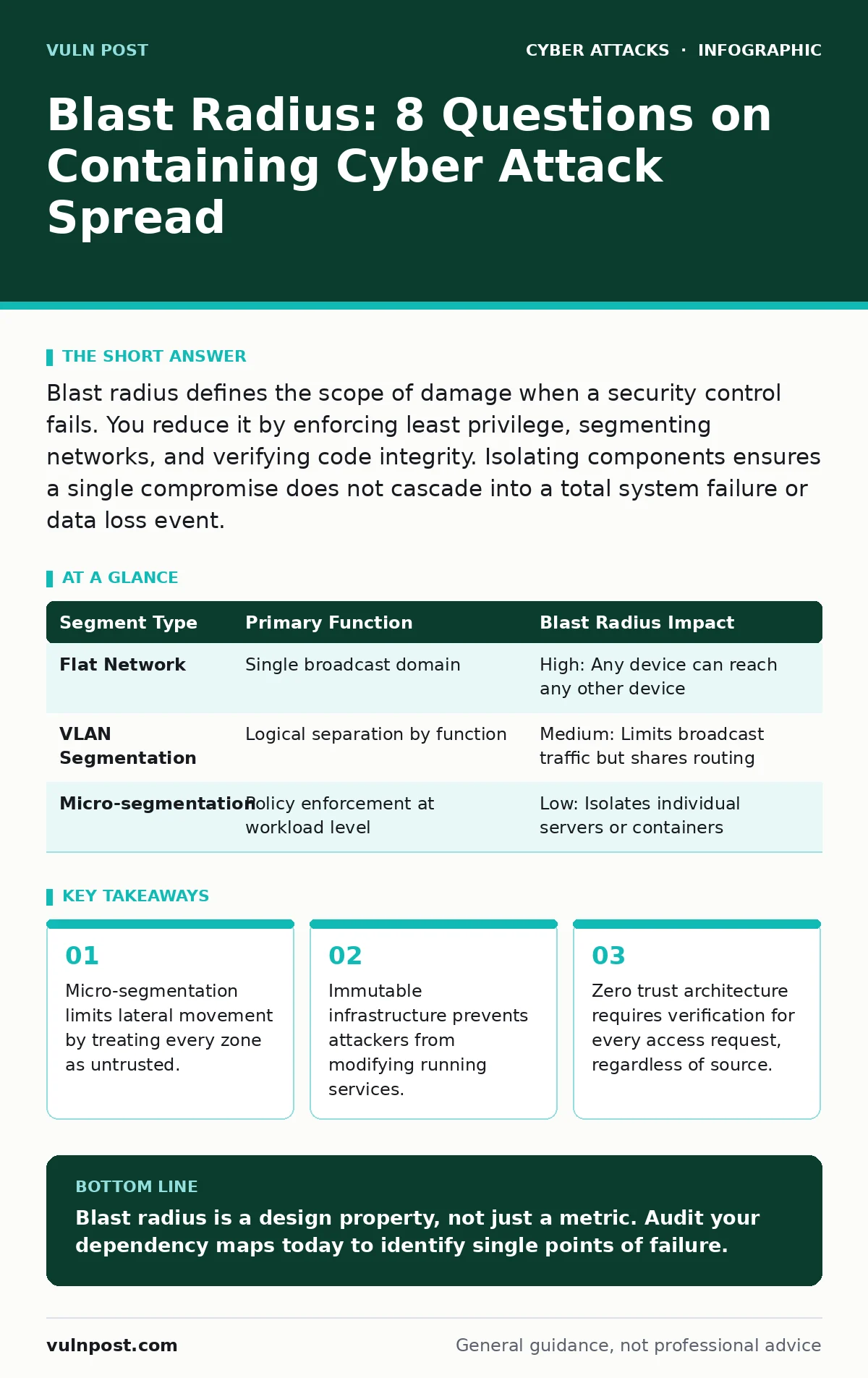
Blast radius defines the scope of damage when a security control fails. You reduce it by enforcing least privilege, segmenting networks, and verifying code integrity. Isolating components ensures a single compromise does not cascade into a total system failure or data loss event.
What exactly is blast radius in security?
Blast radius is the total scope of damage or exposure resulting from a single point of failure or compromise. It measures how many systems, users, or data sets are affected when one security control fails. A large blast radius means a single vulnerability can take down an entire organization. A small blast radius confines the impact to a specific component.
Why does least privilege reduce blast radius?
Least privilege restricts each user and process to only the permissions necessary for their specific tasks. If an attacker compromises a service account with minimal rights, they cannot access unrelated databases or administrative tools. This constraint forces the attacker to find additional vulnerabilities to escalate their access. It turns a potential full-system breach into a contained incident.
Imagine a web server that only needs to read configuration files. If you grant it root access, a exploit in the web application gives the attacker full control of the host. If you grant it read-only access to specific files, the attacker gains nothing beyond those files.
How does network segmentation isolate threats?
Network segmentation divides a single network into smaller, isolated sub-networks or zones. Each zone has strict firewall rules controlling traffic flow between them. If malware infects one zone, it cannot easily jump to others without passing through additional inspection points. This physical or logical separation breaks the path of lateral movement.
| Segment Type | Primary Function | Blast Radius Impact |
|---|---|---|
| Flat Network | Single broadcast domain | High: Any device can reach any other device |
| VLAN Segmentation | Logical separation by function | Medium: Limits broadcast traffic but shares routing |
| Micro-segmentation | Policy enforcement at workload level | Low: Isolates individual servers or containers |
Can identity management limit damage scope?
Identity management controls who can access what resources and for how long. Strong identity governance ensures that access rights are reviewed and revoked promptly when roles change. Without it, former employees or dormant accounts become permanent entry points for attackers. Revoking access immediately after a compromise stops the attacker from using stolen credentials.
What role does supply chain integrity play?
Supply chain attacks compromise trusted software or hardware before it reaches your environment. If you trust a third-party library implicitly, a vulnerability in that library affects every system using it. This creates a massive blast radius because the trust relationship bypasses local security checks. Verifying the integrity of code before deployment is the only defense.
Readers interested in the mechanics of these compromises should review the guide on supply chain attacks to understand how trust transitivity works.
How do API endpoints expand attack surfaces?
APIs allow different software systems to communicate and share data. Poorly secured APIs often expose internal data structures or administrative functions to the public internet. An attacker can abuse these endpoints to exfiltrate data or manipulate services without touching the traditional web interface. This bypasses many standard perimeter defenses.
For deeper analysis on how attackers exploit these interfaces, see the guide on API abuse.
Why does immutable infrastructure help containment?
Immutable infrastructure means servers and containers are never modified after deployment. If a system is compromised, it is destroyed and replaced with a new, clean instance. This prevents attackers from installing persistence mechanisms or modifying logs to hide their activity. It ensures that the state of the system is always known and verified.
How can you measure your blast radius?
You measure blast radius by mapping dependencies between systems and simulating failure scenarios. Identify which systems rely on a given component and calculate the cascading effect of its compromise. Regular chaos engineering tests, where you intentionally break components, reveal hidden dependencies. This data helps you prioritize segmentation and hardening efforts.
What is the cost of over-segmentation?
Over-segmentation creates excessive complexity that hinders legitimate operations. If every microservice requires manual approval for communication, development velocity drops significantly. This friction often leads engineers to bypass security controls to get work done. The hidden cost is that security becomes a blocker rather than an enabler, reducing overall resilience.
How does zero trust architecture minimize exposure?
Zero trust architecture assumes no user or system is trustworthy by default, even if it is inside the network perimeter. Every access request is verified based on identity, device health, and context. This eliminates the assumption that internal traffic is safe. It ensures that a compromised internal host cannot freely access sensitive resources.
Key takeaways
- Micro-segmentation limits lateral movement by treating every zone as untrusted.
- Immutable infrastructure prevents attackers from modifying running services.
- Zero trust architecture requires verification for every access request, regardless of source.
Blast radius is a design property, not just a metric. Audit your dependency maps today to identify single points of failure.
Frequently asked questions
How do I calculate blast radius for a cloud environment?
Map all IAM roles and network policies to identify which resources a single compromised identity can access.
Does encryption reduce blast radius?
Encryption protects data at rest and in transit, but it does not prevent lateral movement or system takeover.
What is the difference between blast radius and attack surface?
Attack surface is the total number of entry points; blast radius is the damage spread after one entry point is breached.
Can automation increase blast radius?
Yes, if automation scripts have excessive privileges, a compromise of one script can execute malicious actions across many systems.
How this guide was produced: written by the Vuln Post editorial team with AI assistance, checked against the public references listed below, and reviewed when the facts change. See our editorial policy or report an error.