
Implement time-bound, role-specific permissions that expire automatically. Verify every request through automated workflows, audit usage logs continuously, and integrate with identity providers to ensure immediate revocation when sessions end or roles change.
Defining the Scope of Temporary Privileges
You cannot secure what you have not defined. The first step in implementing just-in-time access is identifying which resources require elevated permissions. This is not about giving everyone temporary keys; it is about restricting high-impact actions to specific windows of time. You must map your cloud environment to identify administrative roles that are rarely used but critically powerful.
- Inventory all administrative roles: Identify every role that can modify security controls or access sensitive data.
- Define maximum duration limits: Set strict time bounds for each role to prevent indefinite elevation.
- Document business justification fields: Require users to explain why they need access, creating an audit trail.
This foundation ensures that you only apply complex controls where they actually matter. Without this mapping, you risk either locking out legitimate operations or leaving dangerous gaps.
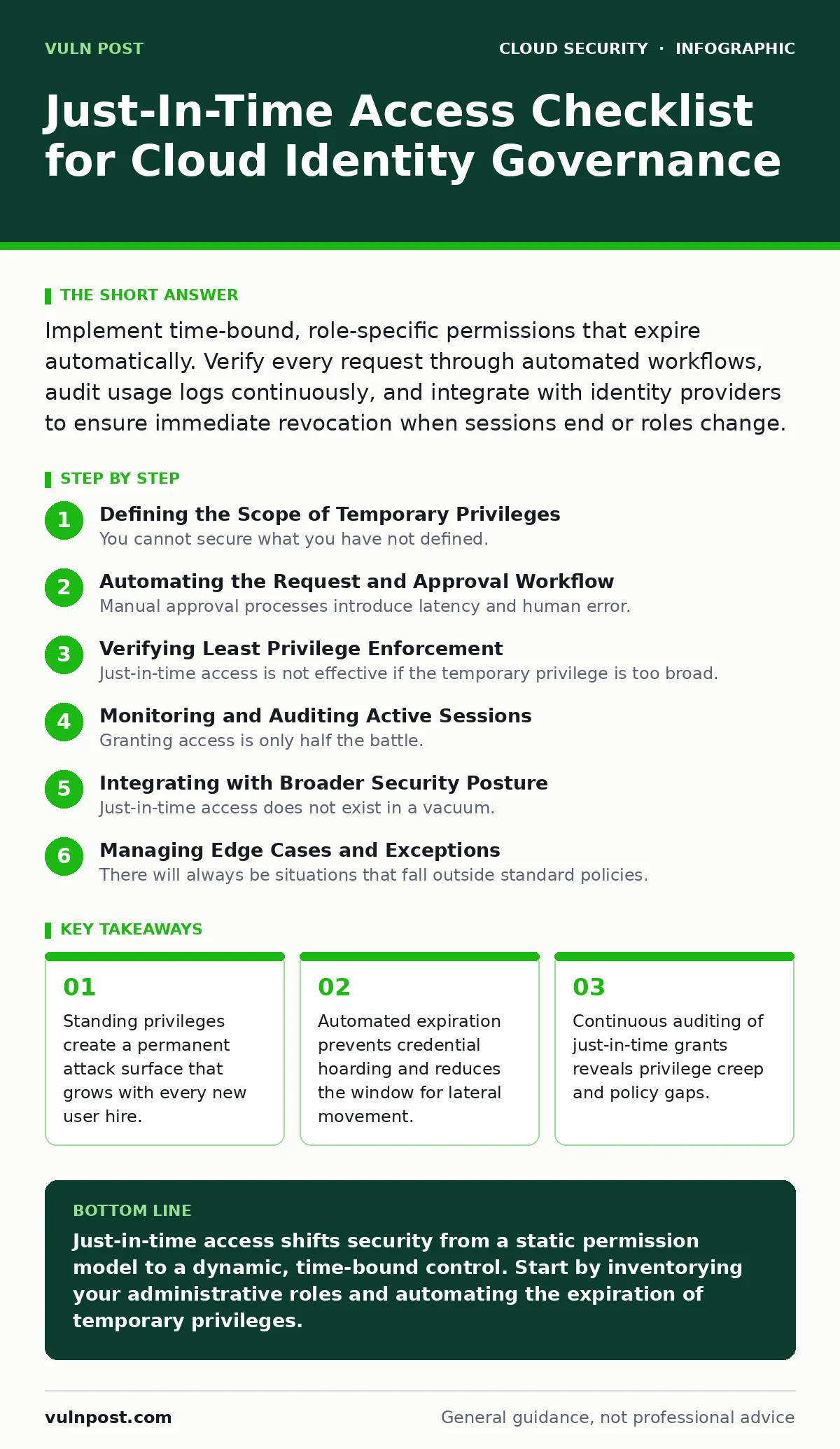
Automating the Request and Approval Workflow
Manual approval processes introduce latency and human error. You need a system that evaluates requests against predefined policies without requiring a human to click a button for every routine task. Automation ensures that the policy is applied consistently, regardless of who is making the request or who is approving it.
- Integrate with identity providers: Connect your JIT system to your primary directory service for real-time user data.
- Implement multi-factor authentication gates: Require additional verification before granting elevated privileges.
- Configure automatic expiration: Ensure privileges are revoked immediately when the time limit is reached.
Verifying Least Privilege Enforcement
Just-in-time access is not effective if the temporary privilege is too broad. You must ensure that the granted permission matches the specific task at hand. Granting full administrator rights for a task that only requires read access defeats the purpose of limiting the blast radius. This requires a granular understanding of the permissions associated with each role.
- Review role permission sets: Audit each role to remove unnecessary capabilities.
- Implement task-specific profiles: Create narrow roles for common maintenance tasks rather than using broad admin roles.
- Test privilege escalation paths: Verify that users cannot chain temporary privileges to gain higher access.
Consider the scenario where a developer needs to restart a service. They do not need the ability to delete the entire production environment. By narrowing the scope, you limit the damage if that temporary session is compromised.
Monitoring and Auditing Active Sessions
Granting access is only half the battle. You must monitor how that access is used while it is active. Static logs are insufficient; you need real-time visibility into who is doing what and when. This allows you to detect anomalies and terminate sessions that appear malicious.
- Enable real-time session logging: Capture every action taken during a JIT session.
- Set up anomaly detection alerts: Flag unusual activity patterns, such as access from new locations or at odd hours.
- Implement automatic session termination: Allow security teams to revoke active sessions immediately upon detecting threats.
This continuous visibility is critical for incident response. If a breach occurs, you need to know exactly which temporary grants were active and what actions were performed.
Integrating with Broader Security Posture
Just-in-time access does not exist in a vacuum. It must work in concert with other security controls to provide layered defense. Ignoring the broader context can lead to false confidence in your identity controls while other vulnerabilities remain open.
- Align with policy as code frameworks: Ensure JIT policies are version-controlled and tested like application code.
- Coordinate with cloud network segmentation: Verify that JIT access does not bypass network-level restrictions.
- Integrate with SaaS security posture management: Ensure external applications also adhere to temporary access principles.
See also: Role-Based Access Control: 8 FAQ Answers for Secure Systems
Managing Edge Cases and Exceptions
There will always be situations that fall outside standard policies. Emergency access, vendor support, and legacy systems often require special handling. You must have a defined process for these exceptions to prevent them from becoming permanent loopholes.
- Define break-glass procedures: Establish clear steps for emergency access that are logged and reviewed.
- Audit exception usage regularly: Review all exception requests to identify trends or policy failures.
- Plan for legacy system integration: Determine how to apply JIT principles to systems that do not support modern identity protocols.
Imagine a critical production outage that requires immediate intervention. Your break-glass process must allow rapid access while still maintaining accountability. Without this planning, teams will bypass security controls in the heat of the moment.
Reviewing and Refining Policies
Security policies degrade over time as roles change and new services are added. You must regularly review your JIT configurations to ensure they remain effective. This is not a one-time setup but an ongoing process of refinement and adjustment.
- Schedule quarterly policy reviews: Assess whether current durations and scopes are still appropriate.
- Analyze access request patterns: Identify roles that are frequently requested and evaluate if they should be permanent or if the workflow is broken.
- Update integration points: Ensure connections to identity providers and logging systems remain functional.
This continuous improvement cycle ensures that your just-in-time access model evolves with your organization’s needs. It prevents the accumulation of technical debt in your identity governance framework.
Key takeaways
- Standing privileges create a permanent attack surface that grows with every new user hire.
- Automated expiration prevents credential hoarding and reduces the window for lateral movement.
- Continuous auditing of just-in-time grants reveals privilege creep and policy gaps.
Just-in-time access shifts security from a static permission model to a dynamic, time-bound control. Start by inventorying your administrative roles and automating the expiration of temporary privileges.
Frequently asked questions
How does just-in-time access differ from role-based access control?
Role-based access control grants persistent permissions based on job function, while just-in-time access grants temporary, time-bound privileges only when needed for specific tasks.
Can just-in-time access be applied to service accounts?
Yes, service accounts can use just-in-time access by requesting temporary credentials for specific jobs, reducing the risk of long-lived secret exposure.
What happens if a user’s JIT session expires while they are working?
The session is terminated immediately, requiring the user to request a new grant if they need to continue their work, ensuring no lingering access.
How do you handle emergency access requests?
Emergency access should follow a predefined break-glass procedure that grants immediate access with enhanced logging and mandatory post-incident review.
How this guide was produced: written by the Vuln Post editorial team with AI assistance, checked against the public references listed below, and reviewed when the facts change. See our editorial policy or report an error.