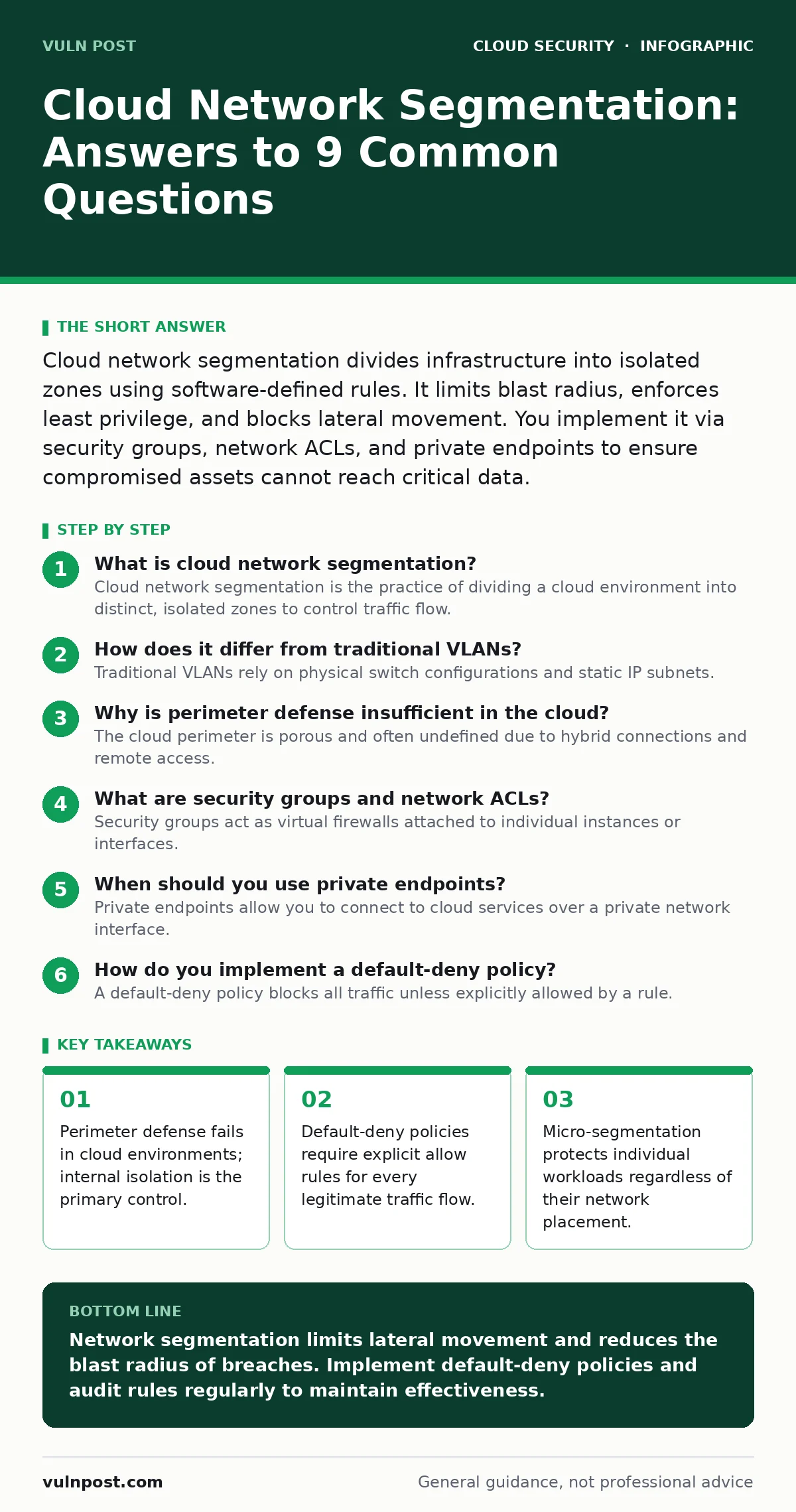
Cloud network segmentation divides infrastructure into isolated zones using software-defined rules. It limits blast radius, enforces least privilege, and blocks lateral movement. You implement it via security groups, network ACLs, and private endpoints to ensure compromised assets cannot reach critical data.
What is cloud network segmentation?
Cloud network segmentation is the practice of dividing a cloud environment into distinct, isolated zones to control traffic flow. It replaces the flat network model of traditional data centers with layered security boundaries. You use software-defined rules rather than physical hardware to enforce these boundaries. This approach allows you to isolate sensitive workloads from general-purpose services.
How does it differ from traditional VLANs?
Traditional VLANs rely on physical switch configurations and static IP subnets. Cloud segmentation uses dynamic, software-defined rules that attach to virtual interfaces directly. This means security policies travel with the workload, regardless of where it moves within the infrastructure. You gain granular control that hardware-based VLANs cannot provide at scale.
Why is perimeter defense insufficient in the cloud?
The cloud perimeter is porous and often undefined due to hybrid connections and remote access. Attackers frequently bypass external firewalls to operate within the network. Once inside, they look for paths to move laterally between systems. Segmentation ensures that a breach in one zone does not grant access to others. This limits the blast radius of any single compromise.
What are security groups and network ACLs?
Security groups act as virtual firewalls attached to individual instances or interfaces. They evaluate traffic at the instance level and support stateful inspection. Network ACLs are stateless rules applied to entire subnets. They provide an additional layer of defense at the subnet boundary. You use both to create defense-in-depth, ensuring that a misconfiguration in one does not leave the other exposed.
When should you use private endpoints?
Private endpoints allow you to connect to cloud services over a private network interface. This keeps traffic off the public internet, reducing exposure to external threats. You should use them for any service that holds sensitive data or requires strict compliance. They effectively remove the service from the public address space. This reduces the attack surface significantly.
| Control Type | Scope | Statefulness | Primary Use Case |
|---|---|---|---|
| Security Group | Instance | Stateful | Fine-grained workload isolation |
| Network ACL | Subnet | Stateless | Broad subnet-level filtering |
| Private Endpoint | Service | N/A | Removing services from public internet |
| WAF | Application | Stateful | Filtering HTTP/S traffic patterns |
See also: What Is Cloud Workload Protection: Defining the Scope · Implement Cloud Landing Zones: A Step-by-Step Framework
How do you implement a default-deny policy?
A default-deny policy blocks all traffic unless explicitly allowed by a rule. You start by removing all inbound allow rules from security groups. Then, you add specific rules for only the required ports and protocols. This forces you to document every legitimate traffic flow. It eliminates the risk of overly permissive rules that attackers can exploit.
What is the risk of shared subnets?
Shared subnets mix workloads with different security requirements in the same network space. This creates implicit trust between unrelated systems. If one system is compromised, the attacker can easily scan and attack neighbors. You should isolate critical workloads into dedicated subnets. This prevents lateral movement through simple network adjacency.
How does micro-segmentation enhance security?
Micro-segmentation applies security policies at the individual workload level. It ignores network topology and focuses on identity and application context. You can restrict communication between two specific servers even if they are in the same subnet. This makes lateral movement nearly impossible for attackers. It provides protection that traditional network boundaries cannot match.
What are the common implementation mistakes?
Teams often copy-paste security group rules, creating identical policies across many instances. This leads to a large blast radius if one rule is flawed. Another mistake is relying solely on network segmentation without application-layer controls. You must also manage identity and access management. Network rules do not protect against compromised credentials.
How do you monitor segmentation effectiveness?
You need continuous monitoring to detect policy violations and unusual traffic patterns. Tools that analyze east-west traffic can identify unauthorized connections. You should alert on any traffic that does not match your defined allow rules. Regular audits of security group associations are also necessary. This ensures that your implementation matches your intended architecture.
Does segmentation impact performance?
Software-defined segmentation adds minimal latency compared to traditional hardware firewalls. The rules are evaluated in the hypervisor or virtual switch. Modern cloud infrastructure is optimized for this processing. You will not notice performance degradation in most standard workloads. The security benefit far outweighs the negligible performance cost.
Key takeaways
- Perimeter defense fails in cloud environments; internal isolation is the primary control.
- Default-deny policies require explicit allow rules for every legitimate traffic flow.
- Micro-segmentation protects individual workloads regardless of their network placement.
Network segmentation limits lateral movement and reduces the blast radius of breaches. Implement default-deny policies and audit rules regularly to maintain effectiveness.
Frequently asked questions
Can segmentation prevent data exfiltration?
Yes, by isolating sensitive data stores and restricting outbound traffic, segmentation makes it harder for attackers to move data out of the environment. See our guide on cloud data exfiltration for more details.
How does this fit with cloud landing zones?
Landing zones provide the foundational network architecture. Segmentation is a key component of this architecture, ensuring that each account or environment is properly isolated. See cloud landing zones for implementation frameworks.
How this guide was produced: written by the Vuln Post editorial team with AI assistance, checked against the public references listed below, and reviewed when the facts change. See our editorial policy or report an error.