
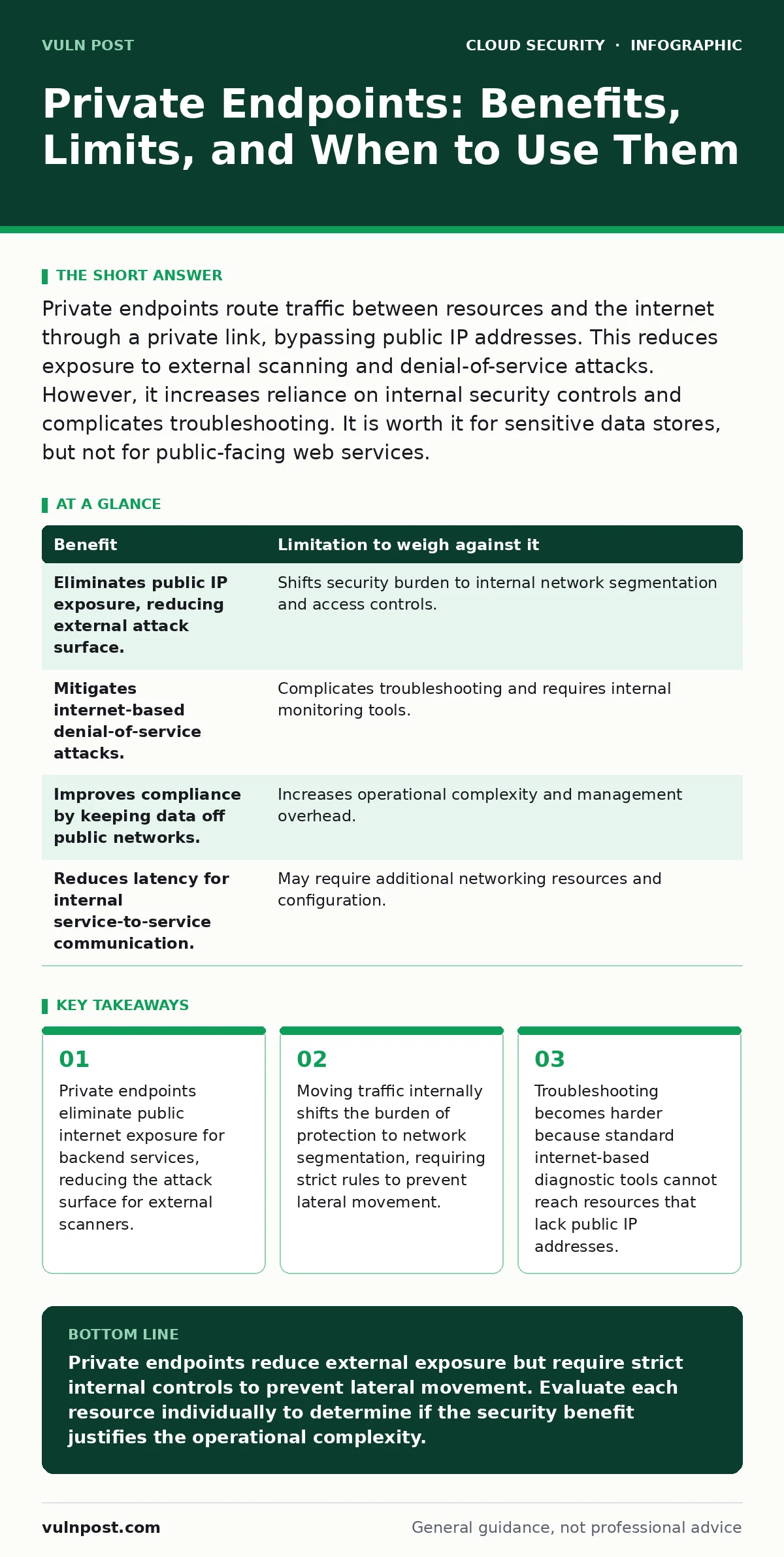
Private endpoints route traffic between resources and the internet through a private link, bypassing public IP addresses. This reduces exposure to external scanning and denial-of-service attacks. However, it increases reliance on internal security controls and complicates troubleshooting. It is worth it for sensitive data stores, but not for public-facing web services.
The Architecture of Isolation
Private endpoints allow you to connect to cloud services without exposing them to the public internet. Instead of assigning a public IP address to a resource like a database or storage account, the cloud provider creates a private interface within your virtual network. Traffic flows through a private link, keeping data within the provider’s backbone infrastructure.
This architecture fundamentally changes how you think about perimeter defense. The traditional model relies on firewalls to filter incoming traffic from the internet. With private endpoints, the resource is effectively removed from the internet entirely. Only resources within your authorized network can initiate connections.
This shift requires a different approach to cloud network segmentation. You must design your internal network zones to ensure that only specific workloads can reach the private endpoint. If an attacker compromises a web server in your DMZ, they should not be able to pivot to a database in your private zone.
Concrete Benefits of Private Connectivity
The primary benefit is the reduction of the attack surface. By removing public IP addresses, you eliminate the possibility of direct attacks from the internet. Port scanners, brute-force bots, and automated vulnerability scanners cannot find the resource because it has no public presence.
This also mitigates certain types of denial-of-service attacks. Since the traffic never traverses the public internet, attackers cannot flood the service with traffic from external sources. The cloud provider’s backbone handles the traffic, which is generally more resilient and monitored than public-facing endpoints.
Another benefit is improved compliance posture. Many regulatory frameworks require that sensitive data does not traverse public networks. Private endpoints provide a clear audit trail showing that data remains within a controlled environment. This simplifies compliance reporting and reduces the need for complex data masking strategies.
Finally, private endpoints can reduce latency. Traffic stays within the provider’s internal network, avoiding the variable delays of the public internet. This is particularly noticeable for applications that require frequent, low-latency communication between services.
Honest Limitations and Hidden Costs
The most significant limitation is the shift in security responsibility. While you are protected from external attacks, you are now fully responsible for internal threats. If an internal resource is compromised, it can potentially access the private endpoint. This makes cloud data exfiltration a more immediate risk if internal controls are weak.
Troubleshooting becomes more complex. Traditional diagnostic tools like ping or traceroute may not work as expected because the traffic path is internal. You need specialized monitoring tools that can inspect traffic within the virtual network. This adds operational overhead and requires deeper expertise from your security team.
Another limitation is the potential for configuration drift. As your environment grows, managing the rules that govern access to private endpoints becomes difficult. Without automated policies, it is easy to accidentally grant overly permissive access. This is where policy as code becomes necessary to ensure that access rules are consistently applied and audited.
The Trade-Off Matrix
To decide whether to use private endpoints, you must weigh the benefits against the limitations. The table below summarizes the key factors to consider.
| Benefit | Limitation to weigh against it |
|---|---|
| Eliminates public IP exposure, reducing external attack surface. | Shifts security burden to internal network segmentation and access controls. |
| Mitigates internet-based denial-of-service attacks. | Complicates troubleshooting and requires internal monitoring tools. |
| Improves compliance by keeping data off public networks. | Increases operational complexity and management overhead. |
| Reduces latency for internal service-to-service communication. | May require additional networking resources and configuration. |
When It Is Worth It
Private endpoints are worth the investment for resources that hold sensitive data. Databases, storage accounts containing personal information, and internal APIs are prime candidates. For these resources, the risk of external exposure outweighs the operational cost of managing private connectivity.
They are also valuable for applications that require strict compliance. If your industry mandates that data never leaves a controlled environment, private endpoints provide the necessary isolation. This is common in healthcare, finance, and government sectors.
Finally, consider private endpoints for high-value internal services. If a service is critical to your business operations and is only accessed by other internal resources, moving it to a private endpoint reduces the risk of disruption from external attacks. This is especially true for services that are targeted by automated scanners.
See also: What Is Cloud Workload Protection: Defining the Scope · Implement Cloud Landing Zones: A Step-by-Step Framework
When It Is Not Worth It
Private endpoints are not suitable for public-facing services. Web applications, APIs that are accessed by external customers, and content delivery networks require public IP addresses. Using private endpoints for these services would break functionality and confuse users.
They are also not necessary for low-risk resources. If a resource contains only public data or is not a target for attackers, the cost of managing private connectivity may not be justified. Simple logging services or public documentation sites can often remain on public endpoints without significant risk.
Additionally, consider the complexity of your environment. If you lack the expertise to manage internal network segmentation, private endpoints may introduce more risk than they mitigate. In such cases, it is better to focus on strengthening your external defenses rather than moving resources internally.
Integrating with Broader Security Strategies
Private endpoints are just one piece of your cloud security strategy. They work best when combined with other controls. For instance, you can use just-in-time access to limit who can connect to private endpoints. This ensures that only authorized personnel can access sensitive resources, and only when necessary.
You should also integrate private endpoints with your cloud landing zones. These are foundational architectures that define how your cloud environment is structured. By including private endpoints in your landing zone design, you ensure that they are consistently applied across all resources.
Finally, consider the risk of container escape. If you run containers that access private endpoints, you must ensure that the containers are properly isolated. A compromised container could potentially access the private network and move laterally to other resources.
Key takeaways
- Private endpoints eliminate public internet exposure for backend services, reducing the attack surface for external scanners.
- Moving traffic internally shifts the burden of protection to network segmentation, requiring strict rules to prevent lateral movement.
- Troubleshooting becomes harder because standard internet-based diagnostic tools cannot reach resources that lack public IP addresses.
Private endpoints reduce external exposure but require strict internal controls to prevent lateral movement. Evaluate each resource individually to determine if the security benefit justifies the operational complexity.
Frequently asked questions
Do private endpoints replace the need for firewalls?
No, private endpoints restrict network access but do not replace firewalls. You still need firewalls to filter traffic within your virtual network and enforce security policies.
Can I use private endpoints for all cloud services?
Not all cloud services support private endpoints. Check the documentation for each service to see if private connectivity is available.
How do I troubleshoot connectivity issues with private endpoints?
Use internal monitoring tools and logs provided by the cloud provider. Standard internet-based tools may not work because the traffic is internal.
Are private endpoints secure against insider threats?
Private endpoints help limit external access but do not protect against insider threats. You must still enforce strong authentication and monitor for suspicious activity within your network.
How this guide was produced: written by the Vuln Post editorial team with AI assistance, checked against the public references listed below, and reviewed when the facts change. See our editorial policy or report an error.