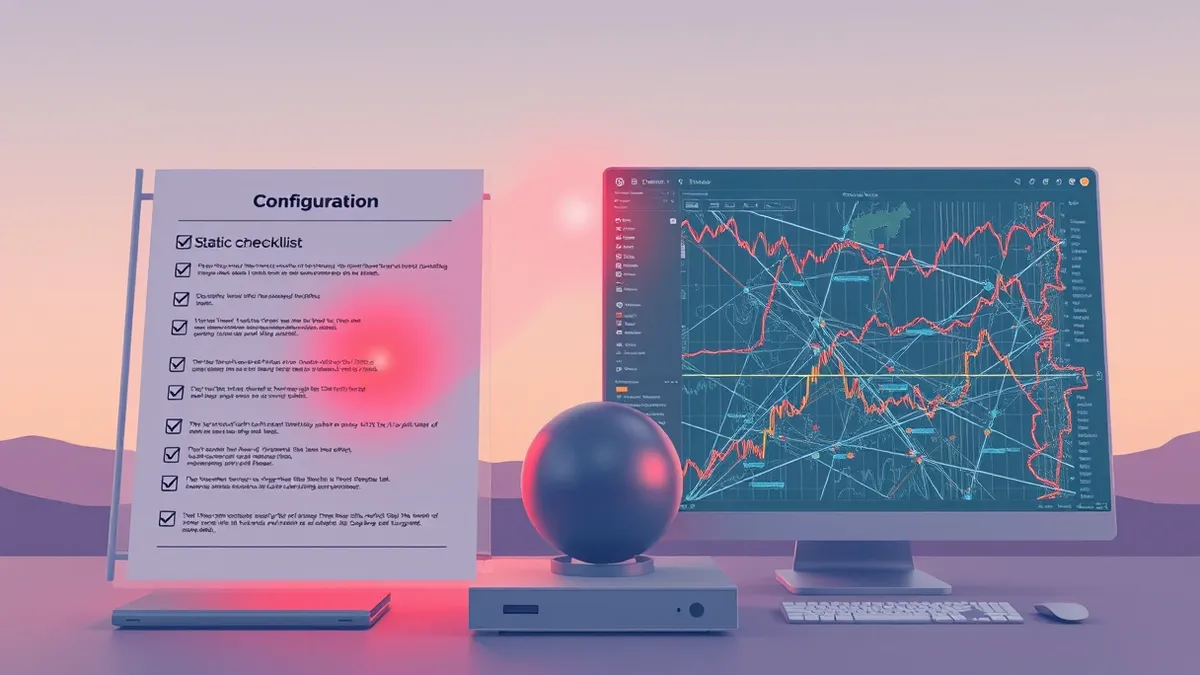
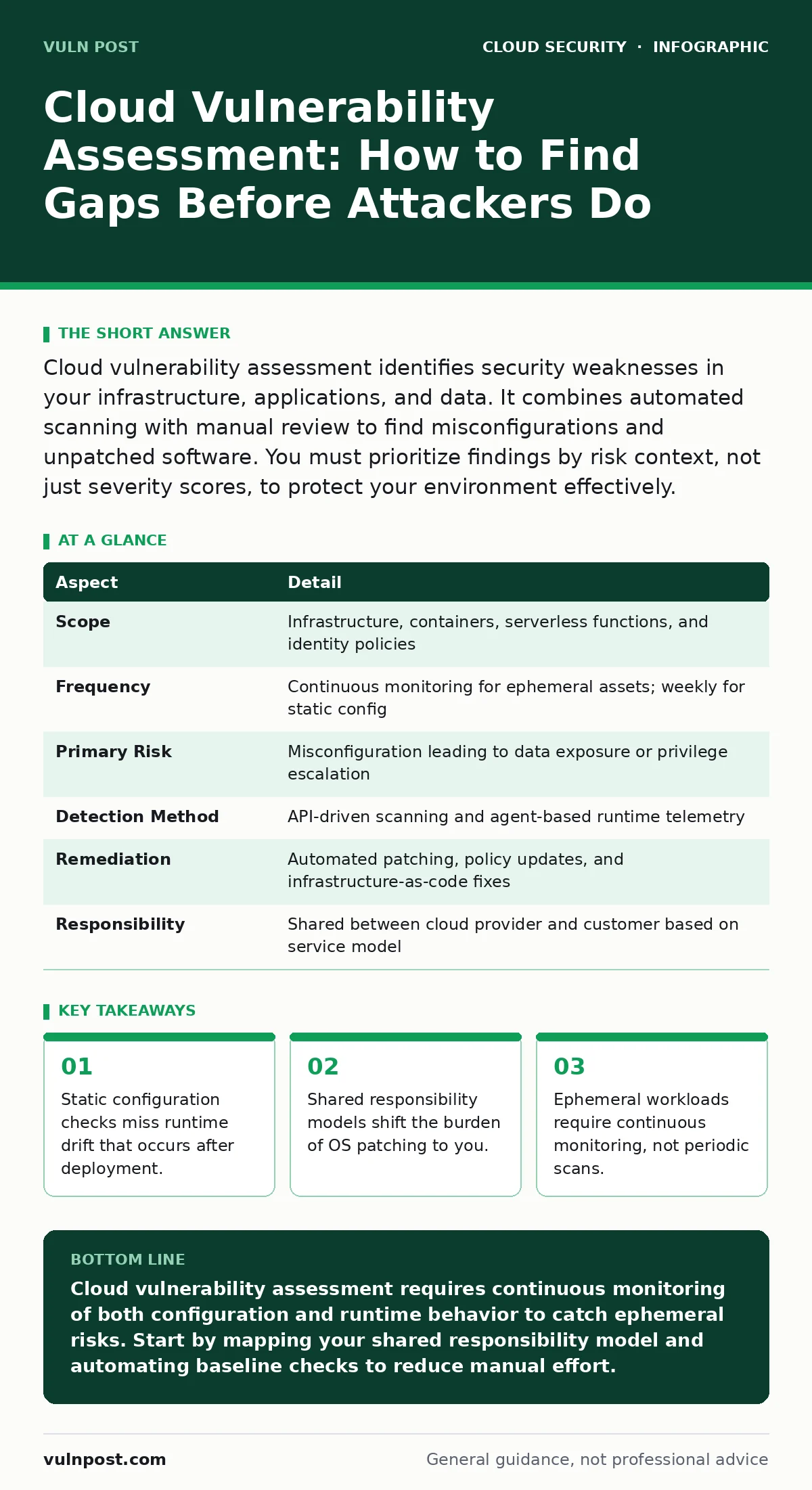
Cloud vulnerability assessment identifies security weaknesses in your infrastructure, applications, and data. It combines automated scanning with manual review to find misconfigurations and unpatched software. You must prioritize findings by risk context, not just severity scores, to protect your environment effectively.
What is Cloud Vulnerability Assessment?
Cloud vulnerability assessment is the systematic process of identifying, quantifying, and prioritizing security weaknesses within a cloud environment. It differs from traditional on-premises scanning because the infrastructure is dynamic, shared, and often ephemeral. You are not just checking servers; you are evaluating network policies, identity permissions, and storage configurations. The goal is to find gaps before attackers exploit them.
This process affects every layer of your stack. It includes the underlying infrastructure provided by the cloud provider, the operating systems you manage, and the applications you deploy. A single misconfiguration in a storage bucket can expose terabytes of data. A weak identity policy can grant an attacker administrative control. You must assess all these layers to maintain security.
| Aspect | Detail |
|---|---|
| Scope | Infrastructure, containers, serverless functions, and identity policies |
| Frequency | Continuous monitoring for ephemeral assets; weekly for static config |
| Primary Risk | Misconfiguration leading to data exposure or privilege escalation |
| Detection Method | API-driven scanning and agent-based runtime telemetry |
| Remediation | Automated patching, policy updates, and infrastructure-as-code fixes |
| Responsibility | Shared between cloud provider and customer based on service model |
How Cloud Vulnerability Assessment Works
The assessment begins with discovery. You must identify every asset in your cloud environment. This includes running instances, stopped instances, storage containers, and database clusters. Manual inventory is impossible at scale. You rely on cloud provider APIs to list resources and tag them for context. Without accurate inventory, you cannot assess what you do not know exists.
Next comes the scanning phase. Tools query the cloud APIs to check configuration against known secure baselines. They look for public storage buckets, open security groups, and missing encryption. They also scan running workloads for known software vulnerabilities. This step reveals static risks. It tells you what the system looks like at a specific point in time. It does not tell you how the system behaves under attack.
The third phase is validation and prioritization. Not all findings are equal. A vulnerability in an internet-facing web server is more urgent than one in an isolated development database. You must correlate technical severity with business context. This requires understanding data sensitivity and network connectivity. Prioritization ensures you fix the most dangerous issues first.
Who Is Affected by Cloud Vulnerabilities?
The shared responsibility model defines who fixes what. The cloud provider secures the underlying infrastructure. This includes the physical data centers, the hypervisor, and the core network. You secure everything you put on top of that foundation. This includes operating systems, applications, data, and identity management. Confusion here leads to gaps. Many teams assume the provider handles OS patches. They do not.
Application developers are heavily affected. They write code that runs in the cloud. Insecure code introduces logic flaws and injection vulnerabilities. They must integrate security checks into their build pipelines. If they ignore these checks, they introduce risk at the source. Security teams are affected by the volume of alerts. They must triage findings from thousands of resources. Without automation, they drown in noise.
Operations teams manage the runtime environment. They handle patching and configuration updates. They must ensure that changes do not break availability. They also manage identity policies. Overly permissive policies allow lateral movement. Restrictive policies block legitimate operations. Finding the balance requires constant adjustment and assessment.
Common Mistakes in Cloud Vulnerability Assessment
Many teams treat cloud assessment like on-premises scanning. They run a tool once a week and ignore the results until the next scan. This fails in cloud environments. Resources spin up and down constantly. A server that was clean yesterday may be misconfigured today. You need continuous monitoring to catch this drift. Periodic snapshots provide a false sense of security.
Another mistake is focusing only on software vulnerabilities. Teams scan for CVEs (Common Vulnerabilities and Exposures) in operating systems and libraries. They ignore configuration errors. A misconfigured database is often easier to exploit than a patched server. You must assess both software flaws and configuration weaknesses. Ignoring one half of the risk profile leaves you exposed.
Teams also fail to assess identity and access management. They check ports and protocols but ignore permissions. An attacker can often achieve full access through stolen credentials or overly broad roles. Identity is the new perimeter. Your assessment must include privilege analysis and token validation. Without this, you miss the most common attack path.
Prioritizing Findings for Remediation
You cannot fix everything at once. Resources are limited. You must prioritize based on risk. Start with internet-facing assets. These are the most exposed to attackers. Then move to assets holding sensitive data. Financial records and personal information require strict protection. Finally, address internal systems. These are lower risk but can be pivoted to.
Use context to refine priority. A high-severity vulnerability in an unused development environment is less urgent than a low-severity issue in production. You must map technical findings to business impact. This requires collaboration between security and operations. They must agree on what matters most. Documentation helps standardize this process.
Automate remediation where possible. Many configuration errors can be fixed with scripts. You can use infrastructure as code to enforce standards. This prevents drift from occurring in the first place. For complex issues, manual review is necessary. You must balance speed with accuracy. Rushed fixes can introduce new vulnerabilities.
See also: Implement Cloud Landing Zones: A Step-by-Step Framework · Private Endpoints: Benefits, Limits, and When to Use Them
Integrating Assessment into Development Pipelines
Shift security left by integrating checks into the development pipeline. Developers should see vulnerabilities before code reaches production. Static analysis tools check source code for flaws. Dynamic analysis tests running applications for runtime issues. Both are necessary. They catch different types of problems.
Container images need special attention. Scan base images for known vulnerabilities. Ensure that containers run with minimal privileges. Avoid running as root. Use read-only file systems where possible. These practices reduce the attack surface. They also limit the impact of a compromise.
Serverless functions require a different approach. You do not manage the underlying server. You manage the function code and its triggers. Check for excessive permissions in the function role. Validate input data to prevent injection attacks. Monitor execution logs for anomalies. These steps secure serverless workloads.
Handling Ephemeral and Containerized Workloads
Containers and serverless functions are ephemeral. They start and stop frequently. Traditional scanning cannot keep up. You need runtime protection. Agents installed in containers monitor system calls and network traffic. They detect suspicious behavior in real time. This complements static scanning.
Container escapes are a serious risk. An attacker might break out of the container to access the host. You must harden the host OS. Limit kernel capabilities. Use seccomp profiles to restrict system calls. These measures reduce the chance of escape. They also limit the damage if an escape occurs.
Exposed Docker APIs are a common mistake. Leaving the API open allows remote control of the container engine. You must restrict access to trusted IPs. Use TLS for encryption. Disable the API in production if not needed. These steps prevent unauthorized control.
Next Steps for Your Assessment Program
Start with an inventory. Know what you have. Then establish a baseline of secure configurations. Use policy as code to enforce these standards. Automate the detection of drift. Integrate findings into your ticketing system. Assign ownership for remediation. Track progress over time.
Continuous improvement is key. Threats evolve. Cloud services change. Your assessment program must adapt. Regularly review your controls. Update your baselines. Train your teams. Security is not a one-time project. It is an ongoing process. Commit to it fully.
Key takeaways
- Static configuration checks miss runtime drift that occurs after deployment.
- Shared responsibility models shift the burden of OS patching to you.
- Ephemeral workloads require continuous monitoring, not periodic scans.
Cloud vulnerability assessment requires continuous monitoring of both configuration and runtime behavior to catch ephemeral risks. Start by mapping your shared responsibility model and automating baseline checks to reduce manual effort.
Frequently asked questions
How often should I run a cloud vulnerability assessment?
Run configuration checks continuously via APIs. Perform deep software scans weekly or on every deployment. Ephemeral workloads need real-time runtime monitoring to catch short-lived exposures.
Does the cloud provider handle patching for my servers?
No. In IaaS, PaaS and SaaS security models, the provider secures the platform, but you secure the OS and applications. You are responsible for patching your operating systems and application dependencies.
What is the difference between scanning and assessment?
Scanning is the automated collection of data about vulnerabilities. Assessment is the broader process that includes scanning, validation, risk prioritization, and remediation planning. Scanning is a tool; assessment is a program.
How do I handle false positives in cloud scanning?
Validate findings manually. Check if the vulnerability is exploitable in your specific context. Exclude known-safe configurations from future reports. Use tagging to mark assets that do not require certain checks.
How this guide was produced: written by the Vuln Post editorial team with AI assistance, checked against the public references listed below, and reviewed when the facts change. See our editorial policy or report an error.