
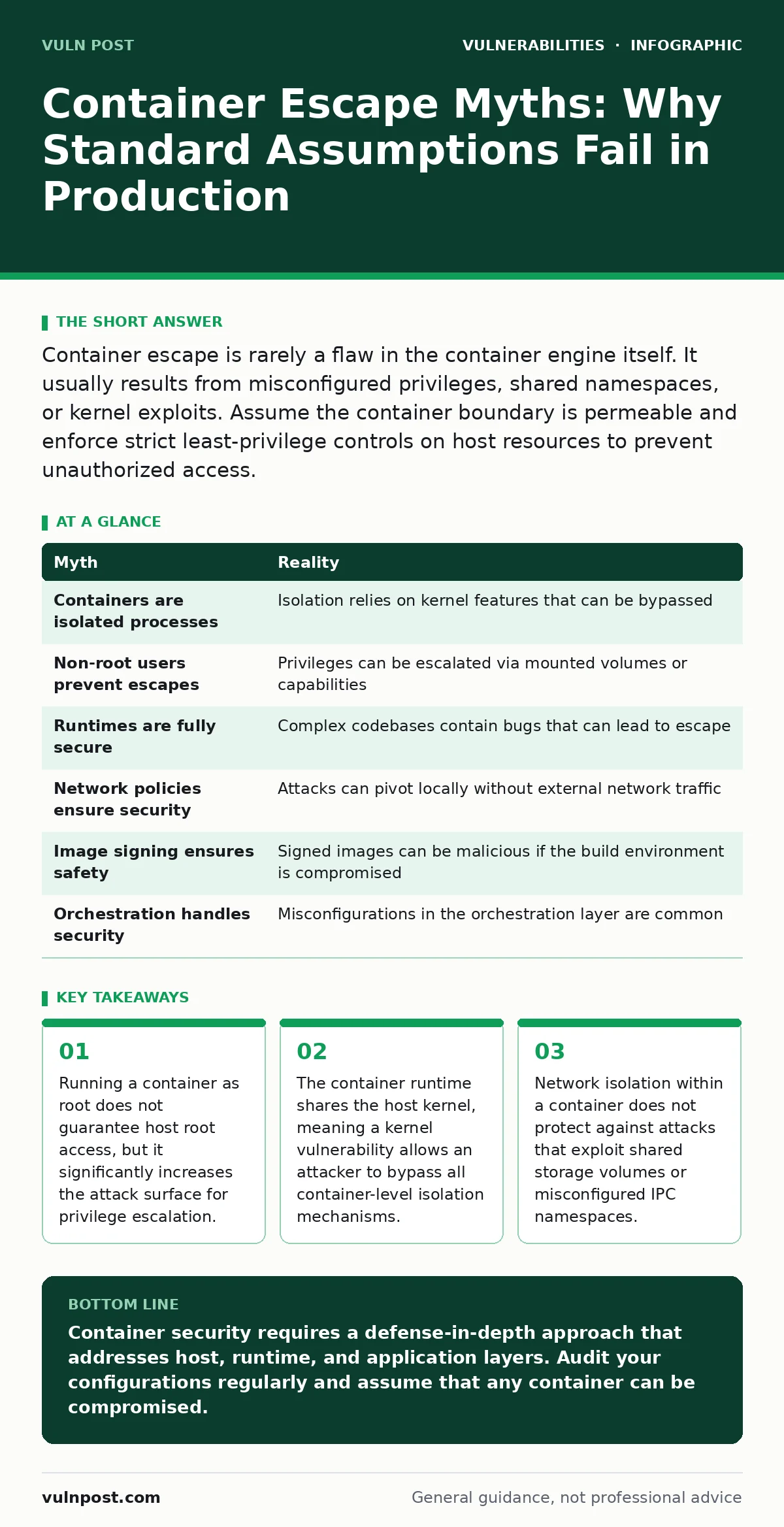
Container escape is rarely a flaw in the container engine itself. It usually results from misconfigured privileges, shared namespaces, or kernel exploits. Assume the container boundary is permeable and enforce strict least-privilege controls on host resources to prevent unauthorized access.
Myth: Containers Are Secure Because They Are Isolated Processes
Reality: Container isolation relies on Linux kernel features like namespaces and cgroups, which are not absolute barriers. Namespaces hide system resources from one another, while cgroups limit resource usage. These mechanisms prevent accidental interference but do not stop a determined attacker with sufficient privileges. If the underlying kernel is compromised, all containers on that host are compromised. This shared dependency means that isolation is a policy enforcement layer, not a hardware-level security boundary.
Imagine a developer assumes that because their application runs in a dedicated container, it cannot interact with other services. This assumption fails when the kernel itself contains a vulnerability. An attacker exploiting a kernel flaw can traverse namespace boundaries and access host memory. This scenario highlights why relying solely on container boundaries for security is insufficient. You must treat the host kernel as the primary trust anchor.
Myth: Running As Non-Root Prevents All Escapes
Reality: Running a process as a non-root user reduces the immediate impact of a breach but does not eliminate the risk of container escape. Many applications require specific capabilities or access to host devices to function correctly. Granting these permissions often reintroduces privilege escalation vectors. For example, an application might need access to a specific character device or a mounted volume with sensitive permissions. If an attacker gains code execution inside the container, they can exploit these granted permissions to elevate their privileges.
Suppose you configure a web server to run as user ID 1000 to avoid root privileges. The application still mounts a host directory for logging. If the logging mechanism has a vulnerability, similar to those found in logging library vulnerabilities, the attacker can write arbitrary data to the host filesystem. This action bypasses the non-root restriction because the file permissions on the host allow the operation. You must audit every host mount and capability granted to the container.
Myth: The Container Runtime Is Fully Audited and Secure
Reality: Container runtimes are complex software stacks that interpret container specifications and interact with the kernel. They contain thousands of lines of code handling image layers, network interfaces, and filesystem mounts. Bugs in these components can lead to privilege escalation or container escape. While major runtimes undergo extensive testing, they are not immune to logical errors or implementation flaws. An attacker might exploit a race condition in how the runtime handles volume mounts or network bridges.
Consider a scenario where the runtime incorrectly validates a container image manifest. An attacker could craft a malicious image that triggers unexpected behavior during the startup sequence. This behavior might allow the container to bypass security profiles or access restricted host paths. This risk is distinct from application-level vulnerabilities like cross-site scripting (XSS). It targets the infrastructure layer that manages the container lifecycle. You must keep the runtime updated and monitor for known issues.
Myth: Network Policies Replace the Need for Host Security
Reality: Network policies control traffic flow between containers but do not protect against attacks that originate from within a compromised container. An attacker who escapes a container does not need network access to the external internet to cause damage. They can pivot laterally within the host, access other containers sharing the same network namespace, or exfiltrate data through local storage. Network segmentation is a defense-in-depth measure, not a substitute for host hardening.
Imagine an attacker breaches a database container. They do not need to send data out over the network to steal credentials. Instead, they can read environment variables or access mounted configuration files that contain secrets for other services. This lateral movement is possible because the attacker has elevated privileges on the host. Network policies cannot stop this because the traffic never leaves the host machine. You must protect secrets and sensitive files at the filesystem level.
Myth: Image Signing Guarantees Image Integrity at Runtime
Reality: Image signing verifies that an image has not been tampered with since it was signed. It does not verify that the image is safe or free from vulnerabilities. An attacker can sign a malicious image if they compromise the build environment or steal signing keys. Furthermore, signing does not prevent runtime modifications. If an attacker gains access to a running container, they can modify the filesystem or inject code without changing the original image hash. The signature only proves the origin, not the safety.
Suppose you enforce strict image signing policies in your registry. An attacker who compromises a developer workstation can build a malicious image and sign it with the developer’s credentials. The registry accepts the image because the signature is valid. When deployed, the malicious payload executes with the privileges granted to the container. This is similar to authentication bypass vulnerabilities where valid credentials are used for unauthorized actions. You must secure the build pipeline and monitor runtime behavior.
Myth: Resource Limits Prevent Denial of Service Attacks
Reality: Resource limits restrict CPU and memory usage but do not prevent all forms of denial of service. An attacker can still exhaust other host resources, such as file descriptors, network connections, or inode counts. Additionally, poorly configured limits can lead to noisy neighbor problems where one container’s behavior impacts others. Limits are a mitigation strategy, not a complete solution. They reduce the blast radius but do not eliminate the ability of an attacker to disrupt service.
Imagine a container configured with a strict CPU limit. The container remains within its limits, but the host experiences performance degradation due to context switching overhead. Other containers on the host may slow down as a result. This demonstrates that resource limits manage consumption but do not prevent malicious activity. You must monitor for anomalous behavior patterns that indicate abuse.
Myth: Container Orchestration Handles All Security Concerns
Reality: Orchestration platforms automate deployment and scaling but delegate security to the underlying infrastructure and user configurations. They provide tools for managing secrets, network policies, and access control, but these tools must be configured correctly. Misconfigurations in the orchestration layer are a leading cause of container escapes. An attacker can exploit misconfigured RBAC policies to gain administrative access to the cluster. This access allows them to modify pod specifications and inject malicious containers.
Suppose you deploy a microservices architecture using a popular orchestration platform. An attacker exploits a vulnerability in a service, similar to broken access control, to gain unauthorized API access. They use this access to create a new pod with elevated privileges. This pod can then access the host filesystem or other sensitive services. The orchestration platform did not fail; the configuration did. You must enforce strict least-privilege principles in your orchestration policies.
| Myth | Reality |
|---|---|
| Containers are isolated processes | Isolation relies on kernel features that can be bypassed |
| Non-root users prevent escapes | Privileges can be escalated via mounted volumes or capabilities |
| Runtimes are fully secure | Complex codebases contain bugs that can lead to escape |
| Network policies ensure security | Attacks can pivot locally without external network traffic |
| Image signing ensures safety | Signed images can be malicious if the build environment is compromised |
| Orchestration handles security | Misconfigurations in the orchestration layer are common |
Key takeaways
- Running a container as root does not guarantee host root access, but it significantly increases the attack surface for privilege escalation.
- The container runtime shares the host kernel, meaning a kernel vulnerability allows an attacker to bypass all container-level isolation mechanisms.
- Network isolation within a container does not protect against attacks that exploit shared storage volumes or misconfigured IPC namespaces.
Container security requires a defense-in-depth approach that addresses host, runtime, and application layers. Audit your configurations regularly and assume that any container can be compromised.
Frequently asked questions
How do I detect a container escape attempt?
Monitor for unexpected process execution, unusual file access patterns, and network connections from containers to host-only interfaces. Use runtime security tools that analyze system calls.
Can I prevent container escapes entirely?
No, you can only reduce the risk. Implement strict least-privilege policies, keep kernels updated, and use read-only filesystems where possible to limit the impact of a breach.
What is the role of seccomp profiles in container security?
Seccomp profiles restrict the system calls a container can make. This limits the ability of an attacker to interact with the kernel, reducing the likelihood of a successful escape.
How does this relate to other web vulnerabilities?
Container escapes are infrastructure-level issues, whereas vulnerabilities like **XML external entity (XXE) attacks** are application-level. However, a successful application attack can lead to a container breach if the application is misconfigured.
How this guide was produced: written by the Vuln Post editorial team with AI assistance, checked against the public references listed below, and reviewed when the facts change. See our editorial policy or report an error.