Logging libraries introduce security risks because they often process untrusted data during formatting. You must sanitize inputs before logging, disable remote logging in production, and treat log files as sensitive data. Failing to validate log entries can lead to injection attacks, data leakage, and system compromise through format string exploits or server-side request forgery.
Why do logging libraries introduce security risks?
Logging libraries introduce security risks because they process data without the same rigor as user input validation. Developers often assume that log statements are passive observers of system state. This assumption fails when the library interprets special characters or executes code during formatting. The logging component becomes a secondary execution engine. If an attacker controls any variable passed to a log function, they control the output behavior. This bypasses standard input sanitization layers that protect the primary application logic.
What is log injection and how does it work?
Log injection occurs when an attacker inserts malicious content into log messages to manipulate log viewing tools. Imagine a web application that logs HTTP headers. An attacker sends a request with a header containing a script tag. When an administrator views the logs in a browser-based dashboard, the script executes in their context. This allows the attacker to steal session cookies or perform actions on behalf of the admin. The vulnerability lies in the trust placed in log data by the viewing interface, not necessarily in the logger itself. Proper encoding of log outputs prevents this cross-site scripting vector.
How do format string vulnerabilities exploit logging?
Format string vulnerabilities exploit logging by using format specifiers to read or write arbitrary memory addresses. Suppose a developer uses a function like printf(user_input) instead of printf("%s", user_input). The attacker supplies a string like %x%x%x%x. The logging function interprets these as commands to print memory values. This leaks sensitive data such as stack addresses or authentication tokens. In severe cases, using %n allows the attacker to write to memory, potentially achieving remote code execution. This is a classic implementation error that remains prevalent in legacy systems and poorly maintained open-source libraries.
Can logging cause denial of service attacks?
Logging can cause denial of service attacks through resource exhaustion and disk filling. Attackers can generate high-volume log entries by triggering repetitive error conditions. The application spends significant CPU cycles formatting and writing these entries. This degrades performance for legitimate users.
If the logging library does not support rate limiting or back-pressure mechanisms, the disk fills rapidly. A full disk prevents the application from writing temporary files or databases, causing a total system crash. This indirect attack vector is often overlooked because the logging component appears benign. Refer to secure configuration baselines for proper disk monitoring thresholds.
What data leakage risks do logs pose?
Logs pose data leakage risks by inadvertently capturing sensitive information such as passwords, tokens, or personal identifiers. Developers often log entire request objects for debugging purposes. These objects may contain authentication credentials or credit card numbers. Once written to disk, this data persists until manual deletion or automated rotation. If log files are backed up to cloud storage or sent to third-party monitoring services, the exposure scope widens significantly. This violates data minimization principles. Even if the application is secure, the logs become a high-value target for attackers seeking credential stuffing material or identity theft data.
How do asynchronous logging libraries affect security?
Asynchronous logging libraries affect security by decoupling the logging action from the application thread, introducing race conditions and data loss. When an application crashes, asynchronous log queues may be discarded, hiding the root cause of the failure. More critically, asynchronous processing can reorder log entries, making forensic analysis difficult. Attackers can exploit this timing gap to hide their actions. If the logging thread is blocked or starved of resources, critical security events may never be recorded. This reduces the visibility needed for incident response. Synchronous logging ensures immediate persistence but impacts application performance.
What is the risk of remote logging protocols?
Remote logging protocols introduce risk by transmitting potentially sensitive data over networks, often in plaintext. Imagine an application sending logs to a central server via UDP. UDP provides no guarantee of delivery or integrity. An attacker on the network can intercept or modify these packets. If the logging protocol does not support encryption, sensitive data is exposed to eavesdropping. Even with TCP, the lack of authentication allows attackers to inject fake log entries from external sources. This compromises the integrity of the central log repository. Secure transport mechanisms and mutual authentication are required to protect remote logging channels.
How do you mitigate logging library vulnerabilities?
You mitigate logging library vulnerabilities by treating log data as untrusted input and enforcing strict output encoding. Sanitize all variables before passing them to logging functions. Use parameterized logging where the library handles the formatting safely. Implement log rotation and retention policies to limit data exposure. Monitor log volumes to detect abuse. Encrypt logs at rest and in transit. Regularly audit logging code for format string errors and sensitive data inclusion. These measures reduce the attack surface without sacrificing observability. See threat modeling for applications for a structured approach to identifying these risks early.
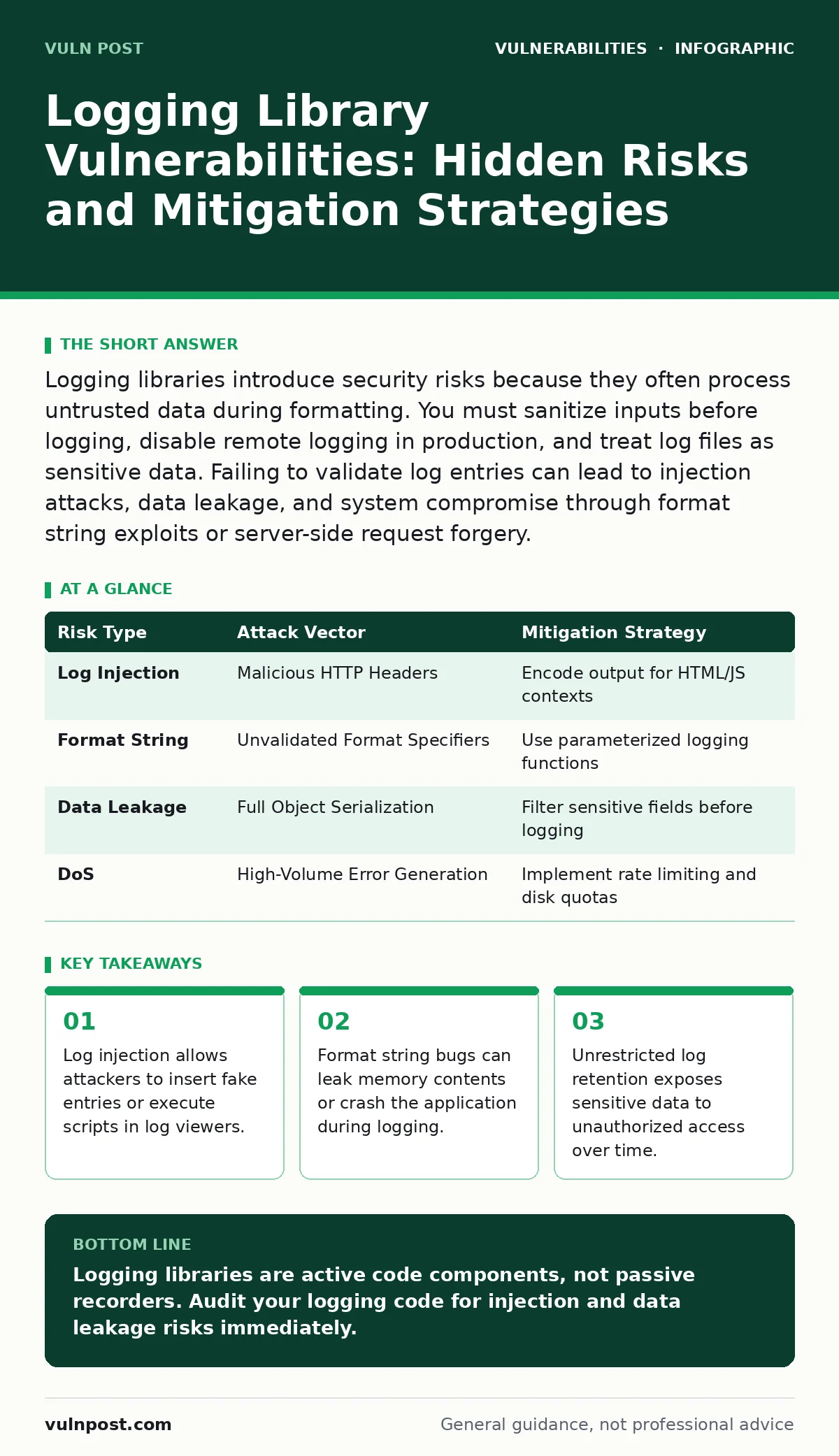
| Risk Type | Attack Vector | Mitigation Strategy |
|---|---|---|
| Log Injection | Malicious HTTP Headers | Encode output for HTML/JS contexts |
| Format String | Unvalidated Format Specifiers | Use parameterized logging functions |
| Data Leakage | Full Object Serialization | Filter sensitive fields before logging |
| DoS | High-Volume Error Generation | Implement rate limiting and disk quotas |
What are the edge cases in logging security?
The edge cases in logging security involve third-party libraries and dynamic code generation. Many applications use logging libraries that depend on other modules for formatting or transport. A vulnerability in a transitive dependency can compromise the entire logging pipeline. Dynamic code generation, such as evaluating log templates, can execute arbitrary code if the template language is not sandboxed.
This turns a configuration file into an execution vector. Additionally, some logging libraries allow plugin architectures. Plugins with excessive permissions can bypass security controls. You must audit the entire dependency chain, not just the primary logging library. This aligns with the principles found in CVE identifiers for tracking complex supply chain issues.
How do logging vulnerabilities differ from other web risks?
Logging vulnerabilities differ from other web risks because they often bypass standard input validation and authentication controls. Unlike authentication bypass vulnerabilities, which target access gates, logging bugs target the observation layer. Attackers do not need to log in to exploit a log injection vulnerability if the logging occurs before authentication.
They do not need to break encryption if the logs store decrypted data. This makes logging a unique attack surface that operates parallel to the main security perimeter. Understanding this distinction helps prioritize remediation efforts. While clickjacking affects user interface integrity, logging flaws compromise data integrity and system availability directly.
Key takeaways
- Log injection allows attackers to insert fake entries or execute scripts in log viewers.
- Format string bugs can leak memory contents or crash the application during logging.
- Unrestricted log retention exposes sensitive data to unauthorized access over time.
Logging libraries are active code components, not passive recorders. Audit your logging code for injection and data leakage risks immediately.
Frequently asked questions
How do I check if my logging library is vulnerable?
Review the library's documentation for safe formatting practices and check for known CVEs. Analyze your code for direct string concatenation in log calls.
Can encrypting logs prevent all logging attacks?
No, encryption protects data in transit and at rest but does not prevent log injection or format string exploits during the logging process.
Should I disable logging in production?
No, disable debug and trace levels. Keep error and security event logging enabled for incident response and compliance requirements.
How do JWT vulnerabilities relate to logging?
If you log JWT tokens, you expose session data. Attackers can steal these tokens from logs to impersonate users, similar to how they exploit JWT vulnerabilities in transmission.
How this guide was produced: written by the Vuln Post editorial team with AI assistance, checked against the public references listed below, and reviewed when the facts change. See our editorial policy or report an error.