
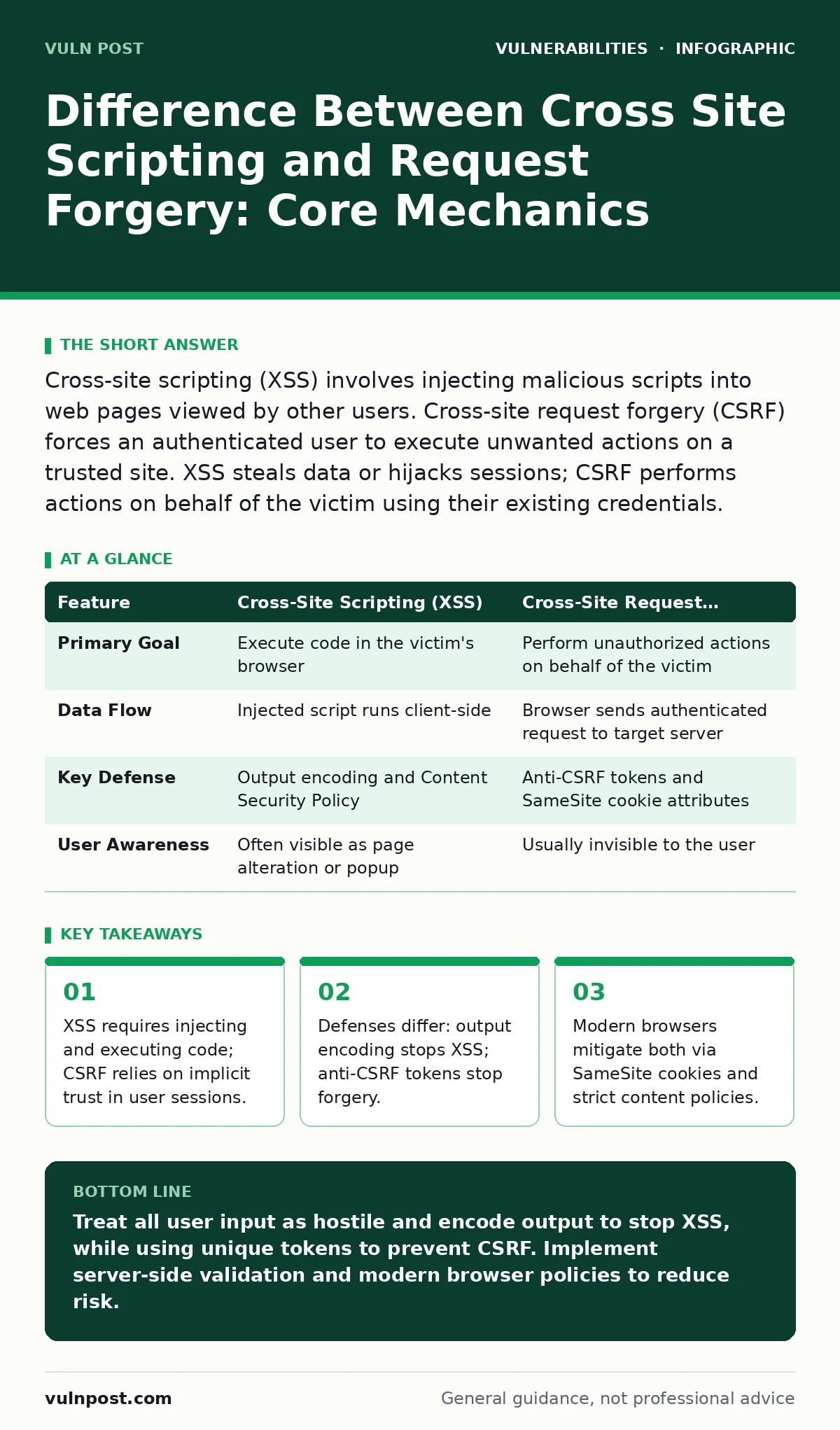
Cross-site scripting (XSS) involves injecting malicious scripts into web pages viewed by other users. Cross-site request forgery (CSRF) forces an authenticated user to execute unwanted actions on a trusted site. XSS steals data or hijacks sessions; CSRF performs actions on behalf of the victim using their existing credentials.
What is the difference between cross site scripting and request forgery?
The difference between cross site scripting and request forgery lies in the mechanism of exploitation and the attacker's goal. Cross-site scripting (XSS) is an injection flaw where an attacker inserts malicious client-side scripts into content viewed by other users. Cross-site request forgery (CSRF) is an attack that tricks the victim's browser into sending a malicious request to a site where the user is currently authenticated. XSS compromises the integrity of the data displayed; CSRF compromises the integrity of the actions performed.
How does cross-site scripting actually work?
Cross-site scripting works by exploiting a web application's failure to validate or encode user input before rendering it. Imagine a comment section where the server stores exactly what you type. If you type a JavaScript snippet, the server saves it. When another user views that comment, their browser executes the script as if it were part of the legitimate site. This allows the attacker to read cookies, steal session tokens, or modify the page's appearance. The vulnerability exists because the server treats user data as executable code.
How does cross-site request forgery exploit trust?
Cross-site request forgery exploits the browser's automatic inclusion of credentials, such as cookies, with every request to a specific domain. Suppose you are logged into your bank. An attacker creates a webpage with an image tag that points to the bank's transfer endpoint. When you visit the attacker's page, your browser automatically attaches your bank session cookie to that request. The bank sees a valid session and processes the transfer. The victim performs the action unknowingly because the browser trusts the established session.
| Feature | Cross-Site Scripting (XSS) | Cross-Site Request Forgery (CSRF) |
|---|---|---|
| Primary Goal | Execute code in the victim's browser | Perform unauthorized actions on behalf of the victim |
| Data Flow | Injected script runs client-side | Browser sends authenticated request to target server |
| Key Defense | Output encoding and Content Security Policy | Anti-CSRF tokens and SameSite cookie attributes |
| User Awareness | Often visible as page alteration or popup | Usually invisible to the user |
Why do standard defenses fail against these attacks?
Standard defenses fail when developers assume input is safe or trust the browser completely. For XSS, using client-side validation is insufficient because attackers can bypass the browser and send crafted requests directly to the server. For CSRF, relying solely on checking the referrer header is risky because headers can be stripped or spoofed in certain network conditions. You must validate on the server side and verify the origin of every state-changing request. Understanding router vulnerabilities helps illustrate how trust assumptions can collapse at the network edge, similar to how application trust models fail here.
What specific controls stop cross-site scripting?
Output encoding is the primary control for stopping cross-site scripting. You must encode special characters like angle brackets and quotes before rendering any user-supplied data in HTML. This converts potentially executable code into plain text. Implementing a Content Security Policy (CSP) header adds a layer of defense by telling the browser which sources are allowed to execute scripts. Even if an injection occurs, a strict CSP prevents the browser from running unauthorized scripts. This approach mirrors the rigor needed in WordPress plugin update policies, where unvetted code can introduce similar injection risks.
See also: Session Fixation Warning Signs and Immediate Response Steps · Detect Data Scraping: Log Analysis and Behavioral Signals
How do you prevent cross-site request forgery?
You prevent cross-site request forgery by requiring a secret value, known as an anti-CSRF token, in every state-changing request. This token is unique to the user's session and is not known to external sites. When the user submits a form, the browser includes this token. The server verifies that the token matches the one stored in the session. If it does not, the request is rejected. Setting the SameSite attribute on cookies to "Strict" or "Lax" also helps, as it prevents the browser from sending cookies with cross-site requests. This is a form of configuration hardening that reduces the attack surface significantly.
Can an attacker combine these two vulnerabilities?
An attacker can combine these two vulnerabilities to create a more potent attack chain. First, the attacker uses cross-site scripting to execute a script in the victim's browser. This script then makes a request to a sensitive endpoint on the victim's behalf, effectively performing a cross-site request forgery. Because the script runs in the context of the victim's session, it can bypass many CSRF protections that rely on tokens embedded in forms. This combination allows the attacker to both read sensitive data and perform actions. Similar to how zero-day vulnerabilities can chain together for greater impact, mixing injection and trust flaws amplifies risk.
What role do modern browser features play?
Modern browser features play a significant role in mitigating both attack types. The SameSite cookie attribute restricts how cookies are sent with cross-site requests, reducing the effectiveness of CSRF. Content Security Policy headers restrict the sources from which scripts can be loaded, limiting the impact of XSS. However, these are mitigations, not complete fixes. You still need server-side validation and proper encoding. Relying solely on browser features is dangerous because older browsers may not support them, and configuration errors are common. This parallels the need to address VPN appliance vulnerabilities through multiple layers, not just a single device setting.
How do these relate to other injection flaws?
These vulnerabilities relate to other injection flaws through the common theme of trusting unvalidated input. XML external entity (XXE) attacks, for instance, exploit parsers that process external entities in XML data, leading to data leakage or server-side request forgery. Like XSS, XXE occurs because the server processes data in a way that allows it to influence the application's behavior.
Understanding CVE identifiers helps you track specific instances of these flaws in software libraries. Recognizing that side-channel attacks also exploit unintended information leaks reinforces the need for strict data handling. Configuration hardening across all layers is the consistent defense strategy.
Key takeaways
- XSS requires injecting and executing code; CSRF relies on implicit trust in user sessions.
- Defenses differ: output encoding stops XSS; anti-CSRF tokens stop forgery.
- Modern browsers mitigate both via SameSite cookies and strict content policies.
Treat all user input as hostile and encode output to stop XSS, while using unique tokens to prevent CSRF. Implement server-side validation and modern browser policies to reduce risk.
Frequently asked questions
Can SameSite cookies prevent all CSRF attacks?
SameSite cookies significantly reduce CSRF risk by blocking cross-site requests, but they do not prevent all attacks, especially if the attacker can host the malicious content on the same domain or if the browser does not support the attribute.
Is input validation enough to stop XSS?
Input validation is a helpful first step, but it is not enough. You must also encode output when rendering data in the browser. Attackers can often find ways to bypass input filters, making server-side output encoding the critical defense.
Do HTTPS certificates protect against XSS or CSRF?
HTTPS encrypts data in transit, preventing eavesdropping, but it does not protect against XSS or CSRF. These are application-layer attacks that occur after the secure connection is established. You still need application-level defenses like encoding and tokens.
Why is CSRF harder to detect than XSS?
CSRF is harder to detect because it often leaves no visible trace on the page. The user may not notice that a background request was sent. XSS often alters the page or shows popups, making it more obvious. Automated scanners are better at finding XSS injection points than CSRF logic flaws.
How this guide was produced: written by the Vuln Post editorial team with AI assistance, checked against the public references listed below, and reviewed when the facts change. See our editorial policy or report an error.