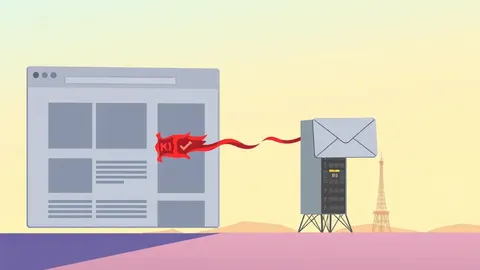
Developers leave XML parsers vulnerable by failing to disable external entity processing or by trusting unvalidated input. These mistakes allow attackers to read local files, trigger server-side requests, or cause denial of service. Fix each issue by explicitly disabling entity resolution in your parser configuration or by switching to a safer data format like JSON.
Mistake 1: Leaving Default Parser Settings Enabled
XML parsers are often configured to process external entities by default. This design choice dates back to early web standards where dynamic content inclusion was a primary feature. Modern applications rarely need this functionality, yet developers frequently accept default configurations without review. The parser treats any external reference as valid data to be fetched and included.
Why it hurts:
An attacker injects a reference to a local file or an internal network resource. The server retrieves this content and includes it in the response. This exposes sensitive configuration files, credentials, or internal network topology. The server acts as a proxy for the attacker, bypassing network firewalls that restrict direct external access to internal systems.
The fix:
Explicitly disable external entity processing in your XML parser configuration. Most modern libraries provide a specific flag or method to turn off entity resolution. Do not rely on the default behavior. Verify that the parser rejects any attempt to load external resources before processing the document structure.
Mistake 2: Validating Input After Parsing Begins
Many security teams implement input validation to check for malicious patterns. They often validate the raw XML string before passing it to the parser. This approach fails because the parser may begin resolving entities during the initial parsing phase, before the validation logic completes. The timing of the resolution matters more than the content check.
Why it hurts:
The parser fetches the external entity during the parsing stage. The validation logic runs afterward or in parallel. If the parser is slow or asynchronous, the file read or network request occurs before the validator can reject the payload. The damage is done before the application realizes the input was malicious.
The fix:
Validate the structure and content of the XML document only after the parser has successfully processed it with external entities disabled. Ensure the parser configuration prevents any network or file system access during the parsing phase. This ensures that no side effects occur before your application logic can evaluate the data.
Mistake 3: Using XML for Simple Data Exchange
Developers sometimes choose XML for simple key-value data exchange because it is human-readable and widely supported. This choice introduces unnecessary complexity and attack surface. XML has a rich feature set including namespaces, attributes, and entities. Simple data does not require these features, yet the parser must support them to be compliant.
Why it hurts:
The complexity of XML allows for sophisticated injection techniques that simple formats cannot support. Attackers exploit the entity resolution mechanism to perform server-side request forgery or file inclusion. Simple data formats like JSON do not support external entities, eliminating this vector entirely. The overhead of XML parsing also increases latency and resource consumption.
The fix:
Switch to JSON or other lightweight data formats for simple data exchange. JSON does not support external entities or complex document structures. This reduces the attack surface and simplifies parsing logic. If you must use XML, ensure the schema is strict and does not allow arbitrary element definitions or external references.
Mistake 4: Trusting Internal Network Resources
Some applications allow XML parsers to resolve entities from internal network locations. This is often intended to include shared configuration files or templates. Attackers exploit this trust to pivot from a web-facing application to internal systems. They use the application as a proxy to access resources that are not directly exposed to the internet.
Why it hurts:
The application server has network access to internal databases, file shares, or administrative interfaces. An attacker injects a reference to an internal resource. The server retrieves the content and returns it to the attacker. This bypasses network segmentation and firewall rules that protect internal resources from direct external access.
The fix:
Disable external entity processing entirely. If internal resource inclusion is required, implement a strict allowlist of permitted file paths or network addresses. Validate that the resolved entity matches an entry in the allowlist before including it. Never allow arbitrary URLs or file paths to be resolved by the parser.
Mistake 5: Ignoring Schema Validation
XML Schema Definition (XSD) or Document Type Definition (DTD) validation ensures that XML documents conform to a specific structure. Developers often skip schema validation to reduce processing time or complexity. This allows attackers to inject arbitrary elements and attributes that the application does not expect.
Why it hurts:
Without schema validation, the parser accepts any well-formed XML document. Attackers can inject malicious entities or complex structures that confuse the application logic. This can lead to unexpected behavior, data corruption, or further exploitation. Schema validation acts as a first line of defense against malformed or malicious input.
The fix:
Enforce strict schema validation for all incoming XML documents. Define a schema that explicitly forbids external entities and complex structures. Reject any document that does not conform to the schema. This ensures that only expected data structures are processed by the application.
See also: Unauthenticated RCE Mistakes: 7 Errors That Expose Your Systems
Mistake 6: Failing to Update Parsing Libraries
XML parsing libraries contain known vulnerabilities that allow bypassing security settings. Developers often use outdated versions of these libraries because they assume the default settings are secure. These vulnerabilities are often discovered years after the library is released.
Why it hurts:
An attacker exploits a known vulnerability in the parsing library to bypass external entity restrictions. This allows file read or server-side request forgery even if the configuration appears correct. Outdated libraries may also lack support for modern security features.
The fix:
Regularly update XML parsing libraries to the latest stable version. Monitor security advisories for your specific library. Apply patches promptly when vulnerabilities are disclosed. Consider using a dependency management tool to automate updates and track known vulnerabilities.
Mistake 7: Overlooking Response Data
Developers focus on validating input but often neglect to sanitize output. If an attacker successfully injects an external entity, the retrieved content may be reflected in the application response. This can leak sensitive data to the attacker or to other users who view the response.
Why it hurts:
The application returns the content of the injected entity in the response body. This exposes file contents, database queries, or internal error messages. Attackers can use this information to further exploit the application or to identify other vulnerabilities.
The fix:
Sanitize all output data before returning it to the user. Ensure that any content retrieved from external entities is not included in the response. Log and alert on any attempts to resolve external entities. Monitor response data for unexpected content or patterns.
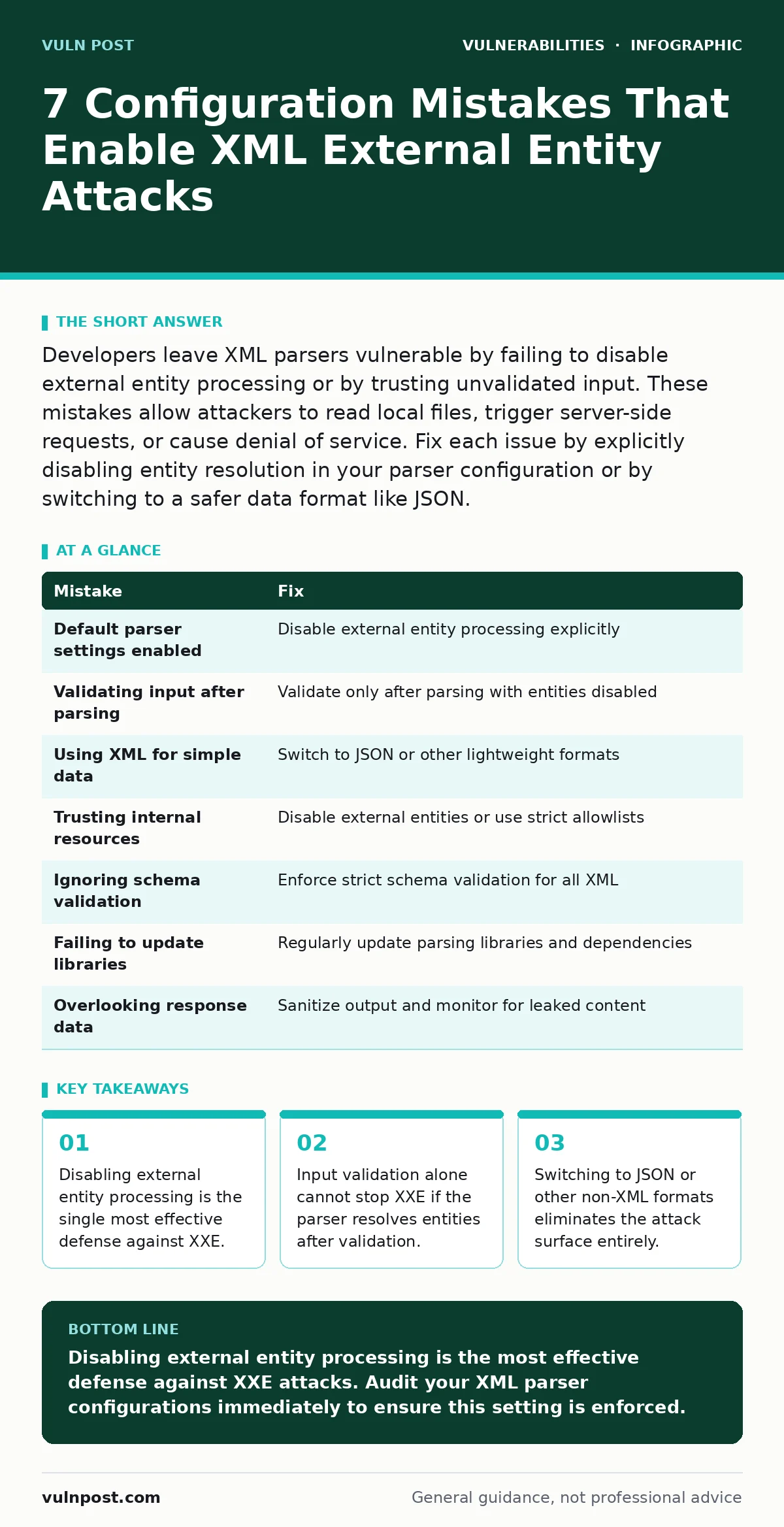
| Mistake | Fix |
|---|---|
| Default parser settings enabled | Disable external entity processing explicitly |
| Validating input after parsing | Validate only after parsing with entities disabled |
| Using XML for simple data | Switch to JSON or other lightweight formats |
| Trusting internal resources | Disable external entities or use strict allowlists |
| Ignoring schema validation | Enforce strict schema validation for all XML |
| Failing to update libraries | Regularly update parsing libraries and dependencies |
| Overlooking response data | Sanitize output and monitor for leaked content |
Key takeaways
- Disabling external entity processing is the single most effective defense against XXE.
- Input validation alone cannot stop XXE if the parser resolves entities after validation.
- Switching to JSON or other non-XML formats eliminates the attack surface entirely.
Disabling external entity processing is the most effective defense against XXE attacks. Audit your XML parser configurations immediately to ensure this setting is enforced.
Frequently asked questions
How do I know if my application is vulnerable to XXE?
Test your application with crafted XML payloads that attempt to resolve external entities. Check if the server responds with the content of the referenced resource. Use static analysis tools to identify insecure parser configurations.
Can XXE attacks lead to remote code execution?
In some cases, XXE can be chained with other vulnerabilities to achieve remote code execution. This often involves reading configuration files to find credentials or exploiting server-side request forgery to access internal services.
Is JSON completely safe from XXE attacks?
JSON does not support external entities, making it immune to traditional XXE attacks. However, JSON parsers can still be vulnerable to other attacks like denial of service through deeply nested structures.
What is the difference between XXE and SSRF?
XXE is a specific type of server-side request forgery that exploits XML entity resolution. SSRF is a broader category of vulnerabilities where an attacker forces a server to make requests to unintended destinations.
How this guide was produced: written by the Vuln Post editorial team with AI assistance, checked against the public references listed below, and reviewed when the facts change. See our editorial policy or report an error.