
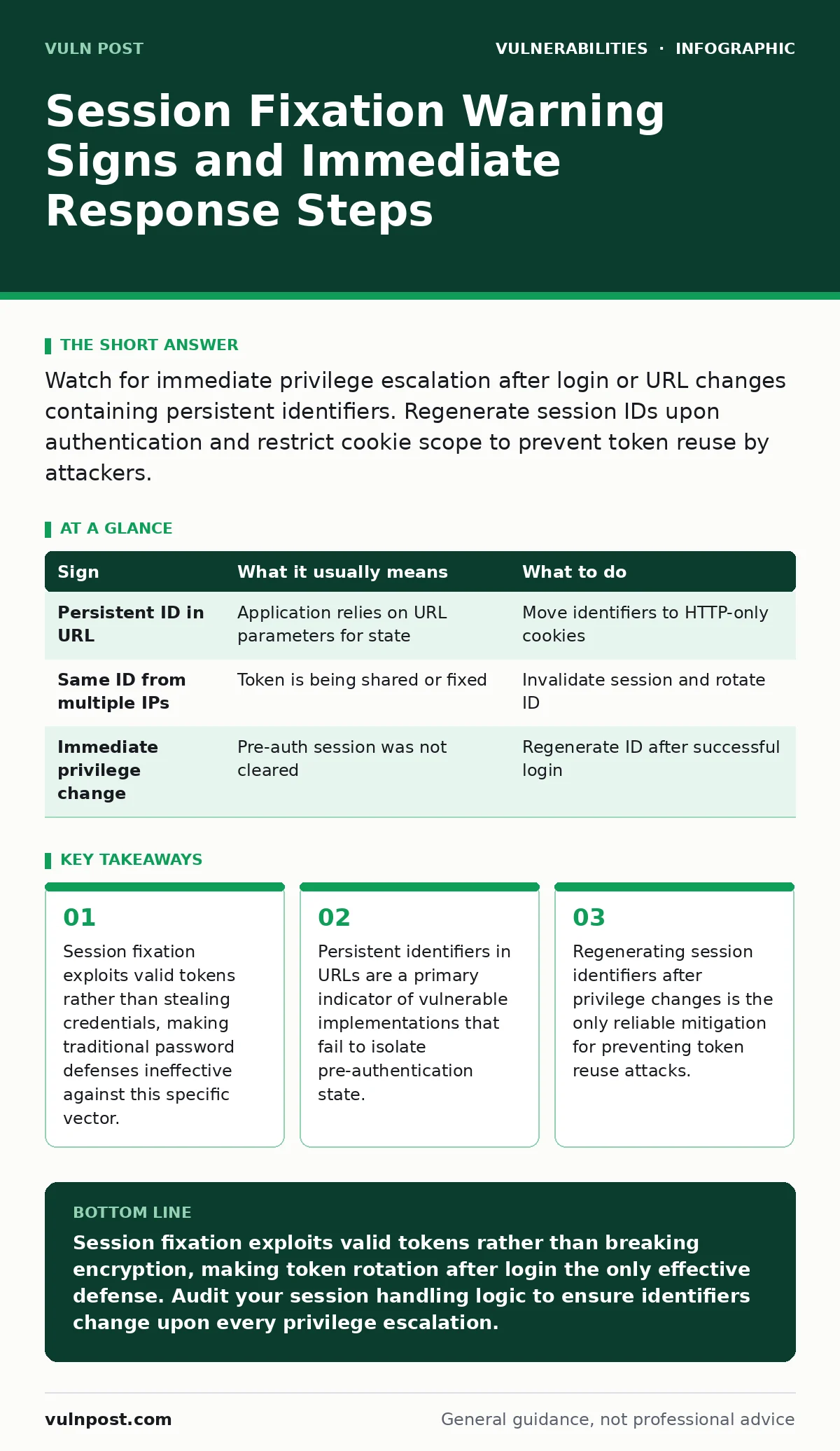
Watch for immediate privilege escalation after login or URL changes containing persistent identifiers. Regenerate session IDs upon authentication and restrict cookie scope to prevent token reuse by attackers.
The Mechanics of Token Reuse
Session fixation is an attack where an adversary forces a user to accept a known session identifier. The attacker does not need to steal a token. Instead, they provide one. When the user authenticates, the application ties the credentials to that pre-existing token. The attacker then uses the same token to access the account. This bypasses standard login protections because the session itself remains valid. The application assumes the session is legitimate because it was issued by the server. The flaw lies in the failure to invalidate the old session state upon successful authentication.
Immediate Signs of Compromise
The most visible sign is a sudden change in user behavior or session data. Suppose a user logs in and immediately sees a different user interface theme or language setting. This suggests another entity modified the session state before the user arrived. Another clear indicator is a URL that changes significantly after login. If the URL structure remains identical but the content shifts to a different user context, the session identifier may have been fixed. Users often notice this when they return to a site and find their shopping cart or preferences altered unexpectedly.
Subtle Indicators in Logs and Traffic
Operational teams often miss signs that appear in network logs rather than user interfaces. Look for requests containing the same session identifier from multiple distinct IP addresses in a short timeframe. This pattern suggests token sharing or fixation. Another subtle sign is a high volume of login attempts associated with a single session ID. If the application does not rotate the ID, the attacker can monitor the session's lifecycle. These patterns are easy to overlook if monitoring focuses only on failed login counts. You must correlate session IDs with source addresses to detect this anomaly.
| Sign | What it usually means | What to do |
|---|---|---|
| Persistent ID in URL | Application relies on URL parameters for state | Move identifiers to HTTP-only cookies |
| Same ID from multiple IPs | Token is being shared or fixed | Invalidate session and rotate ID |
| Immediate privilege change | Pre-auth session was not cleared | Regenerate ID after successful login |
The Role of Cookie Configuration
Cookies are the primary vehicle for session fixation. If a cookie is accessible via JavaScript, an attacker can read it through cross-site scripting. Even if scripting is prevented, a cookie without the HttpOnly flag is vulnerable to local theft. The Secure flag ensures the cookie is only sent over encrypted connections. Without it, the token can be intercepted on unsecured networks. Misconfigured cookies allow fixation to persist across different subdomains or paths, expanding the attack surface. You must verify that cookies are scoped narrowly to the specific application path.
Mitigation Through State Rotation
The primary defense is rotating the session identifier after every privilege change. This includes login, password change, and role elevation. The old identifier must be invalidated immediately. The new identifier should be cryptographically random and unpredictable. This breaks the link between the pre-authentication state and the authenticated session. Implementing this requires careful application logic to ensure no race conditions allow the old ID to remain active. You should also implement absolute and idle timeouts to limit the window of opportunity for an attacker.
See also: Input Validation Cyber Security: Stop Code Injection Before It Starts · Detect Data Scraping: Log Analysis and Behavioral Signals
Integration with Other Security Controls
Session management does not exist in isolation. It interacts with input validation to prevent injection attacks that could manipulate session parameters. It relates to cross-site WebSocket hijacking when real-time connections use the same authentication context. Understanding clickjacking helps you see how UI redress can trick users into fixing their own sessions. While zero-day vulnerabilities offer unknown entry points, session fixation exploits known architectural flaws.
Side-channel attacks may leak session data, but fixation exploits the session logic itself. Authentication bypass vulnerabilities often share root causes with poor session state management. Router vulnerabilities can intercept traffic, but they cannot fix a session without the initial token. CVE identifiers help track specific implementations of these flaws, but the underlying principle remains constant.
Operational Response Procedures
When you detect a potential fixation attempt, immediate action is required. Invalidate the affected session identifier on the server side. Force the user to re-authenticate with a new, random identifier. Review logs for other requests using that identifier to assess the scope of the exposure. Check for any data modifications or privilege escalations that occurred during the compromised session. Update your monitoring rules to alert on similar patterns in the future. Document the incident to refine your session management policies. Regular audits of session handling code are necessary to catch regression in security logic.
Key takeaways
- Session fixation exploits valid tokens rather than stealing credentials, making traditional password defenses ineffective against this specific vector.
- Persistent identifiers in URLs are a primary indicator of vulnerable implementations that fail to isolate pre-authentication state.
- Regenerating session identifiers after privilege changes is the only reliable mitigation for preventing token reuse attacks.
Session fixation exploits valid tokens rather than breaking encryption, making token rotation after login the only effective defense. Audit your session handling logic to ensure identifiers change upon every privilege escalation.
Frequently asked questions
Can multi-factor authentication stop session fixation?
MFA protects the login process but does not invalidate a fixed session token. If the attacker knows the token, they can bypass MFA after the user logs in.
Is HTTPS enough to prevent this attack?
No. HTTPS encrypts the transmission but does not prevent the server from accepting a known, valid token provided by an attacker.
How do I detect fixation in production?
Monitor for session IDs appearing from multiple IP addresses or user agents within a short time window.
What is the difference between fixation and hijacking?
Hijacking steals an existing token. Fixation forces the user to use a token the attacker already knows.
How this guide was produced: written by the Vuln Post editorial team with AI assistance, checked against the public references listed below, and reviewed when the facts change. See our editorial policy or report an error.