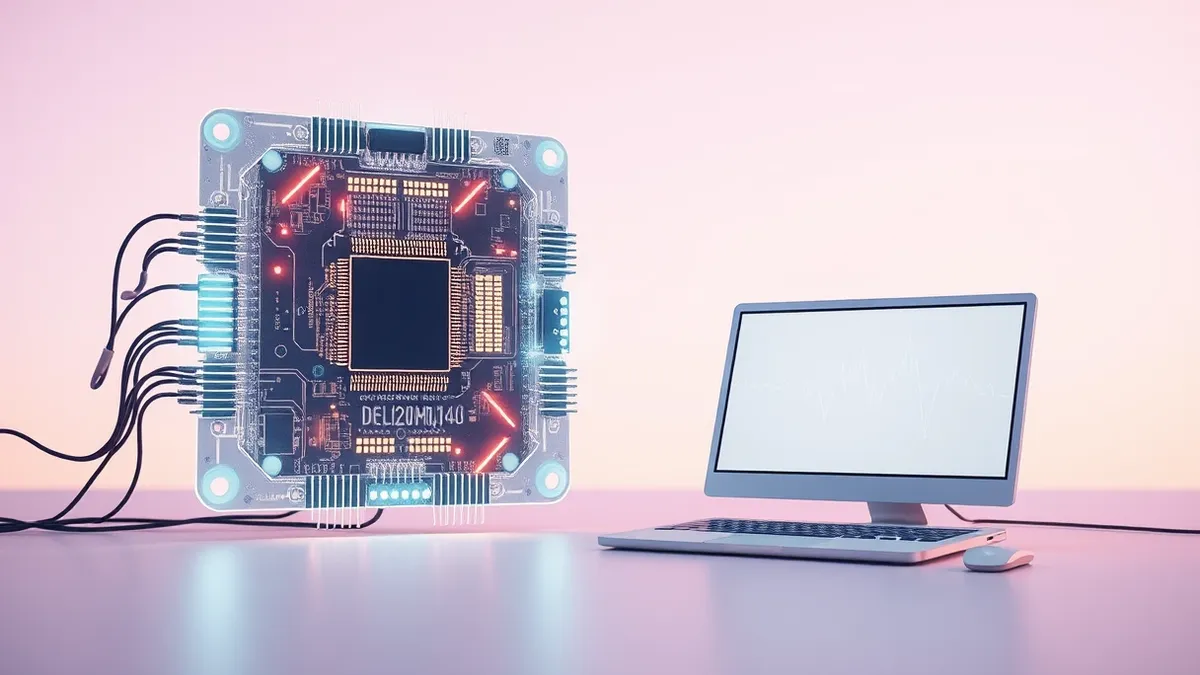
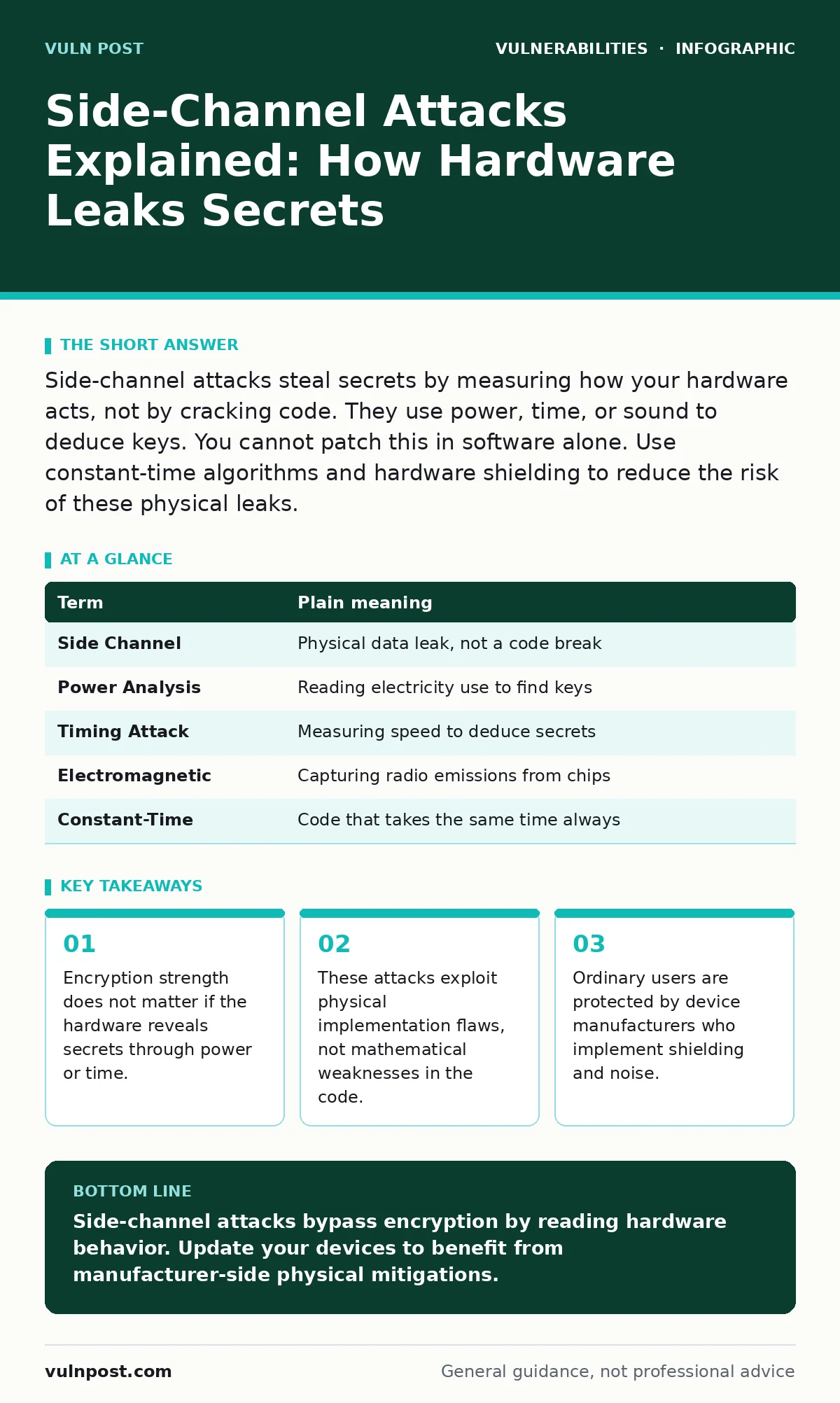
Side-channel attacks steal secrets by measuring how your hardware acts, not by cracking code. They use power, time, or sound to deduce keys. You cannot patch this in software alone. Use constant-time algorithms and hardware shielding to reduce the risk of these physical leaks.
The Noisy Lock Analogy
Imagine a high-security vault with a perfect combination lock. The math behind the lock is unbreakable. No one can guess the numbers. However, the lock makes a distinct click when the correct digit is entered. An attacker stands nearby and listens. They do not need to pick the lock. They simply note which numbers cause the click. After enough turns, they know the combination. This is how side-channel attacks work. They ignore the code and watch the machine.
What Is a Side Channel?
A side channel is any unintended information source that leaks data about a system’s internal state. Standard security focuses on the logic of the software. It assumes the code is black and white. If the input is wrong, the output is wrong. Side-channel attacks assume the hardware is transparent. They measure physical properties like electricity use, heat, or time. These measurements correlate with the data being processed. The attacker reconstructs the secret from these physical traces.
The Three Main Vectors
The most common vector is power analysis. Microchips use more electricity when processing certain bits. A 1 bit might draw more current than a 0 bit. By monitoring the power supply, an attacker sees the pattern. This is called simple power analysis. Another vector is timing. Some operations take longer than others. If checking a password character by character stops early on a mismatch, the time taken reveals how many characters were correct. This is a timing attack. The third vector is electromagnetic. Chips emit radio waves when switching states. These waves can be captured with antennas.
| Term | Plain meaning |
|---|---|
| Side Channel | Physical data leak, not a code break |
| Power Analysis | Reading electricity use to find keys |
| Timing Attack | Measuring speed to deduce secrets |
| Electromagnetic | Capturing radio emissions from chips |
| Constant-Time | Code that takes the same time always |
Why Software Patches Fail
You cannot fix a side-channel vulnerability with a software update alone. The leak comes from the silicon itself. If the processor changes voltage based on the data, no amount of code rewriting stops the physics. This is why these attacks are so persistent. They target the implementation, not the algorithm. Even if you use the strongest encryption standard, the hardware may betray it. This creates a hidden cost. You must trust the hardware manufacturer to build securely. You cannot verify this trust easily.
Impact on Everyday Devices
Your smartphone and laptop perform millions of cryptographic operations daily. They unlock your apps and secure your web browsing. If these devices are vulnerable, your data is at risk. Suppose an attacker has physical access to your phone. They could attach a probe to the battery line. Over hours, they might extract the encryption key. For most users, this is unlikely. It requires specialized equipment and proximity. However, cloud servers are different. They process data for millions of users. A flaw in the server chip could leak data from many tenants. This is a major concern for hosting providers.
Mitigation Strategies for Users
You cannot buy a shield for your chip. But you can choose devices that prioritize security. Look for devices with hardware security modules. These are separate chips designed to resist physical attacks. They use shielding and random delays. They make power and timing analysis much harder. Also, enable full disk encryption. This ensures that even if the key is leaked, the data remains scrambled. Do not rely on software-only encryption for high-value data. The physical layer is the weak point.
The Role of Constant-Time Code
Developers can reduce risk by writing constant-time code. This means the program takes the same amount of time and uses the same power regardless of the input. It checks every character of a password, even if the first one is wrong. It performs dummy calculations to hide the real work. This adds computational overhead. It slows down the system slightly. But it removes the timing signal. It forces the attacker to guess blindly. This is a standard practice for modern cryptographic libraries.
Relating to Other Vulnerabilities
Side-channel attacks differ from zero-day vulnerabilities. A zero-day is a flaw in the code logic. A side-channel is a flaw in the physical execution. They also differ from session fixation. Session fixation exploits how a server tracks users. Side-channels exploit how the processor handles bits. Understanding configuration hardening helps too. Proper settings can disable unused hardware features. This reduces the attack surface. It is similar to how you mitigate router vulnerabilities. You close off unused ports and services. Here, you close off physical leakage paths.
Try This Now
- Check if your device supports a hardware security key. Use it for two-factor authentication. This moves the secret key to a dedicated, hardened chip.
- Review your encryption settings. Ensure your file system uses full disk encryption. This protects data at rest even if the device is stolen.
- Update your operating system regularly. Vendors release patches that add random delays and noise. These updates counter known timing and power analysis techniques.
Key takeaways
- Encryption strength does not matter if the hardware reveals secrets through power or time.
- These attacks exploit physical implementation flaws, not mathematical weaknesses in the code.
- Ordinary users are protected by device manufacturers who implement shielding and noise.
Side-channel attacks bypass encryption by reading hardware behavior. Update your devices to benefit from manufacturer-side physical mitigations.
Frequently asked questions
Can I detect a side-channel attack in progress?
No. These attacks are passive. They only observe the device. They do not modify data or leave log entries.
Do antivirus programs stop these attacks?
No. Antivirus scans for malicious software. Side-channel attacks use physical laws, not code.
Is cloud storage safe from this?
Cloud providers use hardened servers. The risk is lower than personal devices, but not zero.
Does using a longer password help?
It helps against guessing. It does not stop timing attacks if the code is flawed.
How this guide was produced: written by the Vuln Post editorial team with AI assistance, checked against the public references listed below, and reviewed when the facts change. See our editorial policy or report an error.