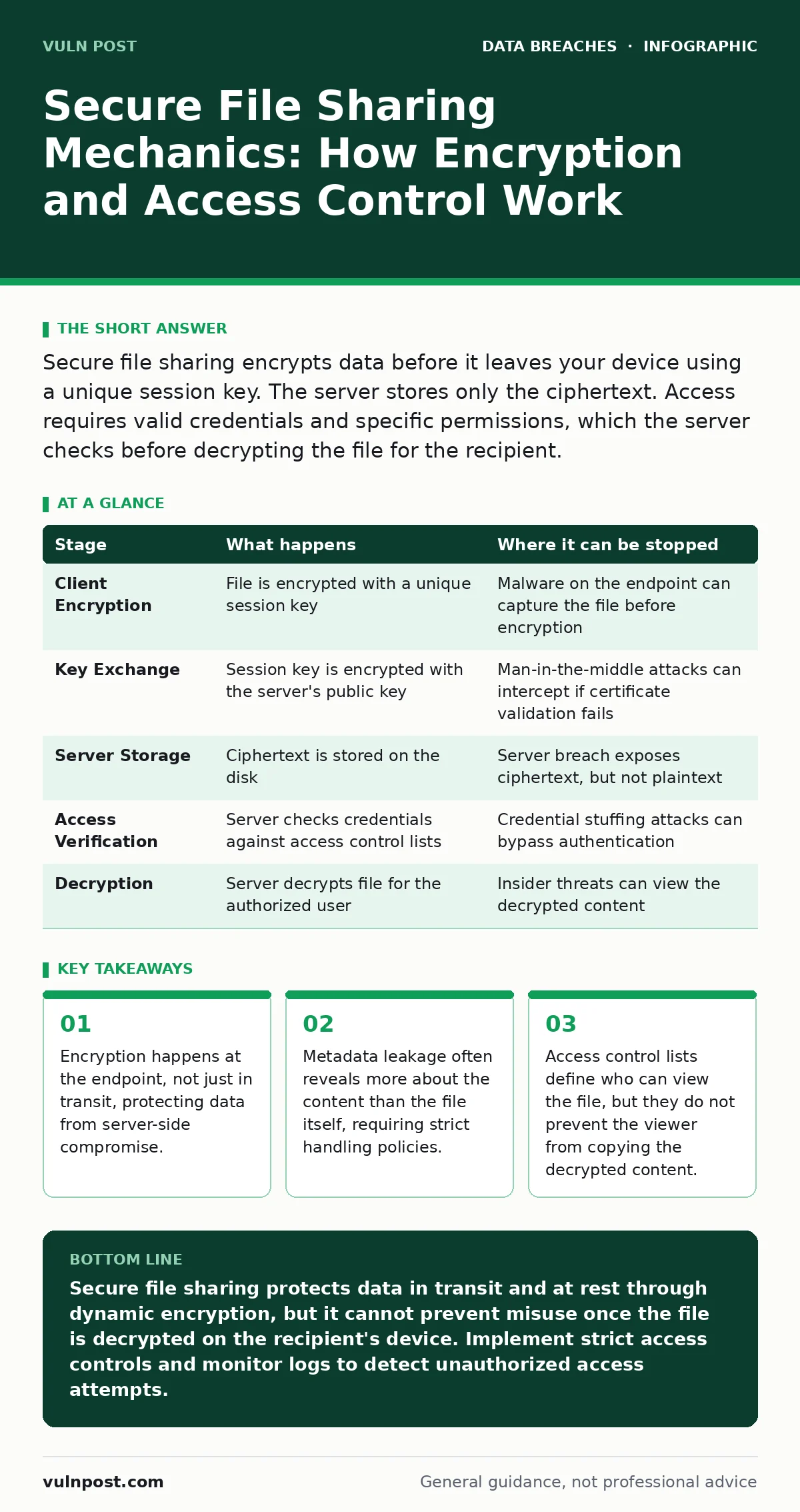
Secure file sharing encrypts data before it leaves your device using a unique session key. The server stores only the ciphertext. Access requires valid credentials and specific permissions, which the server checks before decrypting the file for the recipient.
The Endpoint Preparation Phase
The process begins before the file ever touches the network. When you initiate a transfer, the client application prepares the data for transport. It does not simply wrap the file in a secure connection. Instead, it generates a temporary symmetric key. This key is used to encrypt the file content locally.
This step is critical because it shifts the responsibility of confidentiality from the network to the endpoint. If the server is compromised, the attacker sees only scrambled data. The original file remains unreadable without the specific key generated for that session.
This mechanism complements encryption at rest strategies used for local storage. However, unlike static storage encryption, this key is ephemeral. It exists only for the duration of the upload and the subsequent authorized download.
| Stage | What happens | Where it can be stopped |
|---|---|---|
| Client Encryption | File is encrypted with a unique session key | Malware on the endpoint can capture the file before encryption |
| Key Exchange | Session key is encrypted with the server's public key | Man-in-the-middle attacks can intercept if certificate validation fails |
| Server Storage | Ciphertext is stored on the disk | Server breach exposes ciphertext, but not plaintext |
| Access Verification | Server checks credentials against access control lists | Credential stuffing attacks can bypass authentication |
| Decryption | Server decrypts file for the authorized user | Insider threats can view the decrypted content |
The Key Exchange Mechanism
Once the file is encrypted, the client must send the decryption key to the server. It cannot send this key in plain text. Instead, it uses asymmetric cryptography. The client retrieves the server’s public key. This key is part of a key pair that only the server possesses the private counterpart for.
The client encrypts the temporary session key using the server’s public key. It then sends this encrypted blob along with the encrypted file. Only the server can decrypt this blob using its private key. This ensures that even if an attacker intercepts the transmission, they cannot derive the session key.
This process relies on the integrity of the public key infrastructure. If an attacker can substitute the server’s public key with their own, they can decrypt the session key. This is why certificate validation is mandatory. You must verify that the public key belongs to the legitimate server.
Server-Side Storage and Isolation
The server receives two items: the encrypted file and the encrypted session key. It decrypts the session key using its private key. It then stores both the file and the key in a secure database. The key is often encrypted again using a master key held by the server. This adds a layer of protection if the database is extracted directly.
The server does not store the plaintext file. It stores only the ciphertext. This means that even if an attacker gains root access to the server, they cannot read the files without also compromising the master key. This is a significant advantage over simple secure socket layer connections.
However, the server still holds the keys. This creates a single point of failure. If the master key is exposed, all data on the platform becomes vulnerable. This is why some advanced systems use client-side key management, where the server never sees the plaintext key.
Access Control and Metadata Handling
Before granting access, the server verifies the recipient’s identity. It checks the user’s credentials against its directory. It then consults the access control list. This list defines who can view, edit, or delete the file. If the user is not on the list, the request is denied.
This step is where most breaches occur. Weak password hygiene can allow attackers to guess credentials and bypass the encryption. Even if the file is secure, the door to the room is open if the lock is weak. Multi-factor authentication adds a necessary layer here.
Metadata is also processed during this stage. The server logs who accessed the file, when, and from where. This data is vital for forensic analysis. However, metadata can leak sensitive information. For example, file names and timestamps can reveal the nature of the content.
The Decryption and Delivery Process
When an authorized user requests the file, the server retrieves the session key. It decrypts the key using the master key. It then uses the session key to decrypt the file content. The plaintext file is sent to the user’s client application.
This decryption happens on the server side in most standard configurations. This means the server briefly holds the plaintext in memory. If the server is vulnerable to memory scraping attacks, an attacker could extract the file. This is a known risk in server-side decryption models.
To mitigate this, some systems use end-to-end encryption. In this model, the server never holds the session key. The recipient’s device uses their private key to decrypt the session key. The server only facilitates the transfer of the encrypted packages. This eliminates the server-side decryption risk entirely.
See also: Stop Identity Sprawl: A Cloud Security Prevention Checklist
Limits of the Transmission Channel
The security of the file depends on the security of the channel it travels through. The connection between the client and the server is protected by transport layer security. This protocol encrypts the data in transit. It prevents eavesdropping and tampering.
However, transport layer security does not protect the data once it arrives at the destination. If the recipient’s device is infected with malware, the file is compromised as soon as it is decrypted. The security chain is only as strong as its weakest link.
This is why endpoint protection is necessary. It detects and blocks malware that might try to intercept the decrypted file. Without it, the encryption provided by the sharing service is useless once the file is in the user’s hands.
The Persistence and Audit Trail
After the transfer, the system maintains a log of the activity. This log includes timestamps, user IDs, and IP addresses. These logs are essential for detecting unauthorized access. They allow security teams to trace the flow of data.
Log retention policies determine how long these records are kept. Short retention periods can hinder investigations. Long retention periods increase storage costs and privacy risks. A balance must be struck based on regulatory requirements and operational needs.
These logs can also be used for compliance reporting. They prove that only authorized individuals accessed the data. This is crucial for industries with strict data protection laws. However, logs can be tampered with if the logging system is not secure.
This process highlights the complexity of secure file sharing. It is not just about encryption. It is about managing keys, controlling access, and monitoring activity. Each step introduces new risks that must be mitigated. Understanding these mechanics allows you to configure your systems more effectively.
Key takeaways
- Encryption happens at the endpoint, not just in transit, protecting data from server-side compromise.
- Metadata leakage often reveals more about the content than the file itself, requiring strict handling policies.
- Access control lists define who can view the file, but they do not prevent the viewer from copying the decrypted content.
Secure file sharing protects data in transit and at rest through dynamic encryption, but it cannot prevent misuse once the file is decrypted on the recipient's device. Implement strict access controls and monitor logs to detect unauthorized access attempts.
Frequently asked questions
Can the service provider read my files?
In standard configurations, yes, because the server holds the decryption keys. In end-to-end encrypted systems, no, as the keys never leave your devices.
Does secure file sharing prevent data leaks?
It prevents interception during transfer, but it does not stop a recipient from copying or sharing the decrypted file with unauthorized parties.
What happens if I forget my password?
If you use server-side encryption, the provider can reset your password. If you use end-to-end encryption, you may lose access to your files permanently if you lose your keys.
Is secure file sharing better than email?
Yes, because it provides persistent access controls and encryption at rest, whereas email typically lacks these features and is more susceptible to interception.
How this guide was produced: written by the Vuln Post editorial team with AI assistance, checked against the public references listed below, and reviewed when the facts change. See our editorial policy or report an error.