
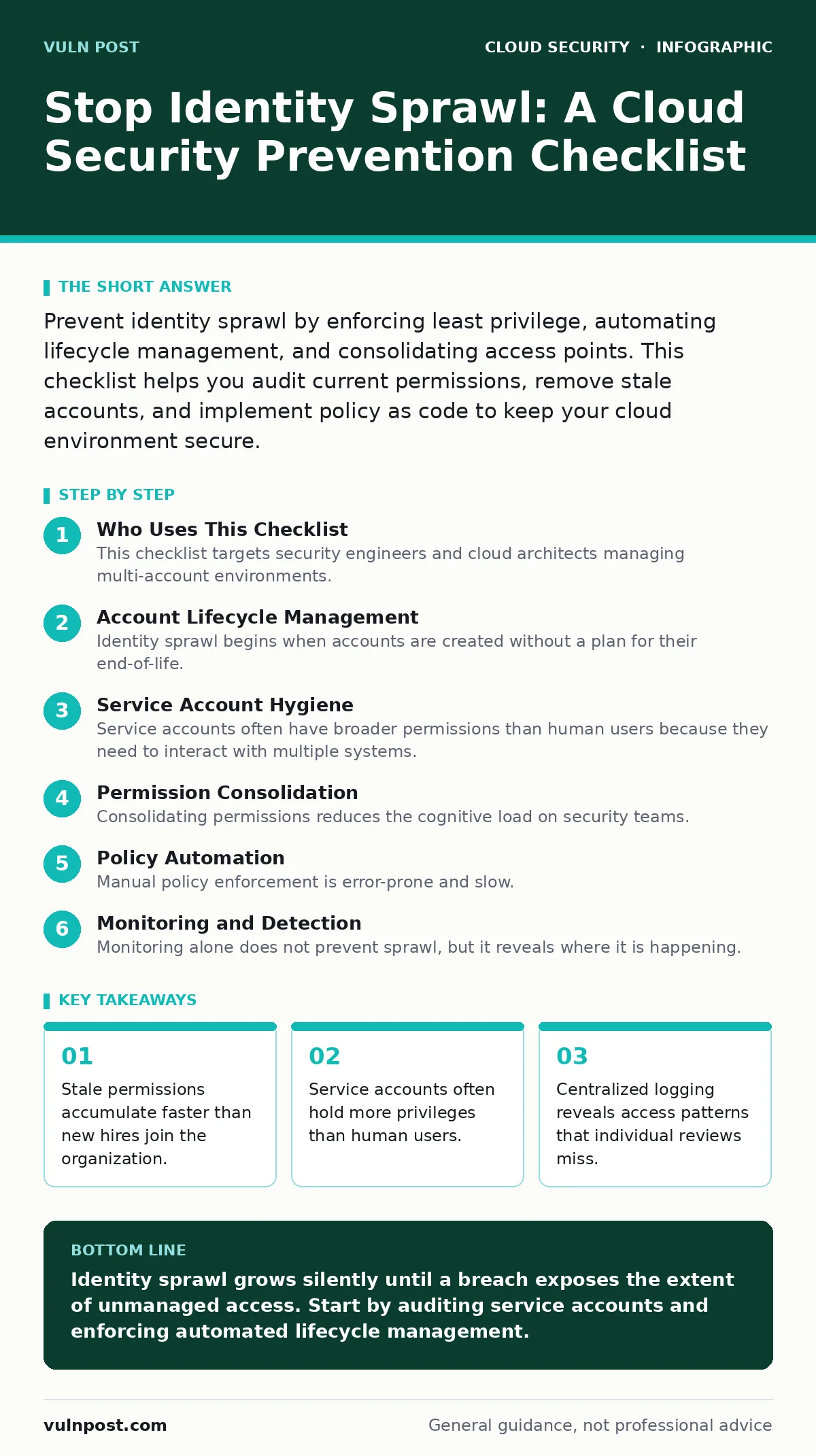
Prevent identity sprawl by enforcing least privilege, automating lifecycle management, and consolidating access points. This checklist helps you audit current permissions, remove stale accounts, and implement policy as code to keep your cloud environment secure.
Who Uses This Checklist
This checklist targets security engineers and cloud architects managing multi-account environments. You use it to audit current permissions, identify orphaned resources, and enforce consistent access controls. The goal is to reduce the attack surface created by unmanaged identities. Use this list during quarterly reviews or before major infrastructure changes.
Account Lifecycle Management
- Define a strict offboarding workflow: Immediate revocation prevents former employees from retaining access to sensitive data.
- Automate user provisioning: Systematic creation ensures every account has a documented owner and purpose.
- Review dormant accounts quarterly: Inactive accounts are prime targets for credential stuffing and brute-force attacks.
- Disable rather than delete: Retaining disabled accounts allows for forensic analysis if misuse is detected later.
- Require manager approval for new admins: Human oversight catches errors that automated systems might miss.
Identity sprawl begins when accounts are created without a plan for their end-of-life. Many teams focus on onboarding but neglect the exit process. This creates a backlog of permissions that never get reviewed.
Service Account Hygiene
- Rotate credentials automatically: Regular rotation limits the window of opportunity for stolen secrets.
- Assign least privilege to services: Service accounts should only access the resources they actively use.
- Avoid long-lived tokens: Short-lived tokens reduce the impact of a compromised key.
- Tag service accounts with purpose: Clear labeling helps auditors distinguish between human and machine identities.
- Monitor service account usage: Unusual API calls from a service account indicate potential compromise.
Service accounts often have broader permissions than human users because they need to interact with multiple systems. This makes them high-value targets. If a service account is compromised, an attacker can move laterally without triggering user-based alerts.
Permission Consolidation
- Merge overlapping roles: Combining similar permissions reduces complexity and audit effort.
- Remove wildcard permissions: Specific resource identifiers prevent accidental access to unrelated data.
- Use groups instead of individual policies: Group-based management simplifies updates and reduces configuration drift.
- Document exception requests: Every deviation from standard policies must have a recorded business justification.
- Implement just-in-time access: Temporary elevation reduces the risk of persistent unauthorized access.
Consolidating permissions reduces the cognitive load on security teams. When roles are too granular, it becomes impossible to track who has access to what. Grouping users by function allows for bulk updates and easier auditing.
Policy Automation
- Deploy policy as code: Version-controlled policies ensure consistent enforcement across all environments.
- Automate compliance checks: Continuous monitoring detects drift from security baselines in real time.
- Fail builds on policy violations: Preventing non-compliant deployments stops sprawl before it starts.
- Centralize policy definitions: A single source of truth prevents conflicting rules across teams.
- Test policies in staging: Validation ensures that new rules do not break existing workflows.
Manual policy enforcement is error-prone and slow. Policy as code allows you to treat security rules like software, enabling testing, versioning, and rollback. This approach scales better than manual reviews.
See also: Role-Based Access Control: 8 FAQ Answers for Secure Systems
Monitoring and Detection
- Enable detailed audit logging: Comprehensive logs provide the data needed for forensic analysis.
- Alert on privilege escalation: Immediate notification helps teams respond to unauthorized access attempts.
- Track cross-account access: Monitoring activity between accounts reveals lateral movement patterns.
- Review failed login attempts: High volumes of failures may indicate credential stuffing attacks.
- Correlate identity events: Linking login data with resource access provides context for anomalies.
Monitoring alone does not prevent sprawl, but it reveals where it is happening. Without visibility, you cannot measure the effectiveness of your controls. Detailed logs are the foundation of any incident response effort.
Integration with Cloud Security
Identity sprawl affects every layer of your cloud infrastructure. Proper management supports IaaS, PaaS and SaaS security by ensuring that only authorized entities access resources. It complements cloud network segmentation by defining who can traverse segment boundaries.
Effective identity management also enhances cloud landing zones by providing a secure baseline for new accounts. It integrates with cloud key management services to protect sensitive data from unauthorized access. Using private endpoints reduces exposure, but identity controls remain the primary defense.
Regular cloud vulnerability management identifies misconfigurations, but identity issues often go undetected. Exposed Docker APIs can be secured by restricting access to specific identities. Combining these practices creates a defense-in-depth strategy.
Key takeaways
- Stale permissions accumulate faster than new hires join the organization.
- Service accounts often hold more privileges than human users.
- Centralized logging reveals access patterns that individual reviews miss.
Identity sprawl grows silently until a breach exposes the extent of unmanaged access. Start by auditing service accounts and enforcing automated lifecycle management.
Frequently asked questions
How often should I review user permissions?
Review permissions at least quarterly, or immediately when employees change roles or leave the organization.
What is the difference between identity sprawl and shadow IT?
Identity sprawl refers to unmanaged accounts within known systems, while shadow IT involves unauthorized tools or services.
Can automation completely prevent identity sprawl?
Automation reduces sprawl by enforcing policies, but human oversight is needed to define those policies correctly.
How do I handle legacy accounts in migration?
Audit legacy accounts before migration, disable those that are no longer needed, and map remaining users to new roles.
How this guide was produced: written by the Vuln Post editorial team with AI assistance, checked against the public references listed below, and reviewed when the facts change. See our editorial policy or report an error.