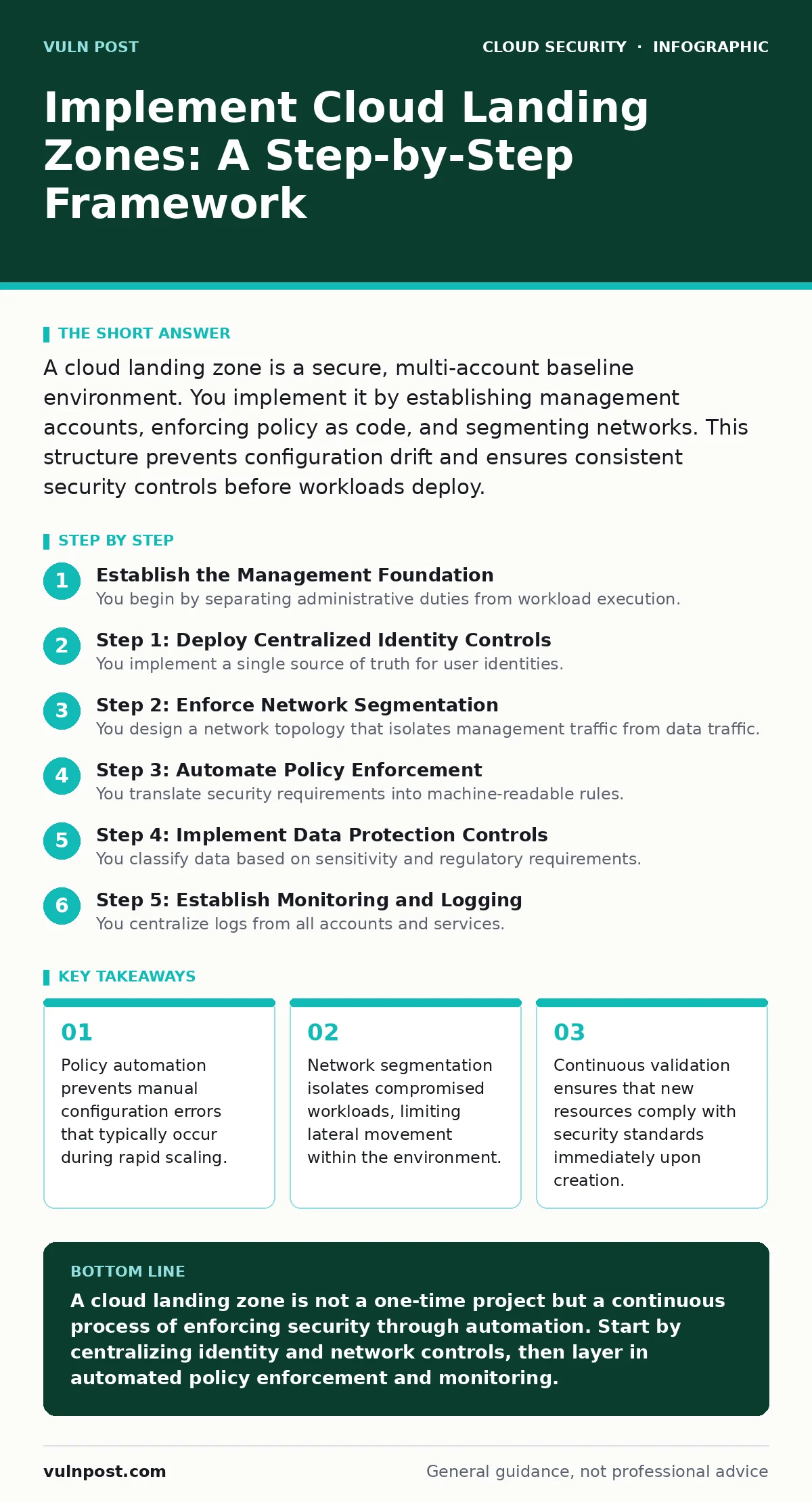
A cloud landing zone is a secure, multi-account baseline environment. You implement it by establishing management accounts, enforcing policy as code, and segmenting networks. This structure prevents configuration drift and ensures consistent security controls before workloads deploy.
Establish the Management Foundation
You begin by separating administrative duties from workload execution. This separation prevents privilege escalation attacks where a compromised application gains control over the entire cloud environment. You create a management account that holds no production data. This account owns the identity providers and billing mechanisms.
You define the hierarchy of accounts or projects. Each team or application gets its own isolated container. This isolation ensures that a security breach in one area does not expose others. You must enforce strict access controls on the management account. Only senior administrators should have write access to these foundational settings.
Step 1: Deploy Centralized Identity Controls
You implement a single source of truth for user identities. This central identity provider connects to all cloud accounts. You disable local cloud users and rely on federated authentication. This approach allows you to revoke access globally when an employee leaves or a device is lost.
You configure role-based access controls based on the principle of least privilege. Users receive permissions only for the specific tasks they perform. You avoid granting broad administrative rights. Instead, you define granular roles that match job functions. This reduces the attack surface by limiting what a compromised credential can do.
You verify this step by attempting to access a resource with insufficient permissions. The system should deny the request immediately. You also check that authentication logs flow to a central storage location. These logs provide the audit trail needed for incident response.
Step 2: Enforce Network Segmentation
You design a network topology that isolates management traffic from data traffic. You create private subnets for workloads that do not need internet access. You use private endpoints to connect to cloud services without exposing them to the public internet. This reduces the risk of exposed Docker APIs or other unintended service exposures.
You implement cloud network segmentation using virtual private clouds or equivalent constructs. You place firewalls between segments to filter traffic. You define rules that deny all traffic by default and allow only specific connections. This explicit allow model prevents accidental exposure of sensitive data.
You validate the network by scanning for open ports from an external perspective. You should see only the intended public-facing services. Internal services must remain invisible to external scanners. You also test connectivity between segments to ensure isolation holds.
Step 3: Automate Policy Enforcement
You translate security requirements into machine-readable rules. This practice, known as policy as code, ensures that compliance is checked automatically. You deploy these policies to the management plane. They evaluate every resource creation or modification in real time.
You configure alerts for policy violations. When a developer attempts to deploy a non-compliant resource, the system blocks it or flags it for review. You define remediation actions that automatically fix simple issues. For complex violations, you notify the responsible team. This automation reduces the burden on security operations teams.
You check this step by deploying a test resource that violates a policy. The system should reject the deployment or trigger an alert. You review the alert details to ensure they provide enough context for resolution.
Step 4: Implement Data Protection Controls
You classify data based on sensitivity and regulatory requirements. You apply encryption to data at rest and in transit. You manage encryption keys separately from the data they protect. This separation ensures that even if storage is compromised, the data remains unreadable without the keys.
You define retention and deletion policies for data. You automate the cleanup of temporary files and logs. You prevent cloud data exfiltration by monitoring outbound traffic for anomalies. You set up alerts for large data transfers to unknown destinations.
You verify data protection by attempting to access encrypted data without the correct key. The system should return an error. You also check that logs are encrypted and stored securely. This ensures that audit trails are protected from tampering.
See also: What Is Cloud Workload Protection: Defining the Scope · Private Endpoints: Benefits, Limits, and When to Use Them
Step 5: Establish Monitoring and Logging
You centralize logs from all accounts and services. You send these logs to a secure, immutable storage system. This ensures that attackers cannot delete evidence of their actions. You configure log retention periods that meet regulatory requirements.
You set up dashboards that visualize security metrics. You monitor for anomalies in user behavior and network traffic. You integrate these logs with your security information and event management system. This integration allows for correlation of events across different sources.
You test the monitoring system by generating synthetic security events. You verify that these events appear in the logs and trigger alerts. You ensure that the data is complete and accurate. This validation confirms that you can detect incidents when they occur.
Verify the Landing Zone Functionality
You conduct a comprehensive review of the landing zone. You check that all accounts are properly configured and isolated. You verify that policies are enforced consistently. You test the incident response procedures using a simulated breach.
You review the logging and monitoring setup. You ensure that all critical events are captured and stored. You validate that the data protection controls are active. You check that identity controls are functioning as expected.
- All accounts are isolated and managed centrally.
- Identity federation is active and local users are disabled.
- Network segmentation prevents lateral movement.
- Policies are enforced automatically via code.
- Logs are centralized and immutable.
- Data is encrypted at rest and in transit.
Maintain and Evolve the Environment
You treat the landing zone as a living system. You update policies regularly to address new threats. You review access permissions periodically to remove unnecessary privileges. You test the infrastructure regularly to ensure it remains secure.
You incorporate lessons learned from incidents and audits. You refine the network segmentation and data protection controls. You stay informed about changes in cloud services and security best practices. This continuous improvement ensures that the landing zone remains effective over time.
You monitor the health of the underlying infrastructure. You address performance issues that could impact security operations. You ensure that the cost of security controls is justified by the risk reduction. This balance ensures sustainable security operations.
Key takeaways
- Policy automation prevents manual configuration errors that typically occur during rapid scaling.
- Network segmentation isolates compromised workloads, limiting lateral movement within the environment.
- Continuous validation ensures that new resources comply with security standards immediately upon creation.
A cloud landing zone is not a one-time project but a continuous process of enforcing security through automation. Start by centralizing identity and network controls, then layer in automated policy enforcement and monitoring.
Frequently asked questions
How do landing zones differ from standard cloud accounts?
Landing zones provide a pre-configured, secure baseline with centralized management, network segmentation, and automated policy enforcement, whereas standard accounts lack these integrated security controls.
Can I implement a landing zone in an existing environment?
Yes, you can gradually migrate existing workloads into a landing zone structure by creating new accounts and enforcing policies, though this requires careful planning to avoid disruption.
Do landing zones protect against all types of attacks?
No, landing zones reduce risk by enforcing security baselines and isolating workloads, but they do not eliminate the need for application-level security, incident response, and user training.
How often should I review my landing zone configuration?
You should review your configuration regularly, ideally after any significant change in cloud services, security threats, or organizational structure, to ensure it remains effective.
How this guide was produced: written by the Vuln Post editorial team with AI assistance, checked against the public references listed below, and reviewed when the facts change. See our editorial policy or report an error.