Cloud workload protection secures applications and services across all environments, including virtual machines, containers, and serverless functions. It monitors runtime behavior to detect anomalies and enforce policies, ensuring security follows the code regardless of where it executes.
Everyday Analogy for Cloud Security
Imagine securing a shipping warehouse. Traditional security focuses on locking the main gates and checking trucks at the entrance. This perimeter defense stops unauthorized vehicles from entering the yard. However, once a truck is inside, it can move freely between storage zones. A compromised package inside a legitimate truck bypasses the gate entirely.
Cloud workload protection acts like sensors on every pallet and shelf. It monitors the contents and movement of goods within the warehouse. It detects when a package moves to an unexpected zone or opens at an unusual time. This internal monitoring catches threats that passed the initial gate check. It focuses on the asset itself rather than the boundary around it.
What Is Cloud Workload Protection
Cloud workload protection defines a security approach that safeguards applications and services across all computing environments. It secures virtual machines, containers, serverless functions, and hybrid infrastructure. The term "workload" refers to any unit of work performed by a computing system. This includes long-running servers and ephemeral microservices that exist for seconds.
Traditional security tools often treat these environments differently, creating gaps in coverage. Workload protection unifies these defenses under a single policy framework. It ensures that security controls travel with the application as it moves between data centers and cloud regions. This consistency prevents security drift in dynamic environments. You gain visibility into the actual behavior of the application, not just its network traffic.
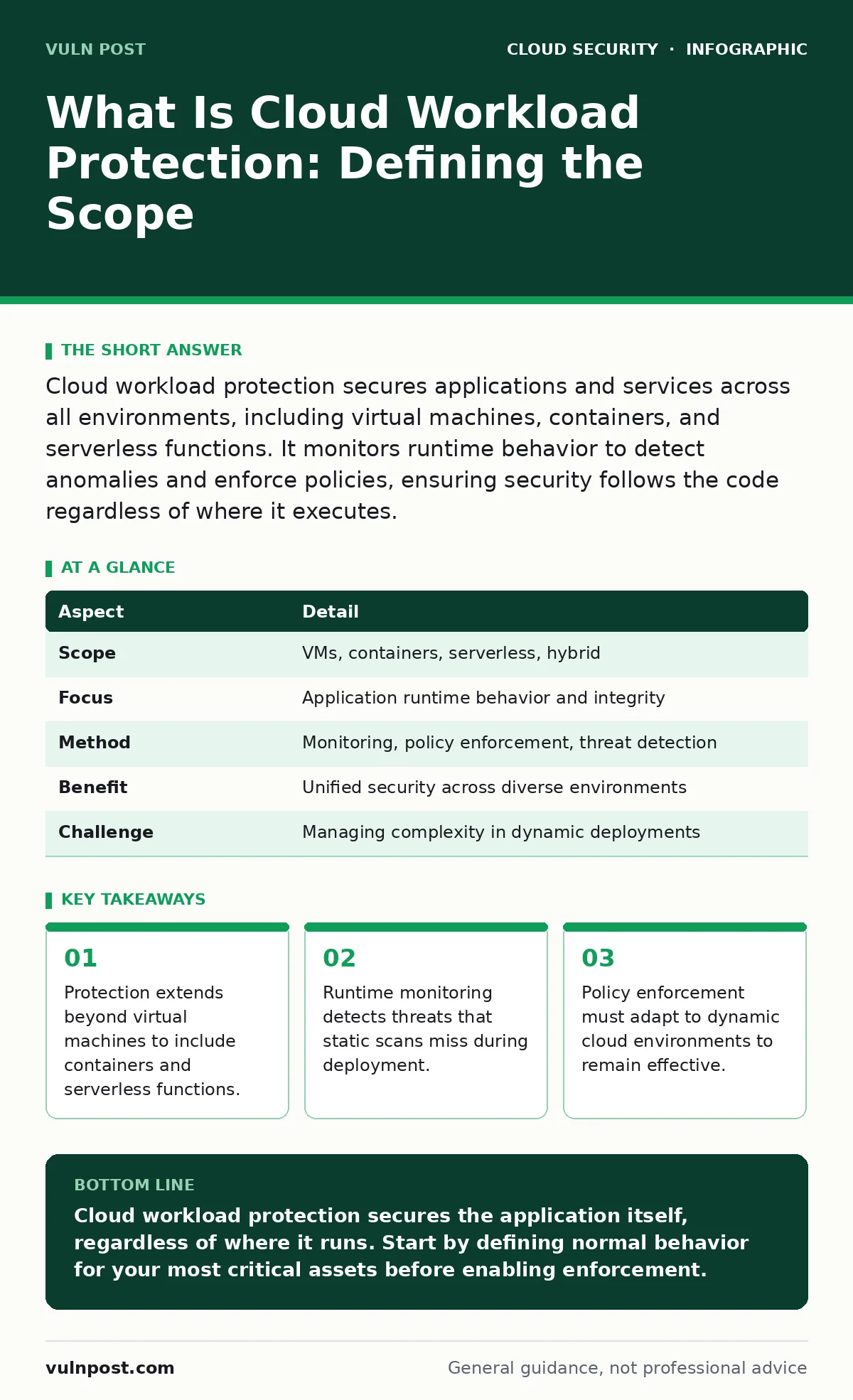
| Aspect | Detail |
|---|---|
| Scope | VMs, containers, serverless, hybrid |
| Focus | Application runtime behavior and integrity |
| Method | Monitoring, policy enforcement, threat detection |
| Benefit | Unified security across diverse environments |
| Challenge | Managing complexity in dynamic deployments |
How It Works Mechanically
The mechanism relies on deep visibility into the operating system and application layers. Agents or agentless sensors collect telemetry data from the workload. This data includes system calls, process executions, and network connections. The platform analyzes this stream against known threat signatures and behavioral baselines. It identifies deviations from normal operation, such as a web server attempting to execute a database command.
When an anomaly is detected, the system can alert operators or automatically block the action. This runtime enforcement stops attacks in progress, rather than after damage occurs. It complements static analysis by catching vulnerabilities exploited in real time. The system continuously updates its understanding of "normal" behavior as the application evolves. This adaptability is critical for environments that change frequently.
Who It Affects in Your Organization
Security operations teams bear the primary responsibility for configuration and response. They must define what constitutes normal behavior for each application type. Developers influence the security posture through their code and deployment practices. Poorly written code increases the attack surface, requiring more complex monitoring rules. Infrastructure engineers manage the underlying platforms where workloads run.
They ensure that the protection tools integrate correctly with orchestration systems. Compliance officers rely on the audit logs generated by these tools. These logs prove that security policies are enforced consistently. All roles must collaborate to close gaps between development and operations. Siloed efforts lead to blind spots where threats can hide. Shared ownership reduces the risk of configuration errors.
Common Misconceptions About Coverage
Many assume that cloud workload protection replaces existing security tools. It actually complements firewalls, intrusion detection systems, and identity management. Perimeter defenses stop external scans, while workload protection handles internal threats. Another mistake is treating all workloads identically. A stateful database requires different monitoring than a stateless web server.
Applying uniform rules creates noise and hides real signals. Some teams believe that immutable infrastructure eliminates the need for runtime security. Immutable servers reduce configuration drift but do not prevent code execution attacks. Vulnerabilities in the application logic remain exploitable. Security must address both the platform and the payload. Understanding these distinctions prevents wasted effort on redundant controls.
See also: Implement Cloud Landing Zones: A Step-by-Step Framework · Private Endpoints: Benefits, Limits, and When to Use Them
Integrating With Related Security Areas
Workload protection does not operate in isolation. It must connect with identity systems to verify who is accessing the workload. Identity sprawl increases the risk of unauthorized access to protected resources. Proper integration ensures that only authorized identities can trigger actions. Network segmentation also plays a role. Private endpoints restrict access to sensitive services, reducing the attack surface.
Workload protection monitors traffic within these segmented zones. For containerized applications, Kubernetes security basics provide the foundation. Workload protection adds runtime depth to platform-level controls. It detects lateral movement that escapes namespace restrictions. Understanding IaaS, PaaS and SaaS security models helps tailor the protection strategy. Each model shifts responsibility differently, affecting what the workload protector must monitor.
What To Do About Implementation
Start by inventorying all workloads across your environment. Identify critical assets that require the highest level of protection. Define baseline behaviors for each application type. This baseline serves as the reference for anomaly detection. Deploy monitoring tools with read-only access first. This phase allows you to gather data without disrupting operations. Analyze the telemetry to refine your policies.
Remove noise by tuning alerts to match actual business logic. Gradually enable enforcement modes to block malicious actions. Test your response procedures with simulated attacks. Ensure that your team can isolate compromised workloads quickly. Regularly review and update your policies as applications change. Continuous improvement maintains effectiveness against evolving threats.
Addressing Serverless and Container Risks
Serverless functions introduce unique challenges for workload protection. These functions execute briefly and then disappear. Traditional agents cannot persist on ephemeral resources. Protection must integrate with the serverless platform itself. It monitors execution logs and environment variables for anomalies. Serverless security risks include event injection and privilege escalation.
Workload protection detects these patterns in the execution context. Containers require similar attention to their lifecycle. Exposed Docker APIs can allow attackers to manipulate container behavior. Workload protection monitors API calls and container runtime events. It ensures that containers operate within their defined boundaries. Combining these protections creates a cohesive defense. It covers the full spectrum of modern application architectures.
Key takeaways
- Protection extends beyond virtual machines to include containers and serverless functions.
- Runtime monitoring detects threats that static scans miss during deployment.
- Policy enforcement must adapt to dynamic cloud environments to remain effective.
Cloud workload protection secures the application itself, regardless of where it runs. Start by defining normal behavior for your most critical assets before enabling enforcement.
Frequently asked questions
Does cloud workload protection replace antivirus software?
No, it complements antivirus by monitoring runtime behavior and enforcing policies. Antivirus scans for known malware signatures, while workload protection detects anomalous actions.
Can workload protection run in hybrid environments?
Yes, it secures workloads across on-premises data centers, private clouds, and public clouds. Unified policy management ensures consistent security everywhere.
How does it handle false positives?
Initial deployment should use monitoring-only mode to establish baselines. Tuning alerts against normal application behavior reduces false positives over time.
How this guide was produced: written by the Vuln Post editorial team with AI assistance, checked against the public references listed below, and reviewed when the facts change. See our editorial policy or report an error.