
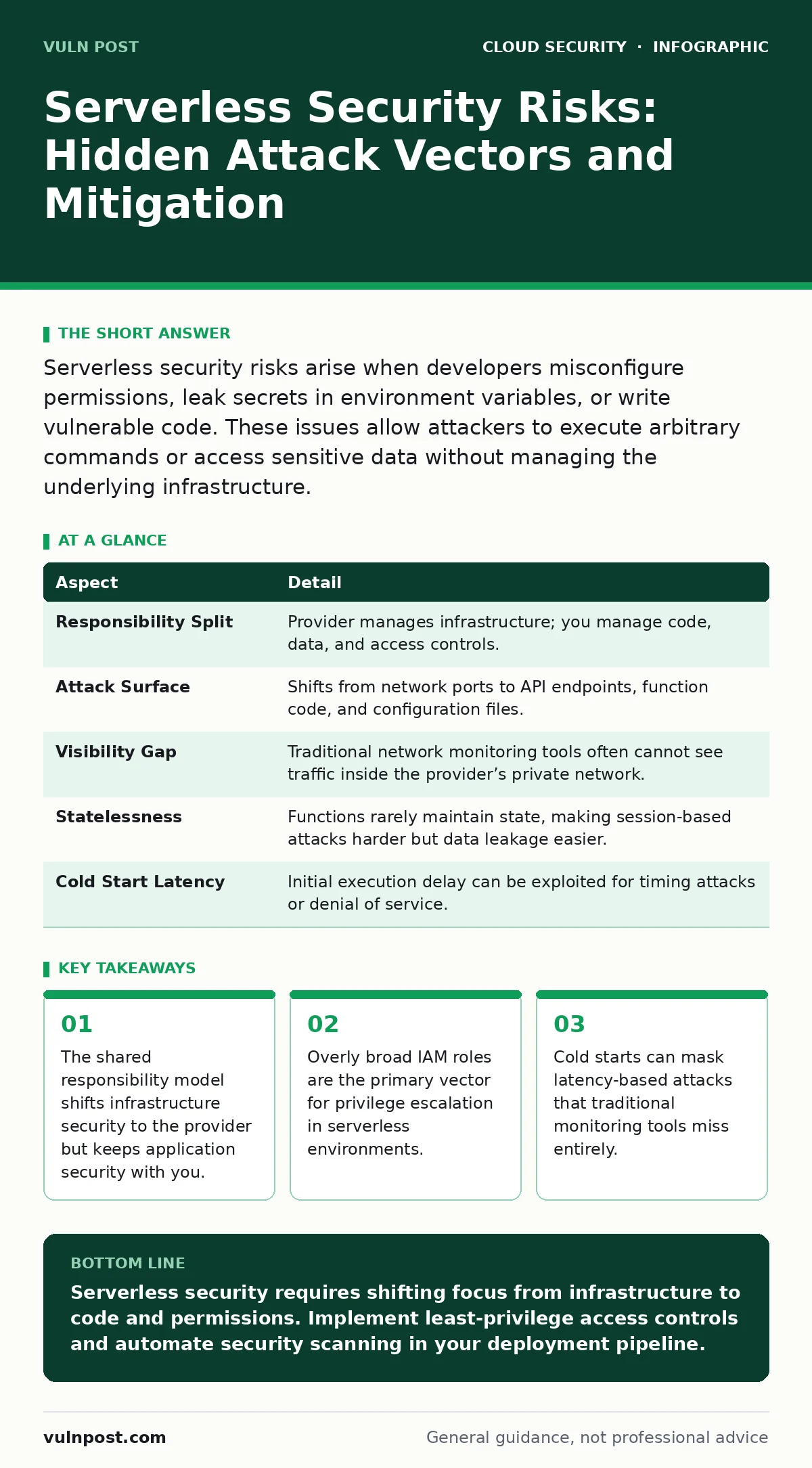
Serverless security risks arise when developers misconfigure permissions, leak secrets in environment variables, or write vulnerable code. These issues allow attackers to execute arbitrary commands or access sensitive data without managing the underlying infrastructure.
The Illusion of Invisible Infrastructure
Imagine a restaurant where you order food, but you never see the kitchen, the chefs, or the ingredients. You trust that the meal is safe because the brand is reputable. Serverless computing works similarly. You deploy code, and the cloud provider handles the servers, operating systems, and scaling. You do not manage the underlying hardware.
This abstraction creates a powerful illusion of security. You assume that because you cannot touch the server, the server is secure. This assumption is dangerous. The provider secures the physical host and the hypervisor. You remain responsible for the code running on top of it. If your code has a flaw, the abstraction does not protect you. It often hides the flaw until an attacker exploits it.
| Aspect | Detail |
|---|---|
| Responsibility Split | Provider manages infrastructure; you manage code, data, and access controls. |
| Attack Surface | Shifts from network ports to API endpoints, function code, and configuration files. |
| Visibility Gap | Traditional network monitoring tools often cannot see traffic inside the provider’s private network. |
| Statelessness | Functions rarely maintain state, making session-based attacks harder but data leakage easier. |
| Cold Start Latency | Initial execution delay can be exploited for timing attacks or denial of service. |
How the Risk Manifests
Serverless security risks happen when the boundary between trusted and untrusted code blurs. In traditional hosting, you secure a server by closing ports and patching the OS. In serverless, you secure a function by restricting what it can do. The risk arises when you grant a function more permissions than it needs. A function that reads a database should not have permission to write to it.
If an attacker compromises that function, they inherit all its permissions. This is known as privilege escalation. Another common failure is insecure dependencies. Serverless functions often pull libraries from public repositories. If a library contains a vulnerability, your function is vulnerable too. You do not patch the OS; you must patch the code. This creates a continuous maintenance burden that many teams overlook.
Common Forms of Exploitation
The most frequent form of serverless attack is injection. Attackers send malicious input to your function, hoping it will execute unintended commands. SQL injection works in serverless databases just as it does in traditional ones. Command injection allows an attacker to run system commands if your code improperly handles user input. Another form is broken access control.
If your API gateway does not verify user identity, anyone with the function URL can invoke it. This exposes internal logic to the public internet. Data exposure is also common. Developers often store secrets, like database passwords, in environment variables. If an attacker can view the function configuration, they can read these secrets. This leads to direct data theft.
Who Is Affected
Any organization using serverless technology faces these risks. This includes startups using managed functions for rapid prototyping and enterprises running complex microservices. The impact varies by industry. Healthcare providers face strict regulatory penalties for data leaks. Financial institutions risk fraud if API endpoints are compromised. Small teams are often hit harder because they lack dedicated security personnel.
They rely on default settings, which are often permissive. Large teams may have more resources but suffer from complexity. With thousands of functions, tracking which one has excessive permissions becomes difficult. The scale of serverless deployments makes manual security reviews impossible. Automation becomes necessary, but incorrect automation introduces its own risks.
What People Usually Get Wrong
Many security teams try to apply traditional perimeter defenses to serverless environments. They focus on firewalls and intrusion detection systems. These tools are less effective because serverless functions communicate over internal networks that bypass the perimeter. The attack happens at the application layer, not the network layer.
Another common error is treating functions as isolated silos. In reality, functions often call other functions or access shared resources. A compromise in one function can cascade through the entire application. This interconnectivity requires a holistic view of trust. You must map data flow between functions. Without this map, you cannot detect lateral movement.
Reducing the Risk
To reduce serverless security risks, start with least privilege. Define strict IAM roles for each function. Grant only the permissions required for that specific task. Use automated tools to scan for overly broad policies. Implement policy as code to manage these permissions consistently across deployments. This ensures that security rules are version-controlled and auditable.
Next, secure your dependencies. Use software composition analysis tools to scan libraries for known vulnerabilities. Update dependencies regularly. Do not run functions with default settings. Configure timeout limits to prevent long-running attacks. Set memory limits to constrain resource usage. Monitor function invocations for unusual patterns. Look for spikes in error rates or unexpected geographic sources.
Integrating with Broader Security Strategies
Serverless security does not exist in a vacuum. It must integrate with your broader cloud security strategy. For instance, if you use containers alongside serverless, you must address container escape risks separately. The isolation mechanisms differ. You also need to consider cloud network segmentation. Even if functions are serverless, the data they access may reside in segmented subnets.
Ensure that your functions can only reach the necessary segments. Use private endpoints to keep data traffic off the public internet. This reduces the exposure of your API endpoints. Additionally, implement just-in-time access for administrative tasks. This limits the window of opportunity for attackers who compromise developer accounts. By combining these controls, you create a defense-in-depth approach. No single measure is sufficient.
The Hidden Cost of Speed
Serverless promotes speed and agility. Developers can deploy code in minutes. This speed often comes at the cost of security review. Teams may skip static analysis or manual testing to meet deadlines. The hidden cost is technical debt. Vulnerable functions accumulate over time. Cleaning them up later is more expensive than securing them initially. You must build security into the deployment pipeline.
Use automated checks that fail the build if vulnerabilities are detected. This shifts security left, catching issues before they reach production. It also educates developers on secure coding practices. Over time, this reduces the frequency of security incidents. The goal is not to slow down development, but to make security a natural part of the process.
Key takeaways
- The shared responsibility model shifts infrastructure security to the provider but keeps application security with you.
- Overly broad IAM roles are the primary vector for privilege escalation in serverless environments.
- Cold starts can mask latency-based attacks that traditional monitoring tools miss entirely.
Serverless security requires shifting focus from infrastructure to code and permissions. Implement least-privilege access controls and automate security scanning in your deployment pipeline.
Frequently asked questions
Does serverless eliminate the need for patching?
No, you still must patch your application code and third-party libraries. The provider only patches the underlying operating system and runtime environment.
Can serverless functions be hacked directly?
Yes, if the function has public access or if an attacker can exploit a vulnerability in the code or its dependencies.
Is serverless more secure than traditional servers?
It reduces infrastructure attack surface but introduces new risks related to configuration and code quality. Security depends on your implementation, not the technology itself.
How do I monitor serverless security?
Use cloud-native logging and monitoring tools to track function invocations, errors, and access patterns. Integrate these logs with your SIEM for centralized analysis.
How this guide was produced: written by the Vuln Post editorial team with AI assistance, checked against the public references listed below, and reviewed when the facts change. See our editorial policy or report an error.