
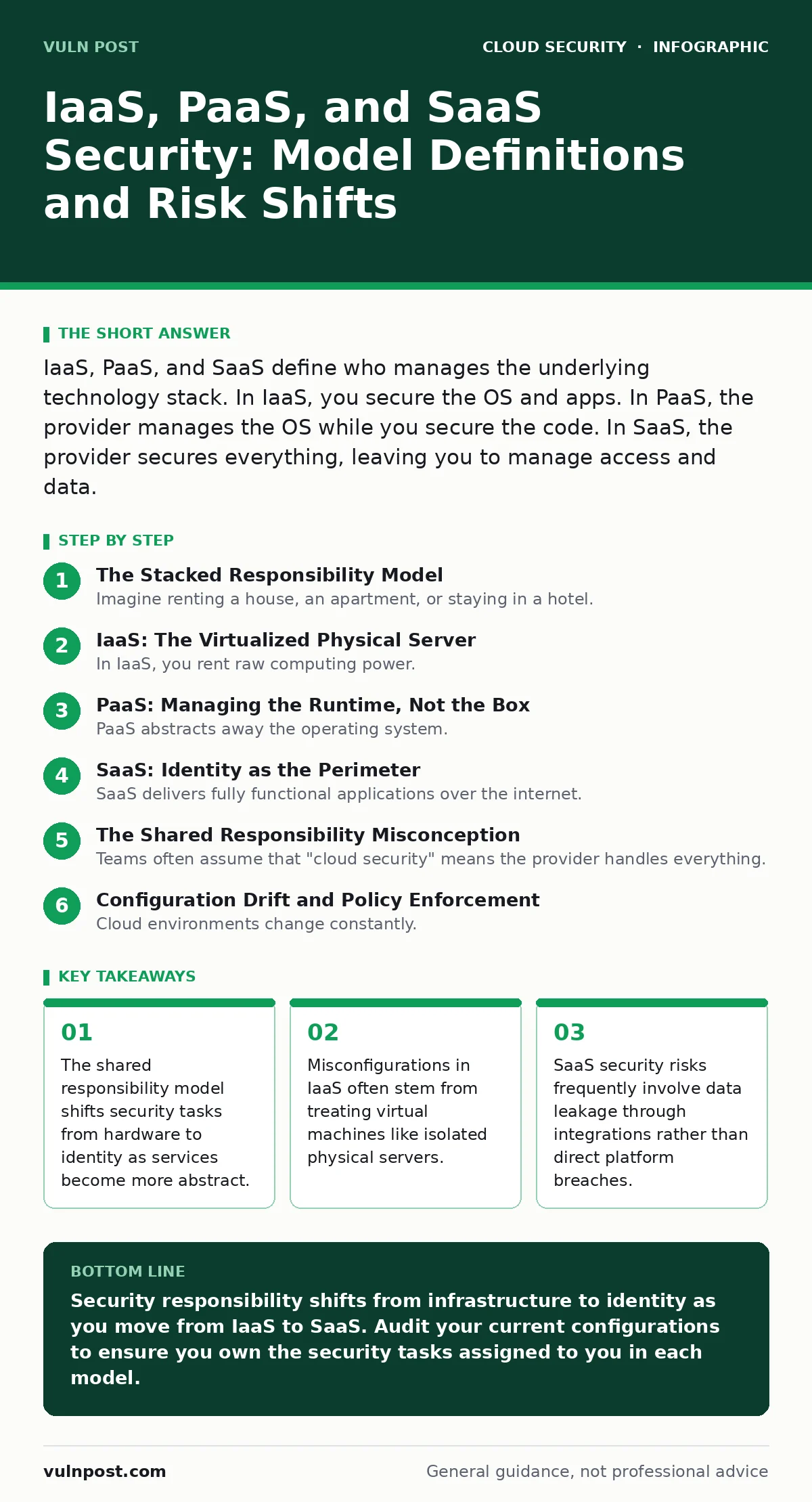
IaaS, PaaS, and SaaS define who manages the underlying technology stack. In IaaS, you secure the OS and apps. In PaaS, the provider manages the OS while you secure the code. In SaaS, the provider secures everything, leaving you to manage access and data.
The Stacked Responsibility Model
Imagine renting a house, an apartment, or staying in a hotel. When you own a house, you fix the roof, the plumbing, and the locks. In an apartment, the landlord maintains the structure, but you control your interior. In a hotel, staff handle everything; you only manage your key card. Cloud computing follows this exact logic. The terms Infrastructure as a Service (IaaS), Platform as a Service (PaaS), and Software as a Service (SaaS) describe layers of abstraction. Each layer changes who is responsible for security controls. Understanding this shift prevents gaps where neither you nor the provider assumes ownership.
| Aspect | IaaS | PaaS | SaaS |
|---|---|---|---|
| Provider Manages | Hardware, Networking, Virtualization | Hardware, Networking, OS, Runtime | Everything including Data and Apps |
| You Manage | OS, Middleware, Apps, Data | Apps, Data, Configuration | Data, Identity, Access Policies |
| Primary Risk | OS Misconfiguration | Supply Chain Vulnerabilities | Identity Mismanagement |
| Security Focus | Patching, Firewalls | Code Security, Dependencies | MFA, Data Loss Prevention |
IaaS: The Virtualized Physical Server
In IaaS, you rent raw computing power. The provider gives you virtual machines, storage, and network connectivity. You install the operating system, configure firewalls, and patch software. This model offers maximum control but demands maximum effort. You are responsible for the entire stack above the hypervisor. The hypervisor is the software layer that allows multiple virtual machines to run on a single physical host.
Many teams treat IaaS virtual machines like physical servers in a data center. This mindset fails in the cloud. Physical servers are isolated by default. Virtual machines share underlying hardware resources. If you neglect to isolate network traffic, a compromised VM can scan and attack others on the same host. This is why cloud network segmentation is critical in IaaS environments. You must define security groups and network access control lists explicitly. Assuming the cloud provider isolates your traffic by default is a dangerous assumption.
PaaS: Managing the Runtime, Not the Box
PaaS abstracts away the operating system. You deploy code to a managed environment. The provider handles patching, scaling, and runtime security. You focus on application logic and data. This reduces operational overhead but introduces dependency risks. You trust the provider’s implementation of the runtime environment. If the runtime has a vulnerability, your application is exposed regardless of your code quality.
The hidden cost of PaaS is reduced visibility. You cannot inspect the kernel or install custom security agents on the host. You rely on the provider’s security posture and your own application security practices. This makes container escape risks relevant even if you do not manage containers directly. The runtime environment acts as a container for your code. If the abstraction layer fails, an attacker may break out of the application context. You must validate third-party libraries and dependencies rigorously. A vulnerable dependency in your code can bypass the platform’s security controls.
SaaS: Identity as the Perimeter
SaaS delivers fully functional applications over the internet. You do not manage servers, runtimes, or even application updates. The provider secures the infrastructure and the application code. Your responsibility is limited to data, user access, and configuration. This shifts the security perimeter from the network to identity. You must ensure that only authorized users access sensitive data.
The most common SaaS failure is not a hack of the platform. It is a misconfiguration of sharing settings or weak identity policies. Users often share documents externally without realizing it. Or they use weak credentials that allow brute-force attacks. You must enforce multi-factor authentication and least privilege access. Data loss prevention tools help monitor for unauthorized sharing. However, these tools cannot stop a user who intentionally exports data. This is why cloud data exfiltration monitoring is necessary. You must detect when data leaves the environment in unexpected volumes or formats.
The Shared Responsibility Misconception
Teams often assume that "cloud security" means the provider handles everything. This is incorrect. The shared responsibility model defines the boundary. The provider secures the cloud itself. You secure what you put in the cloud. This boundary moves depending on the service model. In IaaS, the line is at the hypervisor. In PaaS, it is at the runtime. In SaaS, it is at the user interface.
A common error is assuming that encryption at rest solves all storage risks. Encryption protects data if the storage medium is stolen. It does not protect data if an attacker gains valid credentials. You must secure the keys that encrypt the data. If you use provider-managed keys, you rely on their access controls. If you use your own keys, you must manage rotation and access. This complexity often leads to key management failures.
See also: What Is Cloud Workload Protection: Defining the Scope · Implement Cloud Landing Zones: A Step-by-Step Framework
Configuration Drift and Policy Enforcement
Cloud environments change constantly. Developers spin up resources, modify settings, and tear them down. This dynamic nature causes configuration drift. A secure initial configuration can become insecure over time. Manual audits are insufficient for this pace. You need automated enforcement.
Policy as code allows you to define security rules in a version-controlled format. The system checks configurations against these rules continuously. If a resource violates the policy, the system can alert or auto-remediate. This ensures that security standards are applied consistently. It also provides an audit trail of changes. Without this, you are reacting to issues after they occur.
Integrations and the Expanded Attack Surface
SaaS applications rarely exist in isolation. They connect to other services via APIs. Each integration expands the attack surface. A breach in a less secure integrated app can lead to data exposure in your primary SaaS tool. You must assess the security posture of every third-party connection.
Private endpoints can help secure these connections. They route traffic through a private network interface rather than the public internet. This reduces exposure to scanning and interception. However, private endpoints do not validate the security of the destination application. You still need to trust the partner’s security practices. Reviewing data flow diagrams helps identify unnecessary integrations. Removing unused connections reduces the number of potential entry points for attackers.
Serverless and the Evolving Boundary
Serverless computing pushes abstraction further. You run functions without managing servers or containers. The provider scales resources automatically. This model eliminates server patching but introduces new risks. You must secure the function code and its permissions.
Serverless security risks often involve over-permissive IAM roles. Functions may request more access than they need. If a function is compromised, the attacker inherits those permissions. You must apply least privilege strictly. Monitor function invocations for anomalous behavior. This ensures that even if the code is compromised, the impact is limited. Understanding these nuances is vital for maintaining security as you adopt newer service models.
Key takeaways
- The shared responsibility model shifts security tasks from hardware to identity as services become more abstract.
- Misconfigurations in IaaS often stem from treating virtual machines like isolated physical servers.
- SaaS security risks frequently involve data leakage through integrations rather than direct platform breaches.
- PaaS environments require rigorous supply chain checks because you inherit the security of the runtime environment.
Security responsibility shifts from infrastructure to identity as you move from IaaS to SaaS. Audit your current configurations to ensure you own the security tasks assigned to you in each model.
Frequently asked questions
Who is responsible for patching the operating system in IaaS?
You are responsible for patching the operating system, middleware, and applications. The provider only patches the underlying hypervisor and hardware.
Does SaaS security mean I don't need to worry about data breaches?
No. While the provider secures the platform, you are responsible for securing your data and user access. Misconfigurations and weak credentials remain your risk.
How do I prevent configuration drift in cloud environments?
Use automated policy enforcement tools that continuously check configurations against defined security standards and remediate violations automatically.
Is PaaS safer than IaaS?
PaaS reduces operational security tasks but introduces dependency risks. You rely more on the provider’s security of the runtime environment and less on your own infrastructure management.
How this guide was produced: written by the Vuln Post editorial team with AI assistance, checked against the public references listed below, and reviewed when the facts change. See our editorial policy or report an error.