
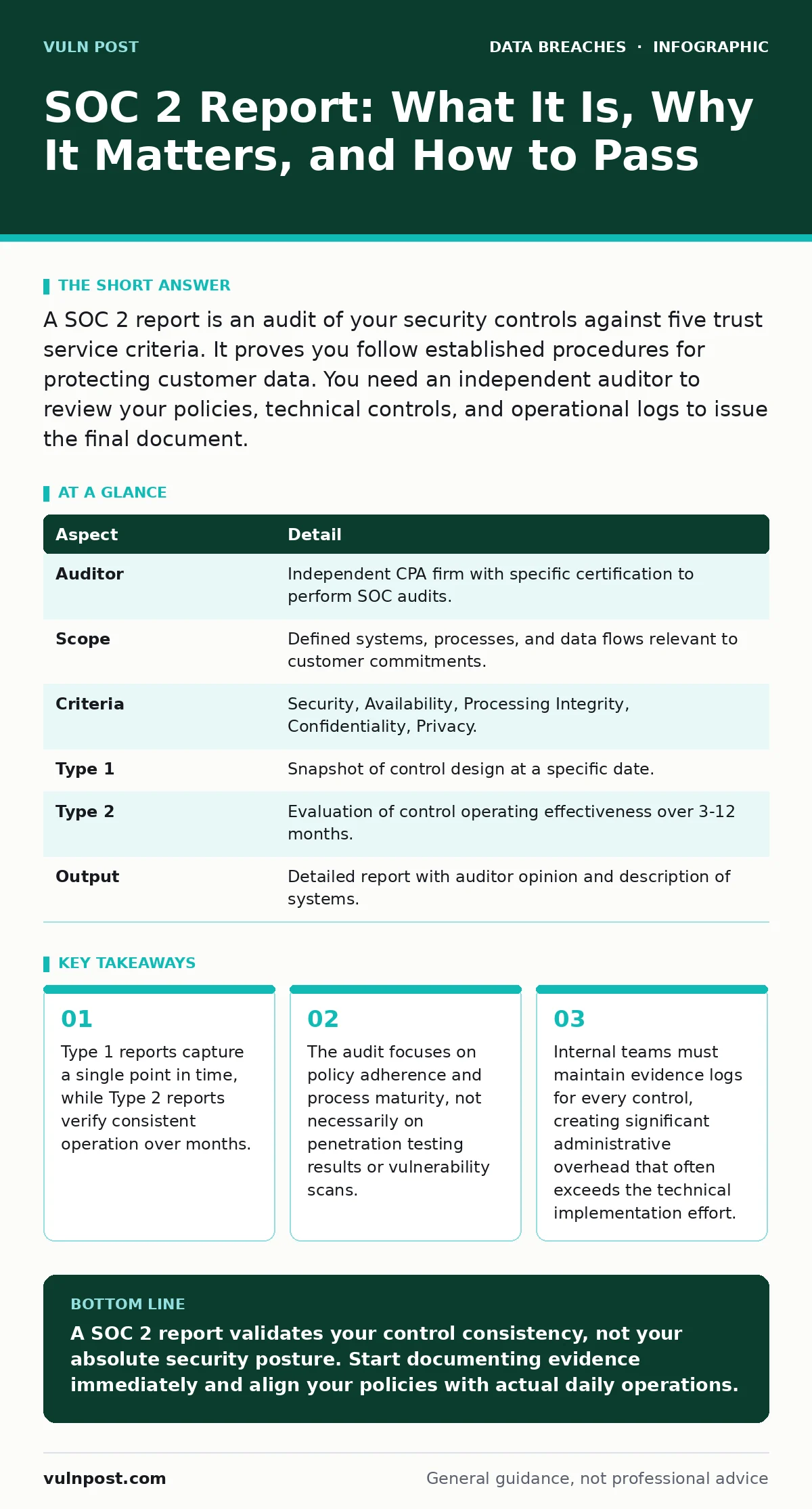
A SOC 2 report is an audit of your security controls against five trust service criteria. It proves you follow established procedures for protecting customer data. You need an independent auditor to review your policies, technical controls, and operational logs to issue the final document.
Understanding the SOC 2 Report Structure
A SOC 2 report is an assurance document issued by an independent Certified Public Accountant. It evaluates how your organization manages customer data based on five trust service criteria: security, availability, processing integrity, confidentiality, and privacy. Most organizations focus on the security criterion, which aligns with the general standards for system protection. The report does not certify that your system is hack-proof. It certifies that your documented controls are designed properly and, in the case of a Type 2 report, operated effectively over a defined period.
Imagine you are renting a secure storage unit. The landlord gives you a brochure claiming the building has 24-hour guards, biometric locks, and camera surveillance. A Type 1 SOC 2 report is like a photo of the guard booth and the lock mechanism, proving they exist. A Type 2 report is a logbook showing that guards were present every hour for six months and that the cameras recorded continuously without interruption. The photo proves design; the logbook proves operation.
| Aspect | Detail |
|---|---|
| Auditor | Independent CPA firm with specific certification to perform SOC audits. |
| Scope | Defined systems, processes, and data flows relevant to customer commitments. |
| Criteria | Security, Availability, Processing Integrity, Confidentiality, Privacy. |
| Type 1 | Snapshot of control design at a specific date. |
| Type 2 | Evaluation of control operating effectiveness over 3-12 months. |
| Output | Detailed report with auditor opinion and description of systems. |
How the Audit Process Works
The audit begins with a scoping meeting where you define the boundaries of the system. You must list every server, application, and third-party service that touches customer data. This step requires precise data inventory and mapping to avoid excluding critical assets or including irrelevant internal tools. The auditor reviews your policy documents to ensure they align with the trust service criteria. They then test the controls. For Type 1, they interview staff and check configuration settings. For Type 2, they review logs, ticket histories, and access records over the entire period.
The auditor looks for exceptions. If your policy states that all employees undergo background checks, the auditor will request a sample of personnel files. If one file is missing, it becomes a finding. If your policy requires 24-hour log retention, but your system only keeps 7 days, that is a gap. The auditor does not fix the gap. They note it in the report. Your responsibility is to remediate the issue before the next audit cycle or address it in the current report as a noted deficiency.
Who Needs a SOC 2 Report
Vendors handling sensitive customer data typically require this report. If you process personal information, financial records, or health data, your customers will likely demand proof of your security posture. The report serves as a standardized way to share your security details without giving auditors direct access to your infrastructure. It reduces the number of custom security questionnaires you must answer. Instead of filling out 50 different forms for 50 different clients, you provide one report that covers common concerns.
Startups selling B2B SaaS products often pursue SOC 2 Type 1 early to win enterprise deals. Larger organizations aim for Type 2 to demonstrate maturity. Internal teams must understand that the audit affects every department that touches the system. Engineering configures the controls. HR manages onboarding and offboarding. Legal drafts the privacy policies. Operations monitors the logs. No single team owns the report. The entire organization must maintain the evidence.
What People Usually Get Wrong
Many organizations believe that passing the audit means they are secure. This is a dangerous misconception. The audit verifies that you followed your own policies. If your policies are weak, the audit will still pass. You can have a SOC 2 report while maintaining poor security practices, provided those practices are documented and consistently applied. The report measures consistency, not strength.
Another common error is assuming the audit covers everything. The scope is limited to what you declare. If you use a third-party cloud provider, you rely on their reports for their infrastructure. You are only responsible for your configuration of their services. You must perform encryption key management correctly within that environment. If you store keys insecurely, your report will reflect that failure, even if the cloud provider’s infrastructure is flawless. The auditor does not fix your cloud configuration mistakes.
Managing Evidence and Operational Costs
The hidden cost of SOC 2 is evidence collection. Every control requires proof. If you have a control for patch management, you need logs showing when patches were applied. If you have a control for incident response, you need tickets showing how incidents were handled. Manual collection of this evidence is tedious and error-prone. Teams often spend hundreds of hours gathering screenshots and logs. Automation tools can help, but they require initial setup and maintenance.
You must also consider log retention policies. Auditors often request logs from months ago. If your system overwrites logs after 30 days, you cannot prove compliance for a 6-month Type 2 audit. You need a secure, immutable storage solution for logs. This adds storage costs and complexity to your architecture. The cost of storing logs is often lower than the cost of manual evidence gathering, but both must be budgeted.
See also: Secure File Sharing Mechanics: How Encryption and Access Control Work · Mobile Device Management for Small Business: Control Without Chaos
Integrating with Other Security Practices
SOC 2 does not replace other security measures. It complements them. You still need penetration testing to find vulnerabilities that policy reviews miss. You still need mobile device management to secure remote access. You still need employee offboarding security procedures to revoke access immediately when staff leave. The audit will check if these processes exist and are followed. It will not test if they are effective against a determined attacker.
Think of SOC 2 as the foundation of your security house. It does not ensure the roof can withstand a hurricane. You need additional assessments for threat modeling and red teaming. These activities provide different insights. SOC 2 proves you have rules. Penetration testing proves your defenses hold up under pressure. Both are necessary for a mature security program.
Preparing for the Audit Cycle
Start preparation months before the audit. Clean up your documentation. Ensure policies are current and reflect actual practices. If your policy says you scan for vulnerabilities weekly, but you only scan monthly, update the policy or change the practice. Consistency is key. Run internal audits to find gaps early. Fix them before the external auditor arrives.
Train your staff on what to expect. They will be interviewed. They need to know their roles and the controls they support. Confusion during interviews raises red flags. Practice answers beforehand. Ensure every employee understands that their daily actions are part of the audit evidence. A single unlogged login or missing ticket can trigger a finding.
Key takeaways
- Type 1 reports capture a single point in time, while Type 2 reports verify consistent operation over months.
- The audit focuses on policy adherence and process maturity, not necessarily on penetration testing results or vulnerability scans.
- Internal teams must maintain evidence logs for every control, creating significant administrative overhead that often exceeds the technical implementation effort.
A SOC 2 report validates your control consistency, not your absolute security posture. Start documenting evidence immediately and align your policies with actual daily operations.
Frequently asked questions
How long does a SOC 2 audit take?
The audit duration depends on your system complexity and evidence readiness. It typically takes 1 to 3 months for the auditor to review and issue the report.
Can I get a SOC 2 report without an auditor?
No. An independent CPA firm must perform the audit and issue the report. Self-assessment does not produce a valid SOC 2 document.
What is the difference between Type 1 and Type 2?
Type 1 assesses design at a point in time. Type 2 assesses operating effectiveness over a period of at least 3 months.
How often do I need to renew the report?
Most organizations update their SOC 2 report annually. This ensures the controls remain effective and aligned with current business operations.
How this guide was produced: written by the Vuln Post editorial team with AI assistance, checked against the public references listed below, and reviewed when the facts change. See our editorial policy or report an error.