
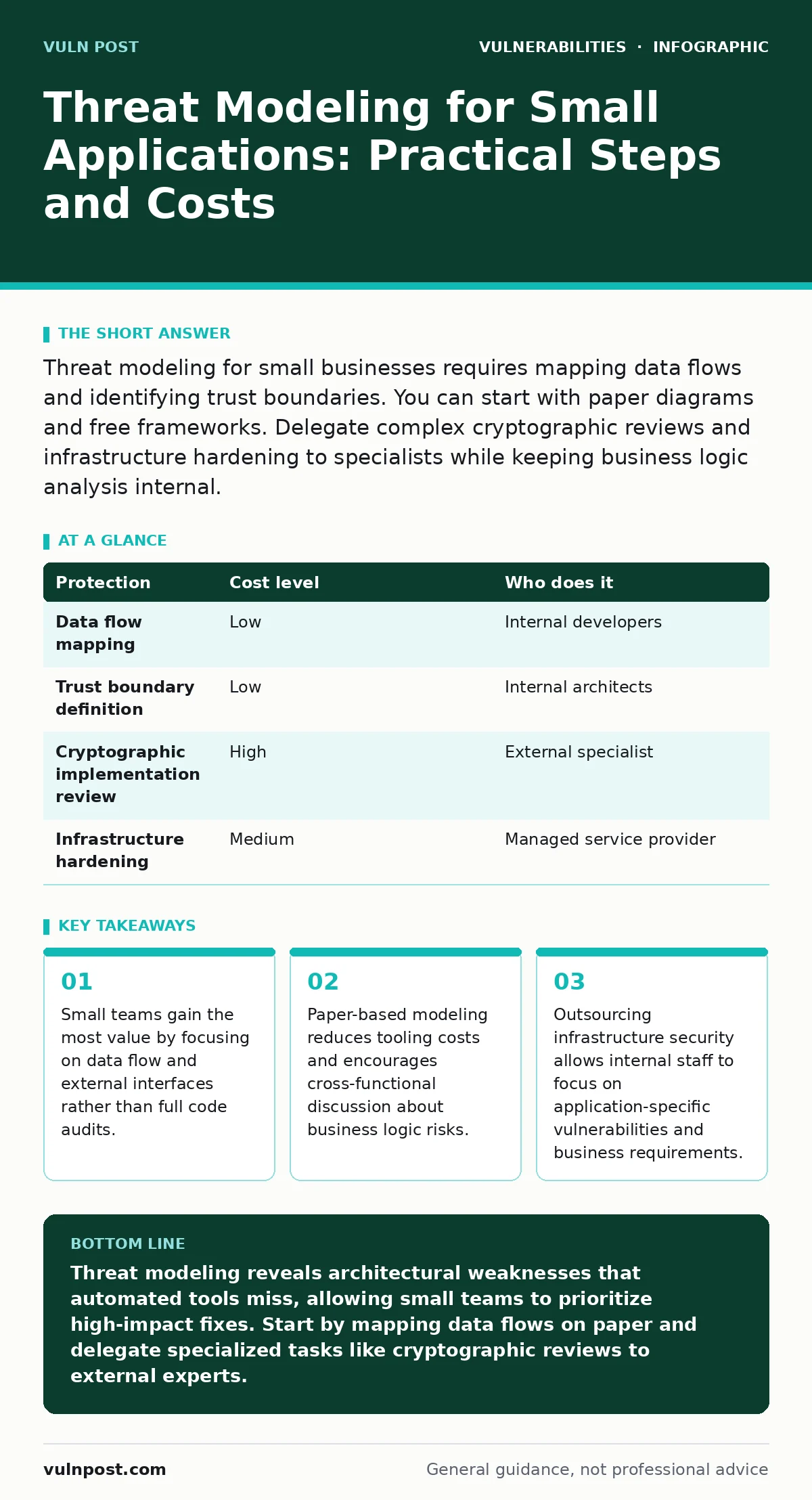
Threat modeling for small businesses requires mapping data flows and identifying trust boundaries. You can start with paper diagrams and free frameworks. Delegate complex cryptographic reviews and infrastructure hardening to specialists while keeping business logic analysis internal.
Why Modeling Matters for Small Teams
Threat modeling identifies risks early in the development lifecycle, reducing the cost of remediation. Small teams often assume that limited exposure means limited risk. This assumption fails when a single misconfiguration exposes sensitive data to the public internet. Modeling forces you to define what you are protecting and who might want it.
You do not need a large budget to start. The primary cost is time spent thinking about system interactions. By documenting how data moves through your application, you create a shared understanding of security requirements. This documentation serves as a baseline for future changes and helps new hires understand the security posture.
Affordable Modeling Methods
Paper and whiteboards remain the most effective tools for initial threat modeling. Digital tools can create a false sense of completeness. Drawing boxes and arrows forces you to clarify component relationships. You identify where data enters the system, where it is processed, and where it exits.
Use standard frameworks to structure your analysis. The STRIDE framework categorizes threats into Spoofing, Tampering, Repudiation, Information Disclosure, Denial of Service, and Elevation of Privilege. Applying these categories to each component ensures you consider a wide range of attack vectors. This method is free and requires no software installation.
| Protection | Cost level | Who does it |
|---|---|---|
| Data flow mapping | Low | Internal developers |
| Trust boundary definition | Low | Internal architects |
| Cryptographic implementation review | High | External specialist |
| Infrastructure hardening | Medium | Managed service provider |
Defining Trust Boundaries
A trust boundary is a point where data moves from a less trusted environment to a more trusted one. Every input crossing this boundary must be validated. Small applications often fail here by trusting data from external APIs or user inputs without strict validation.
Identify all external inputs. These include web forms, API calls, and file uploads. Ask how an attacker could manipulate these inputs. Consider scenarios where an attacker sends malformed data to trigger errors or bypass logic. This analysis reveals vulnerabilities that static code analysis tools often miss because they do not understand business context.
Delegating Complex Security Tasks
Small teams lack the bandwidth to become experts in every security domain. You should delegate tasks that require specialized knowledge or continuous monitoring. Cryptographic implementation is a prime candidate for delegation. Incorrect use of encryption libraries can render data protection useless.
Infrastructure security also benefits from external expertise. Configuring firewalls, load balancers, and cloud resources requires up-to-date knowledge of provider-specific risks. A managed service provider can handle these tasks, freeing your team to focus on application logic. Ensure the provider follows established standards for configuration hardening.
Questions for IT Providers
When outsourcing security tasks, you must verify the provider's capabilities. Ask specific questions to ensure they address your unique risks. Do not accept generic answers about "best practices." You need to know how they handle specific scenarios relevant to your application architecture.
- How do you validate that third-party components do not introduce known vulnerabilities?
- What is your process for updating systems when a new CVE identifier is published?
- How do you monitor for unusual traffic patterns that might indicate an active attack?
- Can you provide evidence that your configuration matches industry benchmarks for your platform?
Integrating with Development
Threat modeling is not a one-time event. You must integrate it into your development workflow. Update your models whenever you add new features or change existing components. This ensures that new risks are identified before code is deployed.
Use your models to inform testing priorities. If your model identifies a high-risk trust boundary, focus your manual testing efforts there. This targeted approach is more efficient than trying to test every line of code. It also helps developers understand why certain security checks are necessary.
Common Pitfalls to Avoid
Small teams often fall into the trap of over-engineering security controls. Adding complex authentication mechanisms or encryption layers without a clear threat model creates maintenance burdens. These controls can introduce new vulnerabilities if not implemented correctly.
Another common mistake is ignoring internal threats. While external attackers are a primary concern, insider risks are often easier to exploit. Ensure your model accounts for privileged users and service accounts. Define strict access controls and monitor for anomalous behavior.
Leveraging Existing Knowledge
You do not need to invent new security controls. Many vulnerabilities are well-documented and have established mitigation strategies. Refer to public frameworks and standards when designing your defenses. This ensures you are not missing known issues.
For example, understanding JWT vulnerabilities helps you design secure authentication flows. Knowing how CRLF injection works prevents header manipulation attacks. These are common issues that can be addressed with standard coding practices and input validation.
Maintaining the Model
Keep your threat models accessible and up to date. Store them in a version-controlled repository alongside your code. This ensures that changes to the model are tracked and reviewed. It also provides a historical record of security decisions.
Review your models periodically. Technology changes, and new attack techniques emerge. Regular reviews ensure your defenses remain effective. Involve different team members in each review to gain fresh perspectives and identify blind spots.
Key takeaways
- Small teams gain the most value by focusing on data flow and external interfaces rather than full code audits.
- Paper-based modeling reduces tooling costs and encourages cross-functional discussion about business logic risks.
- Outsourcing infrastructure security allows internal staff to focus on application-specific vulnerabilities and business requirements.
Threat modeling reveals architectural weaknesses that automated tools miss, allowing small teams to prioritize high-impact fixes. Start by mapping data flows on paper and delegate specialized tasks like cryptographic reviews to external experts.
Frequently asked questions
How often should we update our threat model?
Update your model whenever you add significant features or change system architecture. Conduct a full review at least once per major release cycle to ensure accuracy.
How do we measure the success of threat modeling?
Measure success by the number of high-severity vulnerabilities found during design reviews versus those found in production. A decrease in production issues indicates effective modeling.
How this guide was produced: written by the Vuln Post editorial team with AI assistance, checked against the public references listed below, and reviewed when the facts change. See our editorial policy or report an error.