
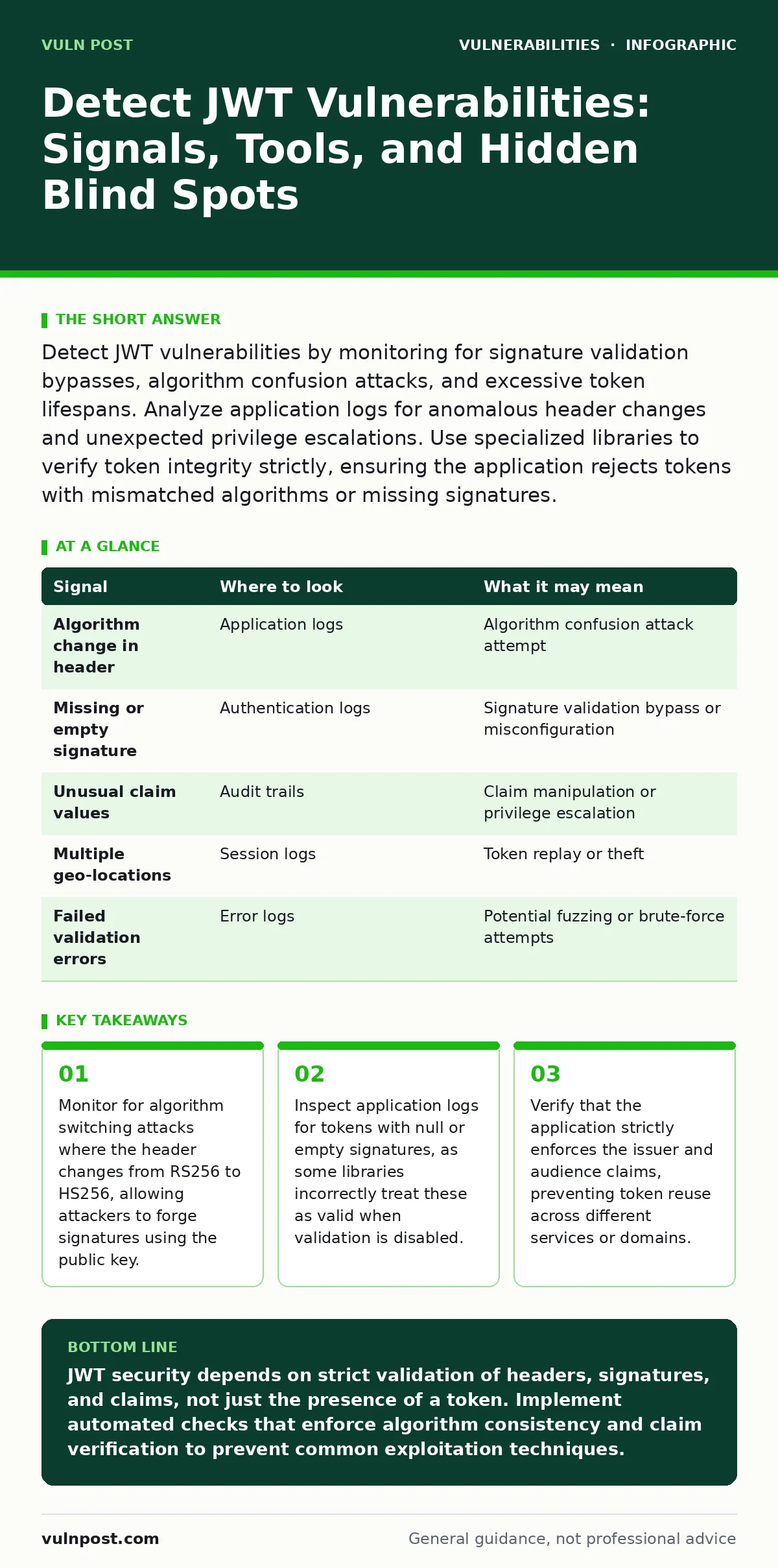
Detect JWT vulnerabilities by monitoring for signature validation bypasses, algorithm confusion attacks, and excessive token lifespans. Analyze application logs for anomalous header changes and unexpected privilege escalations. Use specialized libraries to verify token integrity strictly, ensuring the application rejects tokens with mismatched algorithms or missing signatures.
Algorithm Confusion in Token Headers
JWT vulnerabilities often arise from how the application processes the algorithm specified in the token header. Imagine an application that accepts tokens signed with RSA public keys. An attacker might change the header algorithm to HMAC-SHA256. If the application blindly uses the public key as the HMAC secret, the attacker can forge a valid signature. You must detect this by checking if the algorithm in the token matches the expected algorithm in your configuration.
This attack exploits the difference between asymmetric and symmetric signing. Asymmetric algorithms use a public key for verification and a private key for signing. Symmetric algorithms use the same key for both. When an application fails to enforce the algorithm type, it creates a logical gap. You will see this in logs when a token with a changed algorithm header succeeds in authentication. The application should reject any token where the header algorithm differs from the server-side expectation.
Signature Validation Bypasses
Some JWT libraries contain bugs that allow tokens to be accepted without a valid signature. These vulnerabilities often occur when the library defaults to a permissive mode or when the application code explicitly disables verification for testing. You can detect this by sending tokens with corrupted signatures to your endpoints. If the application accepts the token, your validation logic is broken.
Monitor your application logs for tokens with empty or null signature fields. A properly secured application should reject these immediately. If you see successful logins or data access associated with tokens lacking a signature, your system is vulnerable. This is not a cryptographic weakness but a configuration error. You must ensure that your JWT parsing library is configured to require a signature by default. Regular audits of your dependency versions help catch these library-level flaws.
Claim Manipulation and Privilege Escalation
JWT payloads contain claims that define the user’s identity and permissions. Attackers may attempt to modify these claims to escalate privileges. For example, an attacker might change a "role" claim from "user" to "admin". If the application trusts these claims without verifying the signature, the attack succeeds. You must detect this by ensuring the application never trusts unsigned claims.
Even with a valid signature, attackers might exploit weak validation of specific claims. Suppose your application checks for the presence of an admin claim but does not verify its source. An attacker could inject additional claims that override default permissions. You should look for anomalies in the claim structure during log analysis. Unexpected fields or modified standard claims indicate manipulation. Your application should validate each critical claim against a trusted source, not just the token itself.
Token Lifetime and Replay Attacks
JWTs often have long expiration times to reduce server load. This convenience creates a window for replay attacks. If an attacker steals a valid token, they can use it until it expires. You can detect this by monitoring for multiple sessions originating from different locations or user agents with the same token. This behavior suggests the token has been compromised and is being reused maliciously.
Shortening token lifespans reduces the impact of stolen tokens. However, this increases the frequency of re-authentication, which can degrade user experience. You must balance security and usability. Implement refresh tokens that are short-lived and bound to specific sessions. Monitor for rapid refresh attempts from unusual locations. This pattern may indicate an attacker trying to extend their access window. Your logs should flag tokens used outside their expected geographic or temporal context.
| Signal | Where to look | What it may mean |
|---|---|---|
| Algorithm change in header | Application logs | Algorithm confusion attack attempt |
| Missing or empty signature | Authentication logs | Signature validation bypass or misconfiguration |
| Unusual claim values | Audit trails | Claim manipulation or privilege escalation |
| Multiple geo-locations | Session logs | Token replay or theft |
| Failed validation errors | Error logs | Potential fuzzing or brute-force attempts |
Blind Spots in Standard Monitoring
Standard security tools often miss JWT-specific vulnerabilities because they treat tokens as opaque strings. You might have robust input validation for other data types, but JWTs require specialized parsing. If your web application firewall does not inspect JWT structure, it may allow malicious tokens to pass through. You must configure your monitoring to decode and analyze token headers and payloads.
Another blind spot is the misuse of public keys. Some applications fetch public keys from a well-known URL. If an attacker can control this URL or the DNS resolution, they can serve a malicious key that validates forged tokens. You should monitor for changes in the key discovery endpoint. Ensure the application pins the expected key identifier. This prevents key substitution attacks that bypass standard signature checks.
Integrating Detection with Defense
Detecting JWT vulnerabilities requires integrating specialized checks into your existing security stack. You should use libraries that enforce strict validation rules by default. These libraries prevent common mistakes like accepting null signatures or allowing algorithm switching. Regularly update these dependencies to patch known vulnerabilities. Many JWT libraries have had critical flaws discovered in recent years.
Combine automated detection with manual review of high-risk endpoints. Focus on endpoints that handle sensitive actions like password changes or administrative tasks. These endpoints should require additional verification beyond the JWT. You might require re-authentication or multi-factor authentication for these actions. This adds a layer of defense that compensates for potential token weaknesses.
Configuration Hardening for JWT Security
Configuration errors are the most common cause of JWT vulnerabilities. You must ensure your application enforces strict validation rules. This includes checking the issuer, audience, expiration, and signature. Do not disable any of these checks for convenience. Each check serves a specific security purpose. Removing one weakens the entire authentication mechanism.
Regularly review your JWT configuration against best practices. Ensure that secret keys are stored securely and rotated periodically. Public keys should be verified for integrity before use. Monitor for configuration drift, where settings change over time and weaken security. Automated tests can help verify that your validation logic remains strict. These tests should include cases for malformed tokens, expired tokens, and tokens with invalid algorithms.
Key takeaways
- Monitor for algorithm switching attacks where the header changes from RS256 to HS256, allowing attackers to forge signatures using the public key.
- Inspect application logs for tokens with null or empty signatures, as some libraries incorrectly treat these as valid when validation is disabled.
- Verify that the application strictly enforces the issuer and audience claims, preventing token reuse across different services or domains.
JWT security depends on strict validation of headers, signatures, and claims, not just the presence of a token. Implement automated checks that enforce algorithm consistency and claim verification to prevent common exploitation techniques.
Frequently asked questions
How do I detect if my application is vulnerable to algorithm confusion?
Test your application by sending a token with the algorithm changed to HS256 and signed with the public key. If the application accepts it, you are vulnerable.
Can I use standard web application firewalls to detect JWT attacks?
Standard firewalls may miss JWT-specific issues unless configured to parse and validate token structure. You need custom rules or specialized modules to inspect JWT headers and claims effectively.
What is the risk of using long-lived JWTs?
Long-lived JWTs increase the window for replay attacks if a token is stolen. You mitigate this by using short expiration times and implementing refresh tokens with strict session binding.
How do I prevent claim manipulation in JWTs?
Always verify the token signature before trusting any claims. Additionally, validate critical claims like roles and permissions against a trusted database or identity provider, not just the token itself.
How this guide was produced: written by the Vuln Post editorial team with AI assistance, checked against the public references listed below, and reviewed when the facts change. See our editorial policy or report an error.