
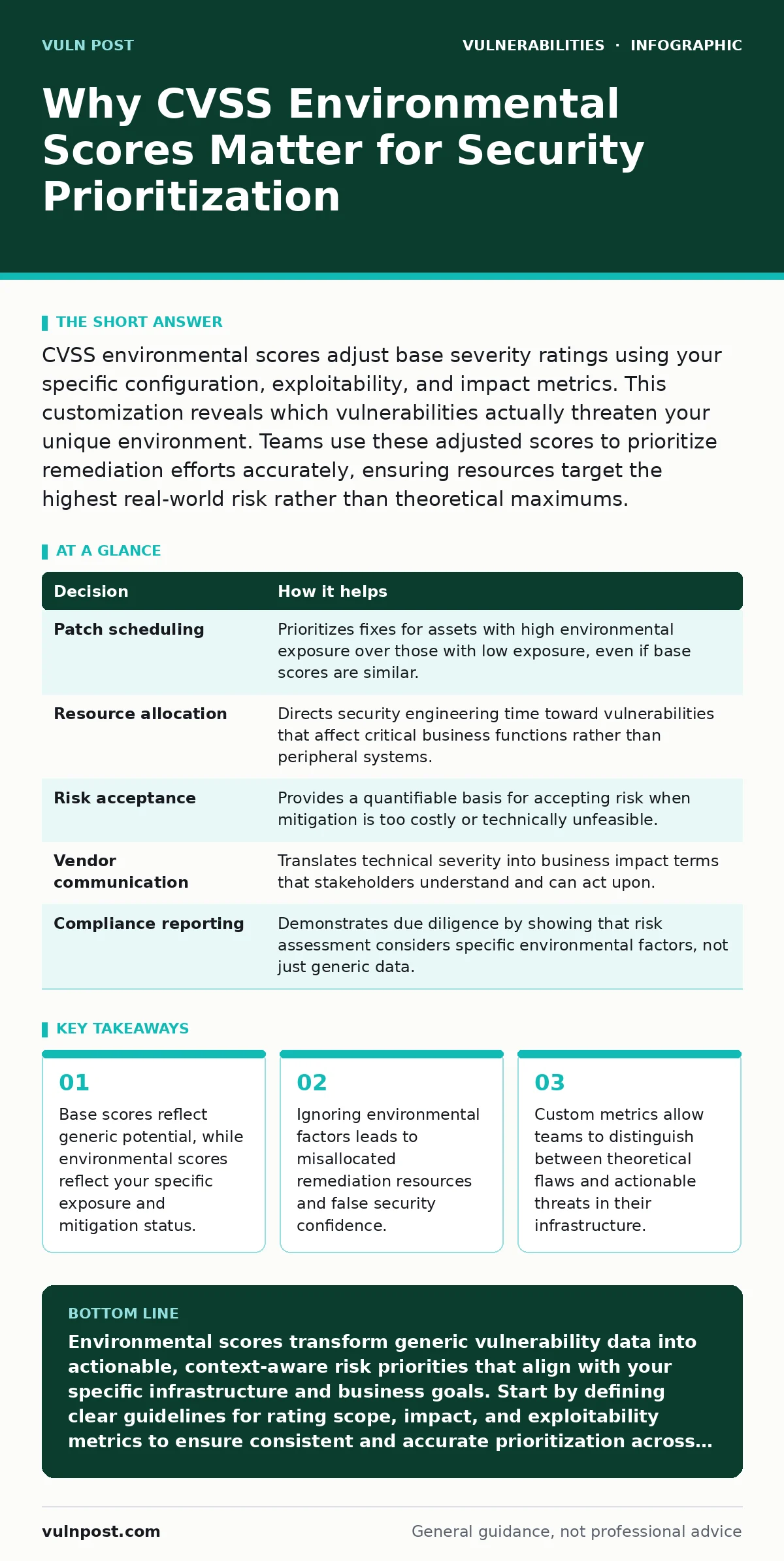
CVSS environmental scores adjust base severity ratings using your specific configuration, exploitability, and impact metrics. This customization reveals which vulnerabilities actually threaten your unique environment. Teams use these adjusted scores to prioritize remediation efforts accurately, ensuring resources target the highest real-world risk rather than theoretical maximums.
The Limitation of Base Scores
Common Vulnerability Scoring System base scores measure the inherent severity of a flaw independent of any specific implementation. They assume a worst-case scenario where an attacker has no barriers and the affected asset is critical. This abstraction helps vendors communicate risk broadly but fails to tell you how that risk applies to your network. A remote code execution flaw in a library you do not use has a high base score but zero actual risk to your operations. Relying solely on these numbers creates noise. You must look beyond the base rating to understand the true threat level. The environmental metrics bridge the gap between theoretical vulnerability and practical exposure.
What Environmental Scores Measure
Environmental scores modify the base rating by incorporating three categories of metrics: scope, confidentiality, integrity, and availability impact; exploitability conditions; and remediation levels. You define these values based on your current infrastructure state. For example, you might lower the exploitability metric if a firewall blocks the relevant traffic. You might raise the impact metric if the affected service hosts sensitive customer data. These adjustments create a score that reflects your specific reality. This process turns a static number into a dynamic risk indicator. It allows you to compare vulnerabilities across different systems fairly.
| Decision | How it helps |
|---|---|
| Patch scheduling | Prioritizes fixes for assets with high environmental exposure over those with low exposure, even if base scores are similar. |
| Resource allocation | Directs security engineering time toward vulnerabilities that affect critical business functions rather than peripheral systems. |
| Risk acceptance | Provides a quantifiable basis for accepting risk when mitigation is too costly or technically unfeasible. |
| Vendor communication | Translates technical severity into business impact terms that stakeholders understand and can act upon. |
| Compliance reporting | Demonstrates due diligence by showing that risk assessment considers specific environmental factors, not just generic data. |
The Cost of Ignoring Context
Imagine two security teams facing the same vulnerability in a popular web framework. Team A looks only at the base score, which is 9.8. They immediately halt all development to patch every instance, causing significant operational disruption. Team B calculates the environmental score. They discover that their deployment architecture isolates the vulnerable component behind a strict authentication layer and that the specific function is disabled in their configuration.
Their environmental score drops to 2.1. Team B logs the issue for the next maintenance window and continues their sprint. Team A wasted days on a fix that provided no immediate security benefit. Team B maintained security posture without sacrificing productivity. This difference highlights the hidden cost of context blindness.
Configuring Scope and Impact
The scope metric determines whether a vulnerability affects only the vulnerable component or other systems. If a flaw in a web server allows an attacker to compromise the underlying operating system, the scope changes. You must identify if your deployment uses isolation techniques like containers or virtual machines. If these controls are effective, the scope may remain unchanged.
The impact metrics assess confidentiality, integrity, and availability. You evaluate these based on what data resides on the affected system. A server hosting public documentation has low confidentiality impact. A server holding encryption keys has high confidentiality impact. Accurately rating these factors requires deep knowledge of your data flow. Misjudging them leads to incorrect prioritization.
Adjusting Exploitability Metrics
Exploitability metrics reflect how easy it is to exploit the vulnerability in your environment. You consider the attack vector, complexity, privileges required, and user interaction. If your application requires multi-factor authentication, the privileges required metric increases, lowering the score. If the vulnerable endpoint is only accessible via an internal network, the attack vector metric changes from network to local.
You must also consider user interaction. If the flaw requires a user to click a link, and your security awareness training reduces click rates, you can adjust the metric accordingly. These adjustments require evidence. You cannot simply assume controls work. You must verify that your security measures are active and effective. This verification step is often skipped, leading to overconfidence.
See also: Why CVE Identifiers Matter for Security Operations · Threat Modeling for Small Applications: Practical Steps and Costs
Integrating with Remediation Workflows
Security operations teams use environmental scores to drive their remediation workflows. The score determines the urgency of the fix. High environmental scores trigger immediate action. Low scores may be accepted or monitored. This integration requires automation. Manually calculating scores for thousands of vulnerabilities is impossible.
You need tools that can ingest your configuration data and automatically adjust the metrics. These tools should pull data from your asset inventory, configuration management database, and security controls. The output is a prioritized list of vulnerabilities. This list becomes the source of truth for your patching schedule. It ensures that your team works on the most dangerous flaws first.
Common Implementation Pitfalls
Teams often struggle with consistency when applying environmental metrics. Different analysts may rate the same vulnerability differently based on their interpretation of the controls. This inconsistency undermines the value of the score. You need standardized guidelines for rating each metric. Document what evidence is required to adjust a metric. Train your team on these guidelines.
Another pitfall is static scoring. Environments change. A server that was isolated may become connected. A control that was effective may be bypassed. You must recalculate environmental scores when your environment changes. Failing to update these scores leads to stale risk assessments. Regular reviews ensure that your prioritization remains accurate.
Beyond Standard Vulnerabilities
Environmental scoring applies to all types of vulnerabilities, not just software bugs. It helps you assess the risk of configuration errors, such as those found during configuration hardening reviews. It also applies to logic flaws like broken access control or authentication bypass vulnerabilities. For instance, a broken access control flaw might have a moderate base score.
However, if it allows access to administrative functions, the environmental impact score rises significantly. Similarly, side-channel attacks might have low base scores because they require specific physical or timing conditions. If your environment exposes these conditions, the environmental score increases. Understanding these nuances ensures that you do not overlook subtle but dangerous threats.
Making Informed Decisions
The ultimate goal of using CVSS environmental scores is to make informed security decisions. You move from reactive patching to proactive risk management. You understand which vulnerabilities pose the greatest threat to your specific business objectives. You allocate resources efficiently, focusing on high-impact areas. This approach reduces the burden on your security team.
It also improves your overall security posture. By addressing the most relevant risks first, you reduce your attack surface effectively. You build a culture of risk-awareness. Your team learns to think critically about vulnerabilities and their context. This mindset shift is more valuable than any single tool or process. It empowers you to defend your organization against evolving threats.
Key takeaways
- Base scores reflect generic potential, while environmental scores reflect your specific exposure and mitigation status.
- Ignoring environmental factors leads to misallocated remediation resources and false security confidence.
- Custom metrics allow teams to distinguish between theoretical flaws and actionable threats in their infrastructure.
Environmental scores transform generic vulnerability data into actionable, context-aware risk priorities that align with your specific infrastructure and business goals. Start by defining clear guidelines for rating scope, impact, and exploitability metrics to ensure consistent and accurate prioritization across your security operations.
Frequently asked questions
How do I calculate environmental scores for a large number of vulnerabilities?
Use automated tools that integrate with your asset inventory and configuration management systems to apply predefined metric adjustments based on your environment.
Can environmental scores be lower than the base score?
Yes, if your environment has strong mitigations, limited scope, or low impact on critical assets, the environmental score will reflect the reduced risk.
Do environmental scores replace base scores?
No, base scores provide a standardized measure of inherent severity, while environmental scores contextualize that severity for your specific situation.
How often should I update environmental scores?
Update them whenever your infrastructure, security controls, or data classification changes to ensure the risk assessment remains accurate.
How this guide was produced: written by the Vuln Post editorial team with AI assistance, checked against the public references listed below, and reviewed when the facts change. See our editorial policy or report an error.