
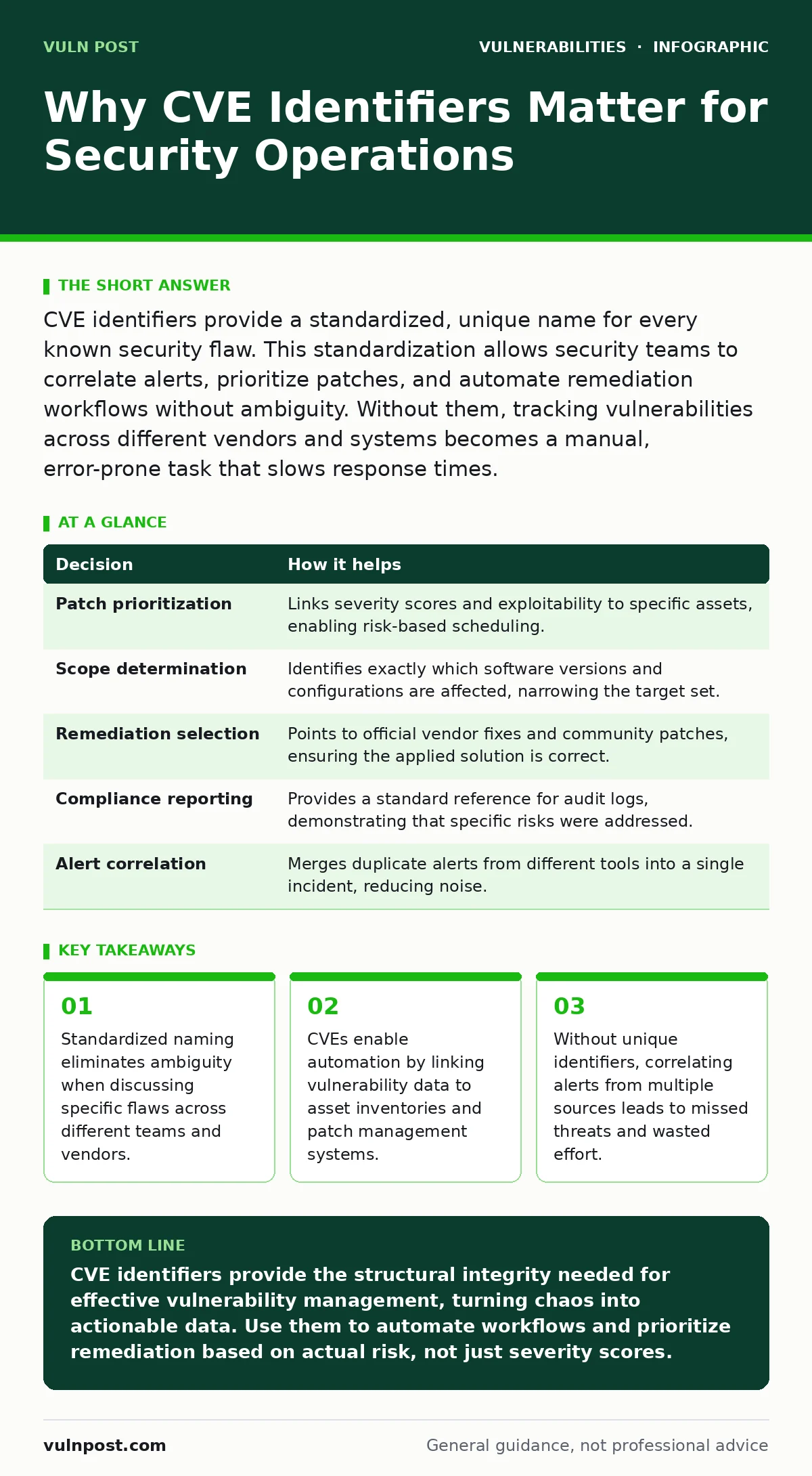
CVE identifiers provide a standardized, unique name for every known security flaw. This standardization allows security teams to correlate alerts, prioritize patches, and automate remediation workflows without ambiguity. Without them, tracking vulnerabilities across different vendors and systems becomes a manual, error-prone task that slows response times.
The Problem of Unnamed Risks
Imagine a security operations center receiving an alert about a buffer overflow in a web server. The alert comes from an intrusion detection system, but it lacks a specific reference. The team must manually search vendor advisories, cross-reference internal asset lists, and guess which systems are affected. This process is slow and prone to human error. Different team members might use different names for the same flaw, causing confusion during incident response.
Without a standardized identifier, communication breaks down. One engineer might refer to "the Apache issue," while another calls it "the HTTP parser bug." This linguistic drift creates gaps in defense. A vulnerability might remain unpatched simply because the ticketing system does not recognize it as the same issue reported by a different sensor. The lack of a common language turns a technical problem into a coordination failure.
How CVE Standardizes Communication
The Common Vulnerabilities and Exposures (CVE) system assigns a unique identifier to each publicly disclosed vulnerability. This identifier, such as CVE-YYYY-NNNN, serves as a universal reference point. When a vendor publishes a fix, they include the CVE ID. When a scanner detects the flaw, it reports the same ID. This consistency ensures that everyone is discussing the exact same code defect.
This standardization extends beyond simple naming. It creates a structured data model for security information. Each CVE entry includes a description, affected products, and severity scores. This data feeds into vulnerability databases, allowing tools to query and filter risks programmatically. You can search for all vulnerabilities affecting a specific version of a software library, regardless of who produced it. This eliminates the need for manual keyword searches that often return irrelevant results.
Decision Support Through Structured Data
CVE identifiers inform critical operational decisions by providing a clear link between a flaw and its impact. When a new vulnerability is disclosed, teams must decide whether to patch immediately, accept the risk, or apply a workaround. The CVE ID allows you to quickly gather all relevant context, including exploit availability and severity ratings. This context prevents overreaction to low-risk issues and underreaction to critical ones.
Consider the decision to patch a production server. If the CVE indicates that the vulnerability is only exploitable via authenticated access, and your server is isolated, you might delay patching until the next maintenance window. Conversely, a CVE indicating remote code execution without authentication would trigger an immediate response. The identifier enables this nuanced decision-making by providing a single point of reference for all technical details.
| Decision | How it helps |
|---|---|
| Patch prioritization | Links severity scores and exploitability to specific assets, enabling risk-based scheduling. |
| Scope determination | Identifies exactly which software versions and configurations are affected, narrowing the target set. |
| Remediation selection | Points to official vendor fixes and community patches, ensuring the applied solution is correct. |
| Compliance reporting | Provides a standard reference for audit logs, demonstrating that specific risks were addressed. |
| Alert correlation | Merges duplicate alerts from different tools into a single incident, reducing noise. |
Automation and Workflow Integration
Security teams rely on automation to handle the volume of modern threats. CVE identifiers are the key that unlocks this automation. Vulnerability scanners, configuration management tools, and incident response platforms all use CVE IDs as primary keys. When a scanner finds a flaw, it tags the finding with the CVE. The patch management system then matches this tag to available updates.
This integration reduces the time from detection to remediation. Without CVEs, each tool would use its own internal ID, requiring complex mapping tables to correlate findings. These mappings are difficult to maintain and often break when tools update. By relying on a public standard, you ensure that your security stack speaks a common language. This consistency allows you to build reliable workflows that automatically create tickets, assign owners, and verify fixes.
The Hidden Costs of Missing Identifiers
When CVE identifiers are absent or misused, the cost is not just in delayed patching. It is in the accumulation of technical debt and operational friction. Teams spend hours researching whether two different alerts refer to the same underlying issue. This research time could be spent on proactive defense measures. Furthermore, the lack of a standard reference makes it difficult to measure progress. You cannot track the rate of closure for a specific vulnerability class if you do not have a consistent way to label them.
This ambiguity also affects long-term security posture. Without clear records of which CVEs were addressed and how, teams cannot learn from past incidents. They may repeat the same mistakes, such as ignoring a vulnerability because it seemed low-risk in the past, only to find it exploited later. The absence of a structured history prevents the organization from building a knowledge base that improves over time.
See also: WordPress Plugin Update Policies: 6 Common Misunderstandings Corrected · MITRE ATT&CK Navigator FAQ: Tactics, Techniques, and Matrix Usage
Context Beyond the Identifier
A CVE identifier is a pointer, not a complete solution. It tells you what the vulnerability is, but not how it affects your specific environment. You must combine CVE data with asset inventory and configuration details. A vulnerability in a legacy application that is no longer in use is less urgent than one in a public-facing service. The CVE provides the technical truth; your context provides the risk assessment.
This distinction is vital for avoiding alert fatigue. Not every CVE requires immediate action. Some are theoretical, with no known exploit. Others affect components that are not present in your infrastructure. By using CVEs to filter and prioritize, you focus your efforts on the threats that matter. This approach is more sustainable than reacting to every disclosure with equal urgency.
Integrating with Other Security Practices
CVE management does not exist in isolation. It intersects with other security disciplines, such as configuration hardening and input validation. For example, a CVE might reveal a flaw in how an application handles input. Understanding this vulnerability can inform your input validation strategies, making your applications more resilient to similar attacks. Similarly, knowledge of router vulnerabilities can drive more rigorous configuration hardening practices in your network infrastructure.
These connections highlight the value of a holistic security approach. CVEs provide the specific technical details, but they fit into a broader framework of defense. By linking vulnerability data to other practices, you create a more cohesive security posture. This integration ensures that lessons learned from specific vulnerabilities are applied to general security improvements, reducing the overall attack surface.
Key takeaways
- Standardized naming eliminates ambiguity when discussing specific flaws across different teams and vendors.
- CVEs enable automation by linking vulnerability data to asset inventories and patch management systems.
- Without unique identifiers, correlating alerts from multiple sources leads to missed threats and wasted effort.
CVE identifiers provide the structural integrity needed for effective vulnerability management, turning chaos into actionable data. Use them to automate workflows and prioritize remediation based on actual risk, not just severity scores.
Frequently asked questions
What is the difference between a CVE and a CVSS score?
A CVE is a unique identifier for a specific vulnerability, while a CVSS score is a numerical rating of its severity. The CVE tells you what the flaw is; the CVSS tells you how bad it might be.
Can a single vulnerability have multiple CVE IDs?
No, each distinct vulnerability should have one unique CVE ID. If a researcher discovers a new aspect of a known flaw, it may be assigned a new CVE, but the original ID remains for the initial finding.
How do I find CVEs for my specific software?
Use vulnerability scanners that integrate with CVE databases. These tools scan your systems, identify installed software versions, and match them against known CVEs to report relevant findings.
Are CVEs updated after initial publication?
Yes, CVE entries can be updated with new information, such as additional affected versions or corrected severity scores. Regularly check for updates to ensure your risk assessment remains accurate.
How this guide was produced: written by the Vuln Post editorial team with AI assistance, checked against the public references listed below, and reviewed when the facts change. See our editorial policy or report an error.