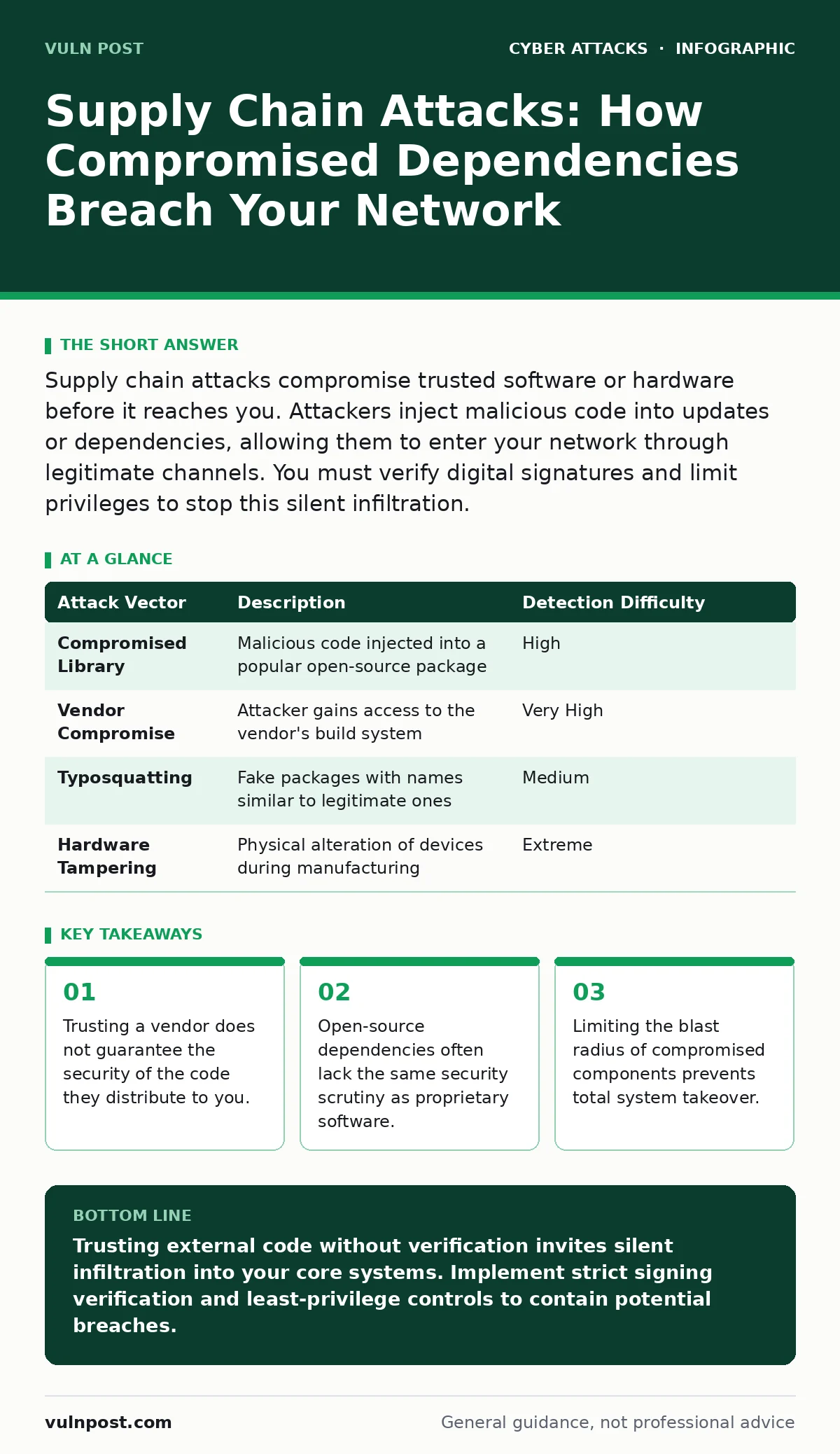
Supply chain attacks compromise trusted software or hardware before it reaches you. Attackers inject malicious code into updates or dependencies, allowing them to enter your network through legitimate channels. You must verify digital signatures and limit privileges to stop this silent infiltration.
What exactly is a supply chain attack?
A supply chain attack targets the weakest link in the production or distribution process of a product rather than the end user directly. Attackers compromise a trusted vendor, a software library, or a hardware manufacturer to distribute malicious payloads to many victims simultaneously. This approach allows adversaries to bypass perimeter defenses because the malicious code arrives via a legitimate, expected update or installation.
Why are open-source libraries dangerous entry points?
Open-source libraries are foundational building blocks used by countless organizations, often without modification or deep inspection. Because developers rarely audit every line of code in their dependencies, a single compromised library can propagate malware across thousands of networks. The convenience of package managers allows these vulnerable components to be installed automatically, creating a wide attack surface that is difficult to monitor.
How do attackers hide malicious code in updates?
Adversaries often use obfuscation techniques to disguise malicious logic within legitimate code updates. They may embed payloads that only activate under specific conditions, such as when a certain file is present or after a delay period. This stealthy behavior makes traditional signature-based detection ineffective, as the code appears benign until the trigger event occurs.
| Attack Vector | Description | Detection Difficulty |
|---|---|---|
| Compromised Library | Malicious code injected into a popular open-source package | High |
| Vendor Compromise | Attacker gains access to the vendor's build system | Very High |
| Typosquatting | Fake packages with names similar to legitimate ones | Medium |
| Hardware Tampering | Physical alteration of devices during manufacturing | Extreme |
Can hardware be part of a supply chain attack?
Yes, hardware can be tampered with at any point from component manufacturing to final assembly. Attackers may insert malicious chips or modify firmware to create backdoors that persist even after software reinstallation. These hardware-level compromises are particularly dangerous because they operate below the operating system, making them nearly invisible to standard security tools.
How do you verify the integrity of software?
Digital signatures provide a cryptographic guarantee that software has not been altered since it was signed by the publisher. You must configure your systems to reject any update or installation that lacks a valid signature from a trusted authority. This practice ensures that even if an attacker intercepts an update, they cannot replace it with a malicious version without detection.
What is the risk of third-party integrations?
Third-party integrations often require elevated permissions to function correctly within your environment. If a connected service is compromised, the attacker can use those permissions to access your data or move laterally across your network. The trust relationship established during integration creates a direct pathway for adversaries to exploit your systems through the vendor.
How do you limit the damage of a compromised dependency?
The principle of least privilege restricts each component to only the permissions it strictly needs to function. By isolating dependencies in containers or virtual machines, you prevent a compromised library from accessing sensitive data or other critical systems. This containment strategy limits the blast radius, ensuring that a single failure does not cascade into a total network breach.
Why is monitoring dependencies so difficult?
Software ecosystems are complex, with dependencies often relying on other dependencies in a deep hierarchy. Tracking every transitive dependency requires automated tools that continuously scan for known vulnerabilities and anomalies. Manual audits are insufficient because new threats emerge daily, and the volume of code exceeds human capacity for thorough review.
How do you respond to a supply chain compromise?
Immediate isolation of affected systems is the first step to prevent further lateral movement. You must then identify the scope of the compromise by analyzing logs and comparing system states against known good baselines. Removing the malicious component and restoring from clean backups is often necessary, but you must also rotate all credentials and certificates that may have been exposed during the incident.
Key takeaways
- Trusting a vendor does not guarantee the security of the code they distribute to you.
- Open-source dependencies often lack the same security scrutiny as proprietary software.
- Limiting the blast radius of compromised components prevents total system takeover.
Trusting external code without verification invites silent infiltration into your core systems. Implement strict signing verification and least-privilege controls to contain potential breaches.
Frequently asked questions
Can a supply chain attack bypass firewalls?
Yes, because the malicious code arrives via legitimate, allowed traffic channels such as software updates or API calls.
How do I know if my open-source packages are safe?
Use automated dependency scanning tools to check for known vulnerabilities and verify digital signatures for authenticity.
Is buying from major vendors safer?
Major vendors are attractive targets precisely because compromising them provides access to a large number of victims simultaneously.
What is the first sign of a supply chain attack?
Unexpected network traffic from a trusted application or unusual behavior in system processes may indicate compromise.
How this guide was produced: written by the Vuln Post editorial team with AI assistance, checked against the public references listed below, and reviewed when the facts change. See our editorial policy or report an error.