
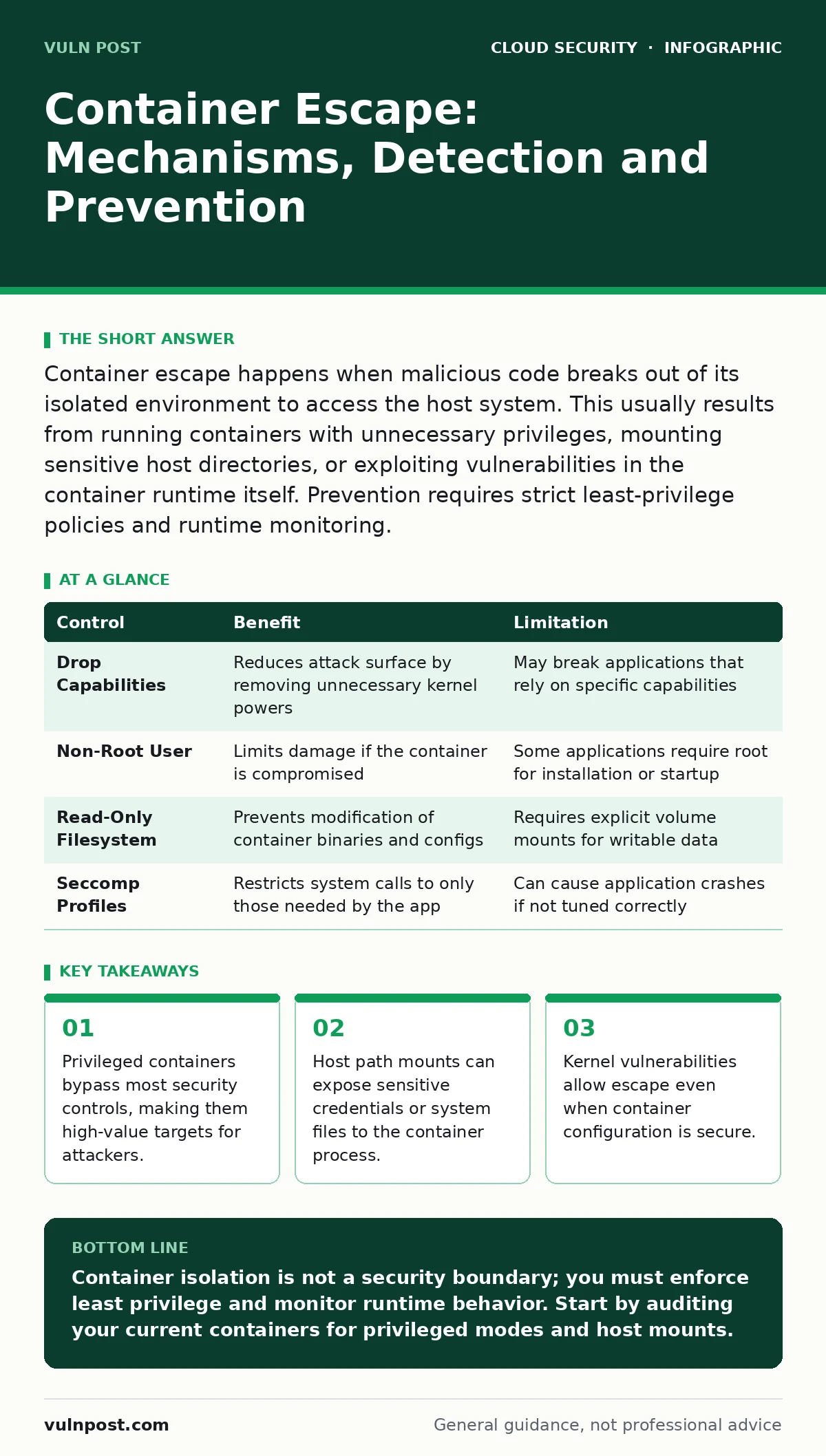
Container escape happens when malicious code breaks out of its isolated environment to access the host system. This usually results from running containers with unnecessary privileges, mounting sensitive host directories, or exploiting vulnerabilities in the container runtime itself. Prevention requires strict least-privilege policies and runtime monitoring.
What exactly is a container escape?
A container escape occurs when a process running inside a container gains access to the host operating system or other containers. Containers rely on Linux kernel features like namespaces and cgroups to isolate processes, but these are not security boundaries in the same way virtual machines are. If an attacker compromises the isolation, they can read host files, execute commands on the host, or pivot to other workloads.
How do attackers typically achieve an escape?
Attackers usually exploit misconfigurations rather than complex zero-day vulnerabilities. The most common method involves running a container with the --privileged flag, which grants the container full access to host devices and kernel capabilities. Another frequent vector is mounting sensitive host directories, such as the Docker socket or the root filesystem, into the container. These mistakes give the container process the same power as the host user.
Why are privileged containers so dangerous?
Running a container in privileged mode disables most security features, including AppArmor and SELinux profiles, and grants access to all host devices. This means the container process can load kernel modules, modify system settings, or access hardware directly. If an attacker gains code execution inside a privileged container, they effectively own the underlying host. You should never run production workloads with privileged access unless absolutely necessary for specific hardware interactions.
Can mounting the Docker socket cause an escape?
Yes, mounting the Docker socket into a container allows any process inside to control the Docker daemon on the host. This is a common pattern for CI/CD tools or container orchestration agents, but it is extremely risky. An attacker can use the socket to create new privileged containers, read secrets from other containers, or modify host configurations. For deeper insights on this specific risk, see our guide on exposed Docker APIs.
Do kernel vulnerabilities still pose a risk?
Yes, because all containers on a host share the same kernel, a vulnerability in the kernel affects every container. An attacker can exploit a kernel bug to execute code with root privileges on the host, bypassing container isolation entirely. This is why keeping the host kernel updated is a critical defense strategy. Even perfectly configured containers are vulnerable if the underlying kernel has a known exploit.
How can you detect a container escape attempt?
Detection relies on monitoring for anomalous behavior that violates the principle of least privilege. Look for processes attempting to access host paths, load kernel modules, or execute unexpected binaries. Security tools can alert on changes to the host filesystem or network connections originating from container processes. You can also monitor for the creation of new containers or changes to container configurations via the API.
What is the role of runtime security tools?
Runtime security tools monitor container behavior while it is running, rather than just scanning images before deployment. They enforce policies that block dangerous actions, such as accessing sensitive files or executing prohibited commands. These tools provide visibility into process execution, network traffic, and system calls, helping you identify escapes in real-time. They complement static analysis by catching dynamic threats that image scans miss.
How do you prevent container escapes effectively?
Prevention starts with strict image scanning to remove vulnerable libraries and secrets. You must then enforce least-privilege policies, dropping unnecessary Linux capabilities and running containers as non-root users. Use read-only root filesystems where possible and avoid mounting host paths unless strictly required. For broader architectural context, review our section on IaaS, PaaS and SaaS security.
| Control | Benefit | Limitation |
|---|---|---|
| Drop Capabilities | Reduces attack surface by removing unnecessary kernel powers | May break applications that rely on specific capabilities |
| Non-Root User | Limits damage if the container is compromised | Some applications require root for installation or startup |
| Read-Only Filesystem | Prevents modification of container binaries and configs | Requires explicit volume mounts for writable data |
| Seccomp Profiles | Restricts system calls to only those needed by the app | Can cause application crashes if not tuned correctly |
Are there edge cases where standard advice fails?
Suppose you run a container as a non-root user with dropped capabilities, yet an attacker still escapes. This can happen if the application itself has a vulnerability that allows arbitrary code execution, or if the container runtime has a bug. Additionally, some legacy applications may require specific kernel features that are difficult to restrict without breaking functionality. In these cases, you must evaluate the risk trade-off carefully.
How does orchestration affect escape risk?
Orchestration platforms like Kubernetes add complexity by managing many containers across multiple hosts. Misconfigured RBAC policies can allow users to create privileged pods, leading to escapes. Network policies must be strictly enforced to limit lateral movement after an escape. For best practices in securing these environments, see our guide on cloud landing zones.
What is the impact of a successful escape?
A successful escape gives the attacker control over the host machine, allowing them to pivot to other containers, steal credentials, or deploy malware. They can also exfiltrate data stored on the host or in other containers. The impact depends on the host's role and the sensitivity of the data it processes. For strategies to limit data loss, refer to our guide on cloud data exfiltration.
How do you secure container builds?
Secure builds by using minimal base images that contain only the necessary components. Avoid building images on untrusted systems to prevent supply chain attacks. Use multi-stage builds to separate build-time dependencies from the final runtime image. This reduces the size of the image and the number of potential vulnerabilities.
What about serverless containers?
Serverless containers offer ephemeral execution, which limits the window for exploitation. However, they are not immune to escapes, especially if they run with elevated privileges. The shared nature of serverless platforms means a kernel vulnerability could affect multiple tenants. For more on this topic, see our guide on serverless security risks.
How do you manage secrets in containers?
Never store secrets in environment variables or image layers. Use dedicated secret management solutions that inject secrets at runtime. Ensure that the container runtime has permissions to access these secrets only when needed. For detailed access control strategies, see our guide on just-in-time access.
What is the role of network policies?
Network policies restrict traffic between containers, limiting the ability of an attacker to move laterally after an escape. They define which containers can communicate with each other and on which ports. Properly configured network policies reduce the blast radius of a breach. For architectural details, see our guide on cloud network segmentation.
How do you handle container updates?
Regularly update container images to patch known vulnerabilities. Automate the update process to ensure timely deployment. Test updates in a staging environment before applying them to production. This reduces the risk of introducing new vulnerabilities or breaking functionality.
What is the future of container security?
The future lies in zero-trust architectures and advanced runtime protection. Technologies like eBPF are enabling deeper visibility into container behavior without significant performance overhead. Continuous monitoring and automated response will become standard practices. For insights on secure connectivity, see our guide on private endpoints.
Key takeaways
- Privileged containers bypass most security controls, making them high-value targets for attackers.
- Host path mounts can expose sensitive credentials or system files to the container process.
- Kernel vulnerabilities allow escape even when container configuration is secure.
Container isolation is not a security boundary; you must enforce least privilege and monitor runtime behavior. Start by auditing your current containers for privileged modes and host mounts.
Frequently asked questions
Can a container escape if it runs as a non-root user?
Yes, if the container has access to the Docker socket, host mounts, or if there is a kernel vulnerability, running as non-root does not prevent escape.
Do container registries scan for vulnerabilities?
Most public and private registries offer scanning, but they only check the image at rest. They do not monitor runtime behavior or configuration misconfigurations.
Is Kubernetes more secure than Docker Swarm?
Security depends on configuration, not the platform. Kubernetes offers more granular controls but has a larger attack surface due to its complexity.
Can I use Windows containers to avoid Linux kernel issues?
Windows containers have different security models and vulnerabilities. They are not immune to escapes and have their own set of risks related to the Windows kernel.
How this guide was produced: written by the Vuln Post editorial team with AI assistance, checked against the public references listed below, and reviewed when the facts change. See our editorial policy or report an error.