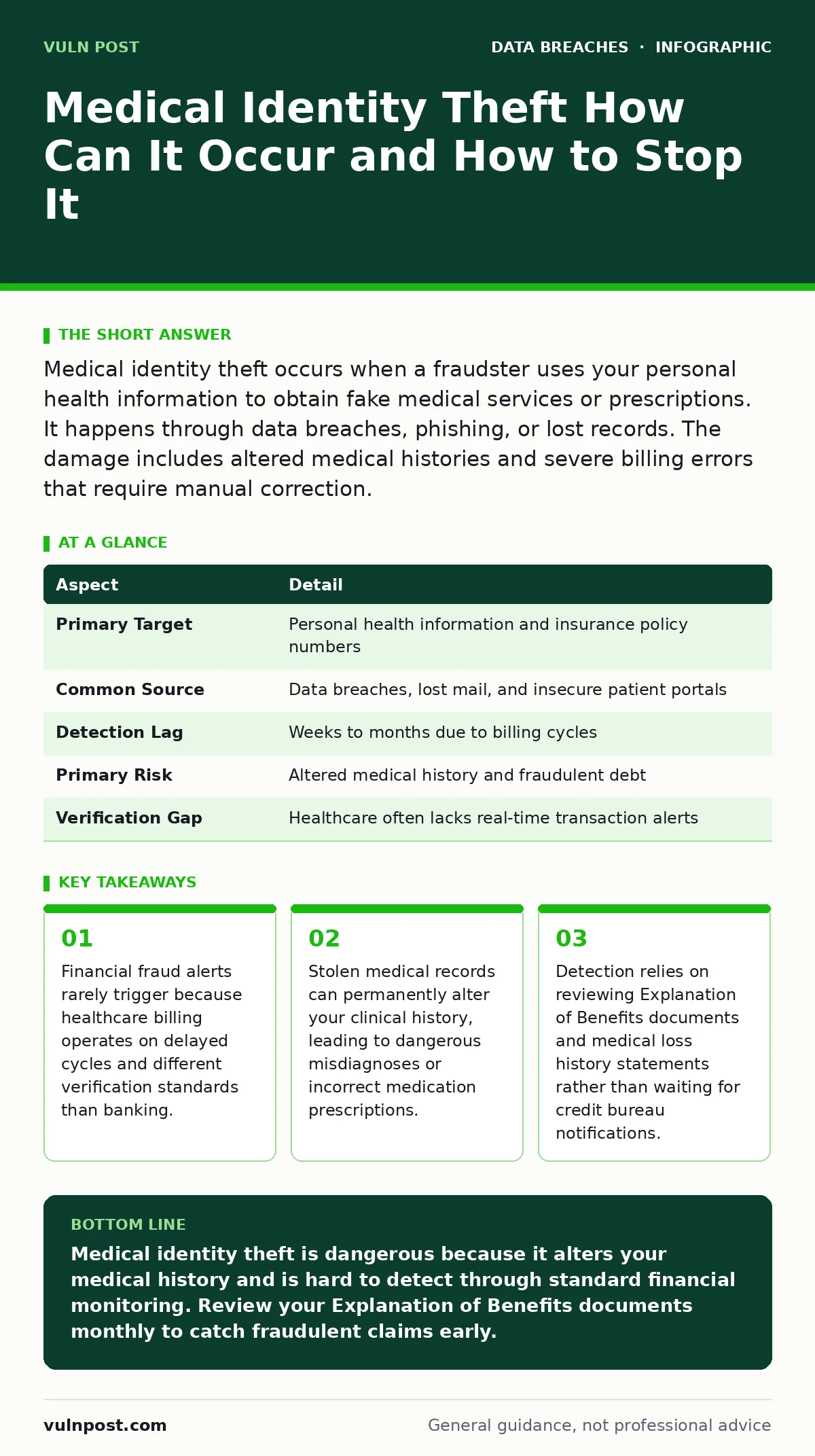
Medical identity theft occurs when a fraudster uses your personal health information to obtain fake medical services or prescriptions. It happens through data breaches, phishing, or lost records. The damage includes altered medical histories and severe billing errors that require manual correction.
The Anatomy of a Medical Record Theft
Imagine leaving your house keys in the front door lock while you go on vacation. Anyone walking by can enter, but you only discover the break-in when you return and notice your furniture moved. Medical identity theft operates with similar stealth. Thieves do not steal your cash. They steal your identity to access the healthcare system. They use your name, date of birth, and insurance details to create a new medical identity or to piggyback on an existing one.
This crime differs from financial fraud because the victim often does not see the transaction immediately. Healthcare billing involves multiple parties: providers, insurers, and patients. Claims can take weeks or months to process. By the time you see a bill for a service you never received, the fraudster has already used the stolen identity multiple times. The delay creates a wide window for damage.
| Aspect | Detail |
|---|---|
| Primary Target | Personal health information and insurance policy numbers |
| Common Source | Data breaches, lost mail, and insecure patient portals |
| Detection Lag | Weeks to months due to billing cycles |
| Primary Risk | Altered medical history and fraudulent debt |
| Verification Gap | Healthcare often lacks real-time transaction alerts |
Medical Identity Theft How Can It Occur
You need to understand the specific vectors to protect your data. The most common method is the exploitation of large-scale data breaches. Healthcare providers store vast amounts of sensitive data. When a data breach occurs, attackers exfiltrate patient records containing names, addresses, and insurance IDs. These records are sold on underground markets. The attackers do not need your password. They need enough static data to pass basic identity verification.
Another vector is physical theft. Medical records are often mailed in standard envelopes. Unsecured trash bins at hospitals or clinics can contain discarded forms with sensitive data. This is low-tech but effective. Thieves harvest these documents to build a profile. They combine this with public data to answer security questions. This ties into the importance of data inventory and mapping for organizations, as knowing where data lives helps identify where it can be lost.
Digital phishing remains a potent tool. Attackers send emails that appear to come from hospitals or pharmacies. They ask you to verify your identity or update your payment method. If you click the link and enter your credentials, they gain access to your patient portal. From there, they can view your full medical history and insurance details. They may also install malware that captures keystrokes or screenshots, allowing them to monitor your interactions in real time.
The Hidden Cost of Altered Medical History
The immediate concern for most people is the financial bill. This is a valid worry. However, the more dangerous consequence is the corruption of your medical record. When a fraudster uses your identity, they create a fake medical history. They might claim you have diabetes, asthma, or a drug dependency. This information becomes part of your permanent file.
Imagine you go to the emergency room after a car accident. The doctor pulls up your chart. They see a history of opioid use or severe allergies that do not exist. They may withhold necessary pain medication or administer a drug to which you are not actually allergic. This is not a hypothetical risk. It is a documented outcome of medical identity theft. The error persists until you manually correct every record across every provider.
This corruption affects your ability to get correct care. It can lead to misdiagnosis. It can cause doctors to ignore real symptoms because they are focusing on the fake history. The financial fraud is annoying. The medical fraud is dangerous. You must treat your medical data with the same protection as your financial data, if not more.
What People Usually Get Wrong
Many people believe that monitoring their credit report is enough to detect medical identity theft. This is incorrect. Most credit bureaus do not include medical debt or medical claims in standard consumer reports. You can have your identity stolen for years and see no red flags on your credit statement. You must monitor your medical records directly.
Another common mistake is assuming that two-factor authentication (2FA) on your patient portal stops the theft. It only stops account takeover if you have already created an account. If the thief uses your static data to create a new identity at a different provider, your 2FA on your old account does not help. They are not logging into your account. They are creating a new one using your name.
People also ignore the Explanation of Benefits (EOB) documents. These are sent by your insurer every time a claim is processed. They list every service billed. If you do not review them, you will not know when a fraudster uses your insurance. You must check these documents regularly. This is similar to how compliance audits ensure that organizational controls are working. You must audit your own medical data.
Protecting Your Medical Identity
You need a proactive strategy. Start by securing your physical mail. Use a locked mailbox. Request electronic statements from your insurer and providers. This reduces the risk of mail theft. It also creates a digital trail that is easier to monitor.
Monitor your Explanation of Benefits. Review them within days of receipt. Look for services you did not receive. Look for providers you have never visited. If you see an error, call the provider and the insurer immediately. Dispute the claim. Ask them to flag your account for potential fraud. This prevents further billing.
Request your medical loss history statement annually. This document summarizes all claims paid on your behalf. It provides a high-level view of your medical activity. It helps you spot patterns of abuse. You can request this from your insurance provider. It is a free service. Use it.
See also: Mobile Device Management for Small Business: Control Without Chaos
Organizational Responsibilities and Data Security
Healthcare organizations hold the majority of the risk. They must implement strong access controls. Employees should only access records they need for their job. This is the principle of least privilege. It limits the damage if an account is compromised.
Organizations must also manage their encryption key management properly. Data should be encrypted at rest and in transit. If a breach occurs, encrypted data is harder to use. However, encryption is not a silver bullet. If keys are stolen or poorly managed, the data is exposed. Regular testing of security controls is necessary.
Employee training is critical. Staff must recognize phishing attempts. They must verify the identity of callers and visitors. Social engineering is a primary method for gaining access to medical records. Attackers pose as patients, family members, or insurance agents. They manipulate staff into releasing information. Rigorous verification procedures prevent this.
Detecting and Responding to Theft
If you suspect medical identity theft, act quickly. Contact your insurance provider. Ask them to freeze your account or place a fraud alert. This stops new claims from being processed. Contact the providers who billed the fraudulent services. Ask them to correct their records. Provide proof of identity and a statement that you did not receive the services.
File a report with the Federal Trade Commission. This creates an official record of the fraud. It helps law enforcement track patterns. It also provides you with a recovery plan. Keep copies of all correspondence. Follow up regularly. Corrections can take months. You must persist.
Consider placing a fraud alert or credit freeze with the major credit bureaus. While medical debt may not appear immediately, thieves often use medical identity theft as a stepping stone to financial fraud. They may apply for credit cards or loans using your identity. Protecting your credit adds another layer of security. This connects to the broader topic of synthetic identity fraud, where criminals mix real and fake data to create new identities.
The Role of Secure Data Practices
Organizations must minimize the amount of data they collect. If they do not need it, they should not store it. This reduces the impact of a breach. Backup data exposure is a common oversight. Backups often contain the same sensitive data as primary systems. They must be equally protected. If a backup is left unencrypted or accessible, it becomes a target.
Regular log retention policies help investigators trace unauthorized access. Logs show who accessed records and when. If a breach occurs, logs provide evidence. They help identify the scope of the incident. Without logs, it is impossible to know what was stolen. Organizations must maintain logs for a sufficient period to detect slow-moving threats.
Employee offboarding is another critical control. When staff leave, their access must be revoked immediately. Delayed offboarding leaves accounts active. Attackers can exploit these dormant accounts. Employee offboarding security procedures must be strict and automated. No human should manually remember to disable an account.
Key takeaways
- Financial fraud alerts rarely trigger because healthcare billing operates on delayed cycles and different verification standards than banking.
- Stolen medical records can permanently alter your clinical history, leading to dangerous misdiagnoses or incorrect medication prescriptions.
- Detection relies on reviewing Explanation of Benefits documents and medical loss history statements rather than waiting for credit bureau notifications.
Medical identity theft is dangerous because it alters your medical history and is hard to detect through standard financial monitoring. Review your Explanation of Benefits documents monthly to catch fraudulent claims early.
Frequently asked questions
Does medical identity theft show up on my credit report?
Not always. Most credit bureaus do not include medical debt in standard consumer reports, so you may not see the fraud reflected in your credit score or history.
How long does it take to fix medical identity theft?
It can take months or even years to correct records across multiple providers and insurers. You must dispute claims, contact providers, and follow up regularly to ensure all errors are removed.
Can I put a freeze on my medical records?
No, you cannot freeze medical records like a credit report. However, you can place a fraud alert with your insurer and monitor your Explanation of Benefits for unauthorized activity.
What is the difference between medical and financial identity theft?
Medical identity theft uses your health information to obtain services or prescriptions, often altering your medical history. Financial identity theft uses your data to open accounts or make purchases, directly impacting your finances.
How this guide was produced: written by the Vuln Post editorial team with AI assistance, checked against the public references listed below, and reviewed when the facts change. See our editorial policy or report an error.