
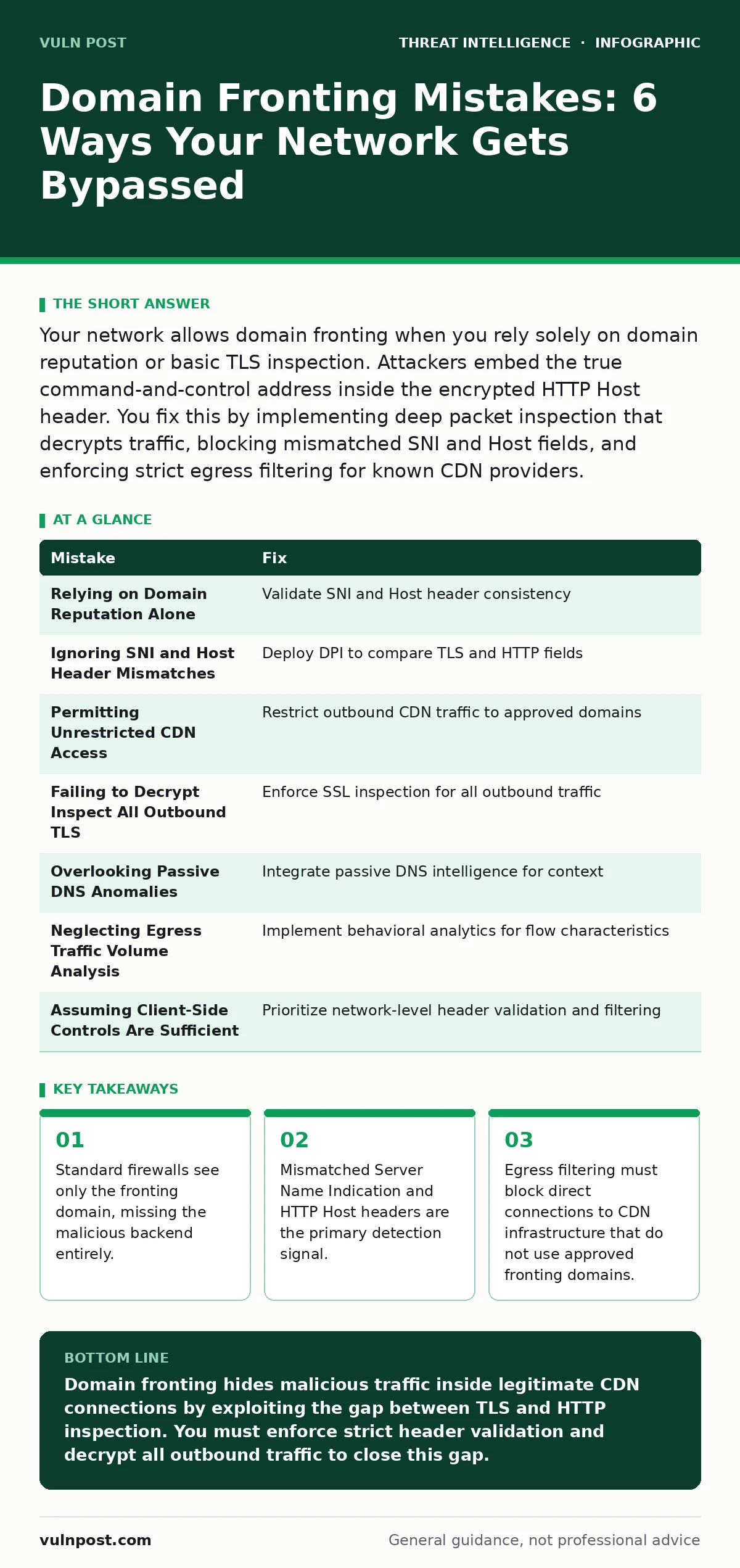
Your network allows domain fronting when you rely solely on domain reputation or basic TLS inspection. Attackers embed the true command-and-control address inside the encrypted HTTP Host header. You fix this by implementing deep packet inspection that decrypts traffic, blocking mismatched SNI and Host fields, and enforcing strict egress filtering for known CDN providers.
Mistake 1: Relying on Domain Reputation Alone
Why it hurts: Security tools often whitelist large content delivery networks because they host legitimate traffic. An adversary uses this trust to tunnel malicious commands through a reputable front. The firewall sees a request to a safe news or video site and allows it. The actual payload travels to a hostile server hidden behind the CDN. This creates a blind spot where reputation-based blocking fails completely. You lose visibility into the true destination of the data.
The fix: Implement application-layer inspection that validates the consistency between the TLS handshake and the HTTP request. Do not trust the fronting domain implicitly. Configure your proxy to reject connections where the destination IP does not match the expected infrastructure for that specific fronting domain. This adds friction for attackers who must constantly rotate their fronting domains to avoid detection.
Mistake 2: Ignoring SNI and Host Header Mismatches
Why it hurts: The Server Name Indication (SNI) extension in TLS reveals the intended hostname during the initial handshake. The HTTP Host header appears later in the decrypted request. In legitimate traffic, these two values usually match. Domain fronting exploits the fact that many proxies only inspect the SNI. When the SNI points to a benign CDN node but the Host header points to a malicious domain, the connection is fraudulent. Ignoring this discrepancy allows the tunnel to remain open.
The fix: Deploy deep packet inspection engines that compare the SNI field against the HTTP Host header for every outbound connection. Flag or block any session where these values diverge significantly. This technique catches the majority of fronting attempts because the attacker must maintain the illusion of legitimacy at both the TLS and HTTP layers. It reduces false positives by focusing on structural anomalies rather than content.
Mistake 3: Permitting Unrestricted CDN Access
Why it hurts: Content delivery networks provide the infrastructure that makes domain fronting possible. If your network allows unrestricted outbound traffic to major CDN IP ranges, you give attackers a vast pool of potential fronting domains. They can pivot to any available edge server. This lack of restriction means you cannot easily block the attack vector without breaking legitimate access to popular websites. The scale of CDN infrastructure overwhelms simple blacklist approaches.
The fix: Restrict outbound traffic to CDN providers to specific, approved fronting domains. Use DNS filtering to resolve CDN domains to their actual IP addresses and block direct IP connections to those ranges. This forces all CDN traffic through your proxy, where you can inspect the headers. It eliminates the ability for attackers to bypass DNS logging by using hard-coded IP addresses.
Mistake 4: Failing to Decrypt Inspect All Outbound TLS
Why it hurts: Many organizations configure their proxies to bypass decryption for certain trusted domains to save processing power or protect privacy. Attackers exploit this by fronting through those trusted domains. If the traffic is not decrypted, your security tools cannot see the HTTP Host header or the payload content. You are effectively allowing encrypted tunnels to bypass your security controls. This creates a persistent channel for command and control that looks like normal web browsing.
The fix: Enforce SSL inspection for all outbound traffic, including traffic to known benign domains. Use a corporate root certificate to decrypt and re-encrypt the connection. This allows your security tools to see the full request structure. While this increases computational load, it is necessary to detect header mismatches. Ensure your endpoint devices trust the corporate root certificate to avoid user interruptions.
Mistake 5: Overlooking Passive DNS Anomalies
Why it hurts: Domain fronting often involves newly registered domains or domains with erratic DNS resolution patterns. Attackers register a domain, point it to a CDN, and then quickly abandon it when detected. If you do not analyze DNS resolution history, you miss the indicator that a domain is part of a short-lived attack campaign. You treat each domain in isolation, failing to see the pattern of rapid turnover. This allows the attacker to maintain persistence by rotating domains faster than you can block them.
The fix: Integrate passive DNS intelligence into your detection rules. Look for domains that resolve to CDN IP addresses but have no historical reputation or very short lifespans. Correlate these DNS events with the TLS mismatch alerts. This provides context that a single packet inspection might miss. It helps you identify the broader campaign rather than just individual malicious connections.
See also: DDoS Protection: 8 FAQs on Mitigation and Architecture · Stop Botnet Attacks: Prioritize Prevention Over Detection
Mistake 6: Neglecting Egress Traffic Volume Analysis
Why it hurts: Domain fronting tunnels often exhibit unusual traffic patterns compared to normal web browsing. They may have consistent data sizes, regular timing intervals, or high entropy in the payload. Standard firewalls do not analyze the statistical properties of the traffic. They only check if the destination is allowed. This allows low-and-slow exfiltration or command-and-control beacons to blend in with background noise. You fail to detect the attack because the volume is too low to trigger traditional threshold alerts.
The fix: Implement behavioral analytics that monitor the flow characteristics of outbound connections. Look for connections that maintain steady data rates or have unusually high payload entropy. Combine this with the header mismatch detection. This multi-layered approach catches attacks that try to mimic normal traffic patterns. It reduces reliance on signatures that attackers can easily modify.
Mistake 7: Assuming Client-Side Controls Are Sufficient
Why it hurts: Some organizations rely on endpoint agents to block malicious domains. However, domain fronting often uses legitimate-looking fronting domains that are not yet flagged as malicious. The endpoint agent sees a safe domain and allows the connection. The attack bypasses the client-side control entirely. This creates a false sense of security. You assume the endpoint is protecting the user, while the network remains vulnerable to the tunneling technique.
The fix: Treat network-level controls as the primary defense against domain fronting. Endpoint agents should supplement, not replace, network inspection. Ensure that your network security posture includes the header validation and egress filtering described above. This creates a defense-in-depth strategy. It ensures that even if an endpoint is compromised or misconfigured, the network blocks the malicious traffic.
| Mistake | Fix |
|---|---|
| Relying on Domain Reputation Alone | Validate SNI and Host header consistency |
| Ignoring SNI and Host Header Mismatches | Deploy DPI to compare TLS and HTTP fields |
| Permitting Unrestricted CDN Access | Restrict outbound CDN traffic to approved domains |
| Failing to Decrypt Inspect All Outbound TLS | Enforce SSL inspection for all outbound traffic |
| Overlooking Passive DNS Anomalies | Integrate passive DNS intelligence for context |
| Neglecting Egress Traffic Volume Analysis | Implement behavioral analytics for flow characteristics |
| Assuming Client-Side Controls Are Sufficient | Prioritize network-level header validation and filtering |
Key takeaways
- Standard firewalls see only the fronting domain, missing the malicious backend entirely.
- Mismatched Server Name Indication and HTTP Host headers are the primary detection signal.
- Egress filtering must block direct connections to CDN infrastructure that do not use approved fronting domains.
Domain fronting hides malicious traffic inside legitimate CDN connections by exploiting the gap between TLS and HTTP inspection. You must enforce strict header validation and decrypt all outbound traffic to close this gap.
Frequently asked questions
Does domain fronting work with HTTPS?
Yes, domain fronting relies on HTTPS. The encryption hides the true destination from intermediate observers, while the fronting domain provides a legitimate cover for the connection.
Can I detect domain fronting without decrypting traffic?
You can detect some attempts by analyzing SNI and Host header mismatches if your proxy captures the HTTP request. However, full decryption provides the most accurate visibility into the payload and true destination.
How does domain fronting differ from DNS tunneling?
DNS tunneling encapsulates data within DNS queries, while domain fronting uses standard HTTP requests over TLS. Domain fronting is harder to detect because it looks like normal web traffic to basic firewalls.
Is domain fronting only used by nation-state cyber attacks?
No, while advanced groups use it for stealth, any attacker can employ domain fronting to bypass simple network filters. It is a technique that leverages public infrastructure rather than proprietary tools.
How this guide was produced: written by the Vuln Post editorial team with AI assistance, checked against the public references listed below, and reviewed when the facts change. See our editorial policy or report an error.