
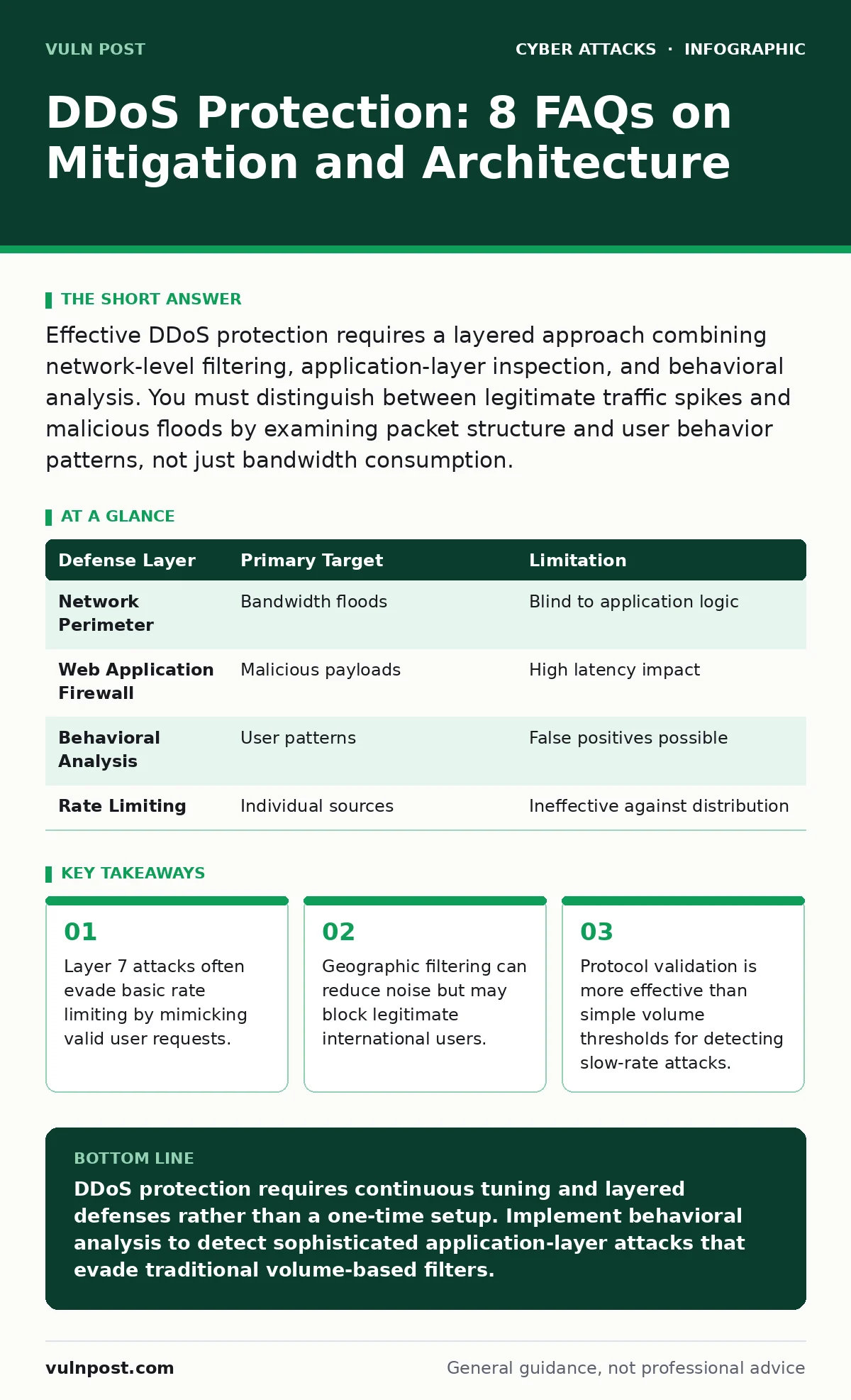
Effective DDoS protection requires a layered approach combining network-level filtering, application-layer inspection, and behavioral analysis. You must distinguish between legitimate traffic spikes and malicious floods by examining packet structure and user behavior patterns, not just bandwidth consumption.
Does DDoS protection stop all traffic floods?
No single mechanism blocks every type of distributed denial of service attack. Network-layer defenses excel at absorbing massive bandwidth floods, but they often miss low-volume application-layer attacks that exhaust server resources through complex queries. You need to understand that volume-based detection has a blind spot for sophisticated protocol abuse.
How do I distinguish legitimate spikes from attacks?
You analyze traffic patterns for anomalies in request frequency, source diversity, and payload consistency. Legitimate traffic usually shows varied user agents, diverse IP sources, and natural browsing paths. An attack often presents synchronized requests, identical payloads, or impossible navigation sequences that no human would execute.
What is the role of rate limiting?
Rate limiting caps the number of requests a single source can make within a specific timeframe. This prevents any one actor from monopolizing server resources, but it does not stop coordinated attacks using millions of compromised devices. It is a necessary control for managing individual abuse, not a shield against distributed threats.
Why do application-layer attacks bypass firewalls?
Firewalls inspect packet headers and ports, not the content or logic of the application data. Layer 7 attacks send valid HTTP or HTTPS requests that look like normal user activity, consuming CPU and memory as the server processes them. This is why you must implement web application firewalls that parse and validate request bodies.
How effective is geographic filtering?
Geographic filtering blocks traffic from regions where you have no legitimate business presence. This reduces the attack surface by eliminating noise from areas that never generate valid users. However, it fails against attacks originating from your primary markets or using anonymization services that mask their true location.
See also: Pass-the-Hash Attacks Explained: How Stolen Credentials Bypass Passwords · Stop Botnet Attacks: Prioritize Prevention Over Detection
What is the cost of scrubbing traffic?
Scrubbing involves routing traffic through a mitigation center to filter out malicious packets before sending clean traffic to your origin server. This adds latency to every request, which can degrade user experience even during normal operations. You must balance security needs against performance requirements to avoid unnecessary slowdowns.
Can DDoS attacks target APIs?
Yes, API abuse is a common vector for resource exhaustion attacks. Attackers exploit poorly documented endpoints or lack of authentication to trigger expensive database queries or computational tasks. This resembles the mechanics of API abuse where valid interactions are weaponized to drain backend resources rather than just bandwidth.
How does botnet activity influence defense strategy?
Botnets provide the distributed nature of these attacks, using thousands of compromised devices to generate traffic from many sources. Defenses must focus on behavioral analysis rather than IP reputation, as botnet nodes often appear as residential users. Understanding botnet attacks helps you recognize that source IPs are often innocent victims of malware.
| Defense Layer | Primary Target | Limitation |
|---|---|---|
| Network Perimeter | Bandwidth floods | Blind to application logic |
| Web Application Firewall | Malicious payloads | High latency impact |
| Behavioral Analysis | User patterns | False positives possible |
| Rate Limiting | Individual sources | Ineffective against distribution |
What happens when mitigation fails?
When defenses are overwhelmed, your services become unavailable, leading to revenue loss and reputational damage. You must have a cyber incident response team ready to execute pre-defined playbooks for traffic rerouting and communication. Preparation includes identifying which services are critical and which can be temporarily scaled down.
How do I protect against supply chain impacts?
If your dependencies are targeted, your own infrastructure may be affected by collateral damage. You cannot control the security of your vendors, but you can monitor their status and have fallback plans. This concept mirrors supply chain attacks where compromising one link disrupts the entire network of trust.
Can I use CDN for DDoS mitigation?
Content Delivery Networks absorb traffic by caching static content and distributing requests across many servers. This reduces the load on your origin servers and can mitigate some volumetric attacks. However, CDNs do not protect dynamic application endpoints that require direct backend processing.
What is the blast radius of a successful attack?
The blast radius defines how much of your infrastructure is affected by a single point of failure. A well-architected system isolates services so that an attack on one component does not cascade to others. Minimizing this exposure ensures that even if one service goes down, the core functionality remains available.
How do I test my defenses?
You conduct controlled penetration tests that simulate various attack vectors without impacting production traffic. These tests reveal gaps in your detection rules and response times. Regular testing ensures your team is prepared for real incidents and your tools are configured correctly.
Key takeaways
- Layer 7 attacks often evade basic rate limiting by mimicking valid user requests.
- Geographic filtering can reduce noise but may block legitimate international users.
- Protocol validation is more effective than simple volume thresholds for detecting slow-rate attacks.
DDoS protection requires continuous tuning and layered defenses rather than a one-time setup. Implement behavioral analysis to detect sophisticated application-layer attacks that evade traditional volume-based filters.
Frequently asked questions
Is DDoS insurance worth it?
Insurance can cover financial losses from downtime but does not prevent the attack or restore services faster. It is a risk transfer mechanism, not a technical control.
How do I protect my home network?
Home networks are rarely primary targets, but you can use router-based filtering and keep firmware updated. Most consumer ISP plans include basic volumetric protection.
What is the difference between DDoS and DoS?
Distributed denial of service uses many sources to overwhelm a target, while denial of service uses a single source. DDoS is harder to mitigate because blocking one IP does not stop the attack.
Can AI prevent DDoS attacks?
AI can help identify anomalous patterns faster than static rules, but it is not a silver bullet. It requires training data and can still produce false positives if not carefully calibrated.
How this guide was produced: written by the Vuln Post editorial team with AI assistance, checked against the public references listed below, and reviewed when the facts change. See our editorial policy or report an error.