
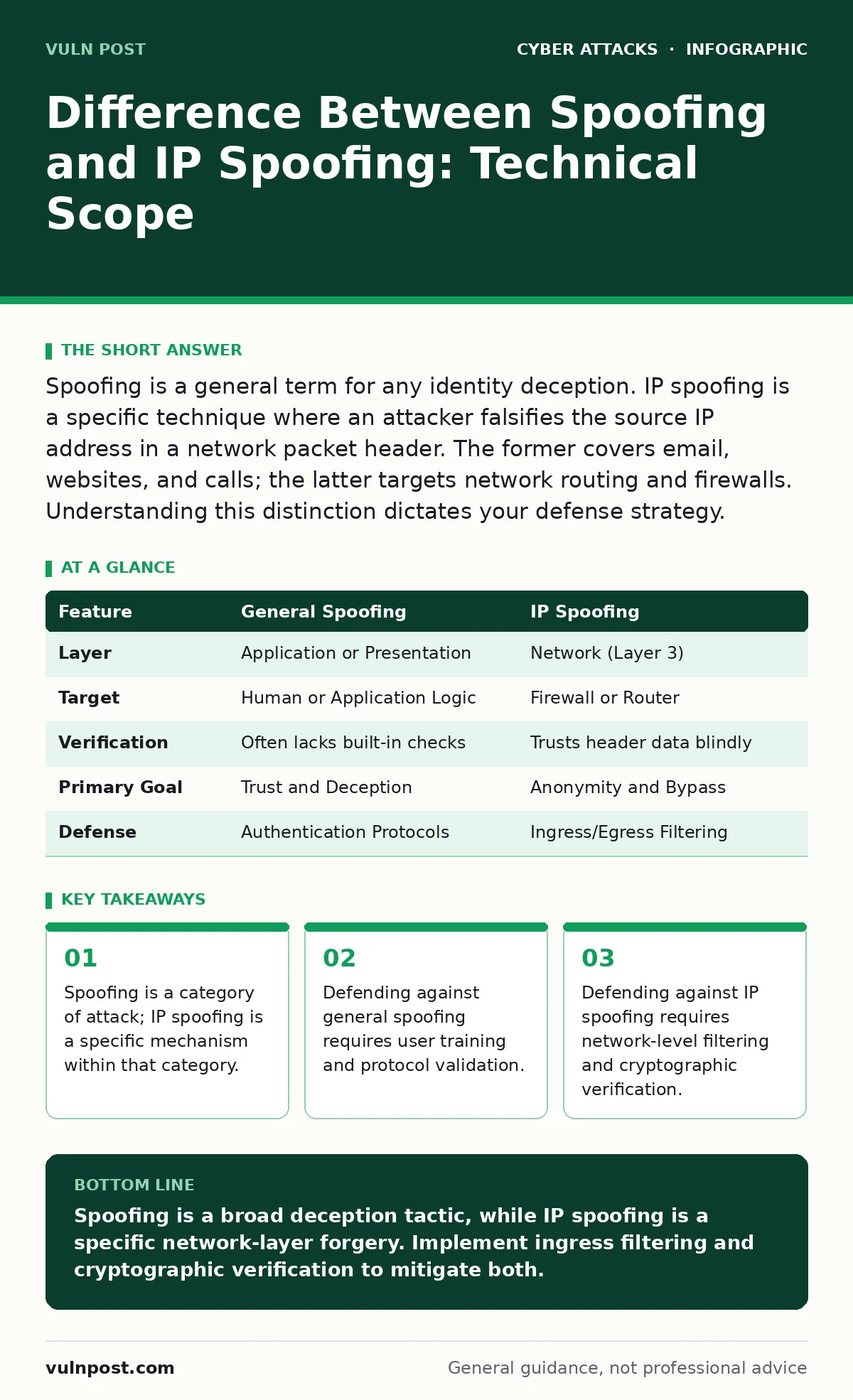
Spoofing is a general term for any identity deception. IP spoofing is a specific technique where an attacker falsifies the source IP address in a network packet header. The former covers email, websites, and calls; the latter targets network routing and firewalls. Understanding this distinction dictates your defense strategy.
What is the difference between spoofing and IP spoofing?
Spoofing is a broad umbrella term for any act of masquerading as a trusted entity, while IP spoofing is a specific technical method of falsifying the source address in a network packet. When you search for the difference between spoofing and ip spoofing, you are asking about the scope of deception versus the mechanics of execution. General spoofing applies to email headers, website URLs, and phone numbers. IP spoofing applies strictly to the Internet Protocol layer. The distinction matters because the defenses differ entirely. You cannot stop IP spoofing with antivirus software, just as you cannot stop email spoofing with a firewall rule.
How does general spoofing operate in digital communications?
General spoofing relies on the lack of inherent verification in many communication protocols. An attacker crafts a message that appears to originate from a known sender. In email, this means altering the "From" field. In web browsing, this involves registering a domain that looks similar to a legitimate one. The goal is to trick a human or an application into trusting false data. This technique often serves as the first step in a chain of events. It provides the initial access needed for deeper infiltration. Unlike IP spoofing, which hides the sender from the network, general spoofing hides the sender from the recipient. The recipient believes the source is legitimate.
What is the mechanism behind IP spoofing?
IP spoofing manipulates the source IP address field within the IP header of a data packet. The Internet Protocol does not verify that the packet actually came from the stated address. It trusts the header at face value. An attacker sends a packet with a fake source address. The target system receives the packet and assumes it is from the spoofed address. This breaks the assumption of trust in network routing. The attacker can use this to hide their true location. They can also use it to bypass IP-based access controls. If a system only allows traffic from specific IPs, a spoofed packet from an allowed IP might pass through. This is a foundational technique in many network-level attacks.
Why does IP spoofing fail for most interactive sessions?
IP spoofing is rarely useful for establishing a two-way conversation. The Internet Protocol is connectionless. When you send a packet with a fake source IP, the reply goes to that fake address. The attacker never receives the response. This makes IP spoofing poor for hijacking ongoing sessions or stealing data directly. It works best for one-way attacks. The attacker sends a command and does not need a reply. This limitation is why IP spoofing is often paired with other techniques. It is used to overwhelm a target or to mask the origin of an attack. The lack of feedback is the attacker's biggest constraint.
| Feature | General Spoofing | IP Spoofing |
|---|---|---|
| Layer | Application or Presentation | Network (Layer 3) |
| Target | Human or Application Logic | Firewall or Router |
| Verification | Often lacks built-in checks | Trusts header data blindly |
| Primary Goal | Trust and Deception | Anonymity and Bypass |
| Defense | Authentication Protocols | Ingress/Egress Filtering |
How do attackers combine spoofing with other threats?
Attackers rarely use IP spoofing in isolation. They combine it with brute force attacks to hide the source of credential guessing. They use it in botnet attacks to amplify traffic volume. The spoofed IP addresses make it difficult to trace the attack back to the origin. This obfuscation protects the infrastructure controlling the attack. It also complicates the work of security operations centers trying to identify the threat. The spoofed packets blend in with legitimate traffic. This makes detection slower and more resource-intensive. The attacker buys time to achieve their objective before being blocked.
See also: DDoS Protection: 8 FAQs on Mitigation and Architecture · Stop Botnet Attacks: Prioritize Prevention Over Detection
What is ingress filtering and why does it matter?
Ingress filtering is a network security practice that drops incoming packets with source IP addresses that are not routable from the incoming interface. If a packet arrives on your external connection with a source IP from your internal network, it is forged. Ingress filtering discards these packets. This prevents attackers from using your network as a launchpad for spoofed attacks. It also reduces the noise in your logs. Configuring routers to enforce strict ingress filtering is a standard best practice. It stops a significant portion of spoofed traffic at the perimeter. This measure does not stop attacks originating from within your network.
How do protocols mitigate spoofing risks?
Modern protocols include cryptographic signatures to verify identity. DomainKeys Identified Mail (DKIM) and Sender Policy Framework (SPF) add digital signatures to email. These signatures prove the message came from an authorized server. For web traffic, Transport Layer Security (TLS) uses certificates to verify the server's identity. These mechanisms do not rely on IP addresses. They rely on shared secrets and public key infrastructure. This makes them resistant to spoofing. An attacker can fake an IP address, but they cannot forge a valid cryptographic signature without the private key. This shifts the trust model from network location to cryptographic proof.
What role does user behavior play in spoofing defense?
Technology cannot eliminate all spoofing risks. Users often overlook subtle signs of deception. A slightly misspelled URL or a generic greeting can indicate spoofing. Training users to verify unexpected requests through a separate channel is critical. This is a key component of managing the human factor in security. Even with perfect technical controls, a user can be tricked into bypassing them. Social engineering often precedes technical exploitation. The attacker uses spoofing to create a sense of urgency or authority. The user then performs an action that compromises security. Technical controls must be paired with behavioral awareness.
How do insider threats interact with spoofing?
Insider threats bypass external spoofing defenses entirely. An insider already has legitimate access. They do not need to spoof an IP address to enter the network. They may spoof identity to access restricted areas or data. This complicates detection because the traffic appears legitimate. Monitoring for unusual behavior patterns is more effective than checking source addresses. Insider threats highlight the limitation of perimeter-based security. Once inside, the assumption of trust is broken. Zero Trust architectures address this by verifying every request, regardless of origin. This prevents insiders from relying on implicit trust.
What is the impact on supply chain security?
Supply chain attacks often involve spoofing vendor identities. An attacker may send a malicious update from a spoofed source. If the recipient trusts the vendor's IP or email, they install the malware. This is a sophisticated form of spoofing that targets trust relationships. It requires rigorous verification of software updates. Digital signatures on code packages are essential. They ensure the code has not been altered and comes from the legitimate vendor. Relying on IP reputation for software updates is dangerous. Attackers can compromise legitimate servers or spoof their addresses. Verification must be cryptographic.
Key takeaways
- Spoofing is a category of attack; IP spoofing is a specific mechanism within that category.
- Defending against general spoofing requires user training and protocol validation.
- Defending against IP spoofing requires network-level filtering and cryptographic verification.
Spoofing is a broad deception tactic, while IP spoofing is a specific network-layer forgery. Implement ingress filtering and cryptographic verification to mitigate both.
Frequently asked questions
Can IP spoofing be used to hack a specific computer?
IP spoofing alone cannot hijack a session or steal data because the attacker does not receive replies. It is used to hide origins or overwhelm targets, not for direct intrusion.
Does HTTPS prevent IP spoofing?
HTTPS prevents data interception and verifies the server's identity via certificates. It does not prevent an attacker from sending spoofed IP packets, but it makes those packets useless for session hijacking.
How do I detect IP spoofing in my logs?
Look for packets with impossible source addresses, such as internal IPs arriving from the internet. Analyze traffic patterns for sudden spikes from single sources that do not respond to challenges.
Is email spoofing the same as IP spoofing?
No. Email spoofing falsifies the sender address in the email header. IP spoofing falsifies the network address in the packet header. They occur at different layers and require different defenses.
How this guide was produced: written by the Vuln Post editorial team with AI assistance, checked against the public references listed below, and reviewed when the facts change. See our editorial policy or report an error.