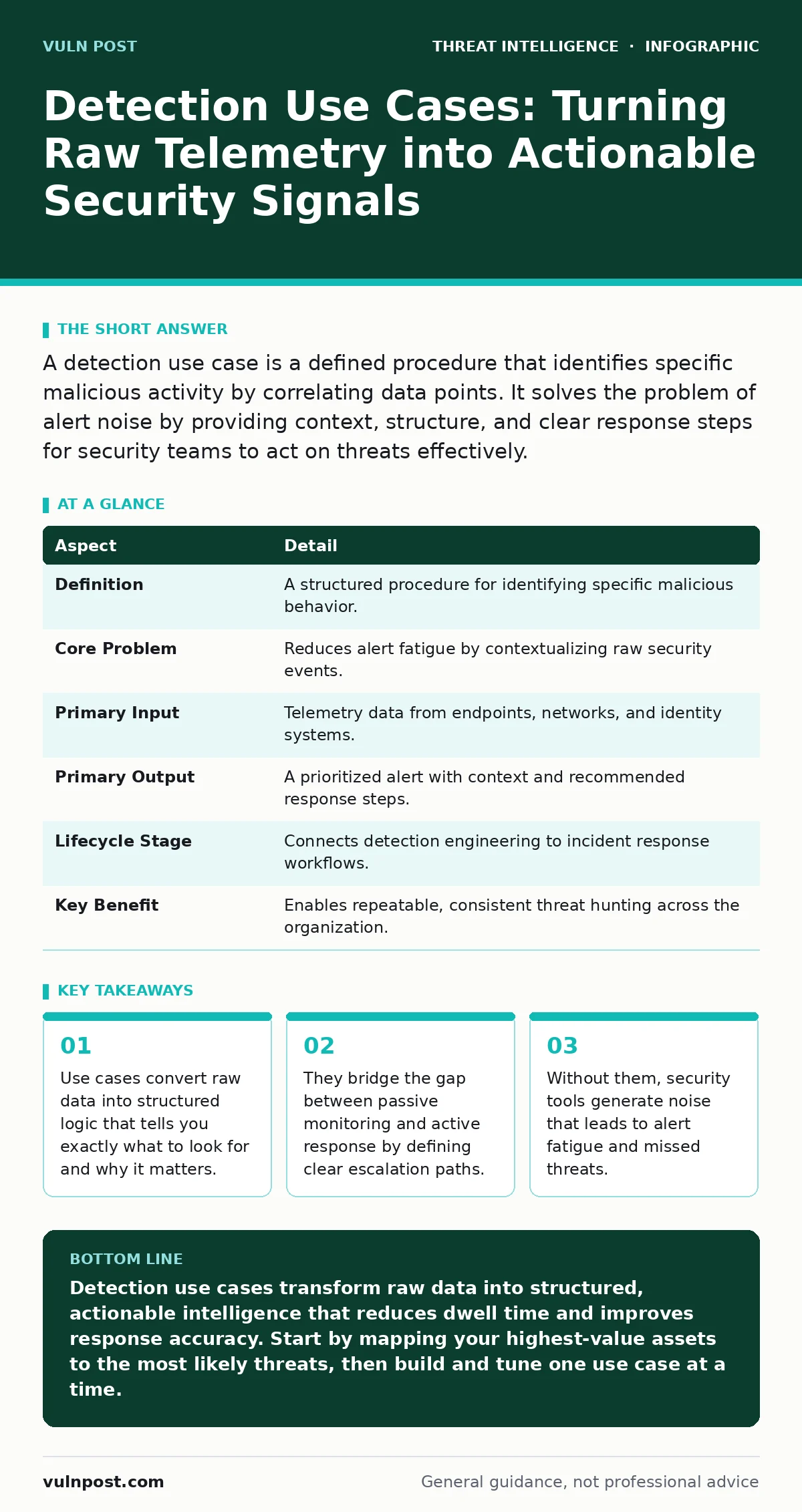
A detection use case is a defined procedure that identifies specific malicious activity by correlating data points. It solves the problem of alert noise by providing context, structure, and clear response steps for security teams to act on threats effectively.
The Signal in the Noise
Imagine a security operations center as a crowded radio station. Without filters, every frequency broadcasts at once. You hear static, music, news, and interference. You cannot tell if a distress call is occurring because everything sounds equally loud. A detection use case acts as the filter. It tunes the radio to a specific frequency, amplifies the signal you care about, and ignores the rest.
This concept solves a fundamental problem in modern cybersecurity. You have terabytes of telemetry flowing through your network. Most of it is benign activity. The challenge is not collecting data; it is finding the needle in the haystack before the haystack catches fire. A use case gives you a map to the needle.
| Aspect | Detail |
|---|---|
| Definition | A structured procedure for identifying specific malicious behavior. |
| Core Problem | Reduces alert fatigue by contextualizing raw security events. |
| Primary Input | Telemetry data from endpoints, networks, and identity systems. |
| Primary Output | A prioritized alert with context and recommended response steps. |
| Lifecycle Stage | Connects detection engineering to incident response workflows. |
| Key Benefit | Enables repeatable, consistent threat hunting across the organization. |
Anatomy of a Detection Use Case
A detection use case is more than a rule. It is a narrative. It answers three questions: What is happening? Why is it bad? What should you do? The first component is the hypothesis. This is the assumption that a specific sequence of events indicates an attack. For example, you might hypothesize that a user logging in from two countries within an hour is compromised.
The second component is the data source. You must identify which logs or telemetry streams contain the evidence. If you are looking for identity anomalies, you need identity provider logs. If you are looking for network exfiltration, you need firewall or proxy logs. The third component is the logic. This is the correlation rule that connects the data points. It defines the threshold for what constitutes an anomaly.
The final component is the response. This details the immediate actions to take. Do you isolate the machine? Do you reset the credentials? Do you escalate to a senior analyst? A use case without a response plan is just an observation. It lacks operational value.
Where Use Cases Fit in Defence
Detection use cases do not exist in a vacuum. They sit between threat intelligence and incident response. Operational threat intelligence provides the context. It tells you what adversaries are doing and what tools they are using. You translate this intelligence into use cases. For instance, if intelligence indicates a rise in pass-the-hash attacks, you create a use case to detect those specific lateral movement patterns.
On the other end, use cases feed into your response playbook. When a use case triggers, it hands off the incident to the response team. This handoff must be clean. The use case should provide enough context that the responder does not have to start from scratch. This integration reduces the time between detection and containment.
The Hidden Cost of Complexity
A common mistake is over-engineering use cases. You might try to detect every possible variant of an attack. This leads to complex rules that are hard to maintain. When a rule is too complex, it becomes brittle. Small changes in software versions or operating systems can break the logic. This results in false negatives, where real attacks slip through because the rule no longer matches the behavior.
There is also a hidden cost in tuning. Every use case requires baseline data to establish what is normal. If you deploy a use case without tuning, it will generate false positives. These false positives consume analyst time. They create noise. Over time, analysts begin to ignore alerts. This phenomenon is known as alert fatigue. It is dangerous because it causes teams to miss real threats amidst the noise.
What People Usually Get Wrong
Many teams confuse detection rules with detection use cases. A rule is a simple condition. It says, "If X happens, alert." A use case is the broader context. It includes the rule, but it also includes the hypothesis, the data sources, the tuning parameters, and the response actions. Treating them as the same thing leads to shallow detections.
Another error is assuming that detection is binary. You either detect the threat or you do not. In reality, detection is probabilistic. You are looking for indicators of compromise or anomalous behavior. You must accept that some attacks will evade detection. The goal is to reduce the dwell time, not to achieve perfect coverage. Accepting this uncertainty helps you prioritize high-value use cases over low-value ones.
See also: How Adversary Emulation Works: Mechanics, Limits, and Detection · Sigma Rules: Fix 6 Common Misunderstandings in Detection Logic
From Detection to Dwell Time Reduction
The ultimate goal of a detection use case is to reduce dwell time. Dwell time is the period between an initial compromise and its detection. The longer the dwell time, the more damage an attacker can do. Attackers often use privilege escalation attacks to gain higher access. If you have a use case that detects unusual privilege changes, you can cut this timeline short.
Consider the scenario of golden ticket attacks. These are sophisticated Kerberos-based attacks that allow persistent access. Without a specific use case, these attacks are nearly invisible. They do not trigger standard antivirus alerts. They do not appear in standard firewall logs. You need a use case that monitors for anomalous Kerberos ticket requests. This specific focus turns an invisible threat into a detectable one.
Integrating with Broader Strategies
Detection use cases must align with your overall security strategy. They should complement other defences, not replace them. For example, if you rely on bulletproof hosting for certain services, you need use cases that monitor for traffic to known high-risk IPs. This integration ensures that your detection logic accounts for your infrastructure choices.
Similarly, if you are concerned about nation-state cyber attacks, your use cases must reflect the advanced techniques these groups employ. These groups often use slow, low-and-slow methods to avoid detection. Your use cases must be sensitive enough to catch these subtle behaviors without triggering on normal business activity. This requires a deep understanding of both the threat actor and your own environment.
Key takeaways
- Use cases convert raw data into structured logic that tells you exactly what to look for and why it matters.
- They bridge the gap between passive monitoring and active response by defining clear escalation paths.
- Without them, security tools generate noise that leads to alert fatigue and missed threats.
Detection use cases transform raw data into structured, actionable intelligence that reduces dwell time and improves response accuracy. Start by mapping your highest-value assets to the most likely threats, then build and tune one use case at a time.
Frequently asked questions
How do I prioritize which detection use cases to build first?
Start with use cases that protect your highest-value assets and address the most likely threats based on your industry and threat exposure.
What is the difference between a detection rule and a detection use case?
A rule is a simple condition, while a use case includes the hypothesis, data sources, tuning, and response actions, providing broader context.
How do I measure the effectiveness of a detection use case?
Measure effectiveness by tracking false positive rates, detection accuracy, and the time it takes to respond to alerts generated by the use case.
Can detection use cases replace threat hunting?
No, use cases automate known patterns, while threat hunting actively searches for unknown threats that may not match existing rules.
How this guide was produced: written by the Vuln Post editorial team with AI assistance, checked against the public references listed below, and reviewed when the facts change. See our editorial policy or report an error.