
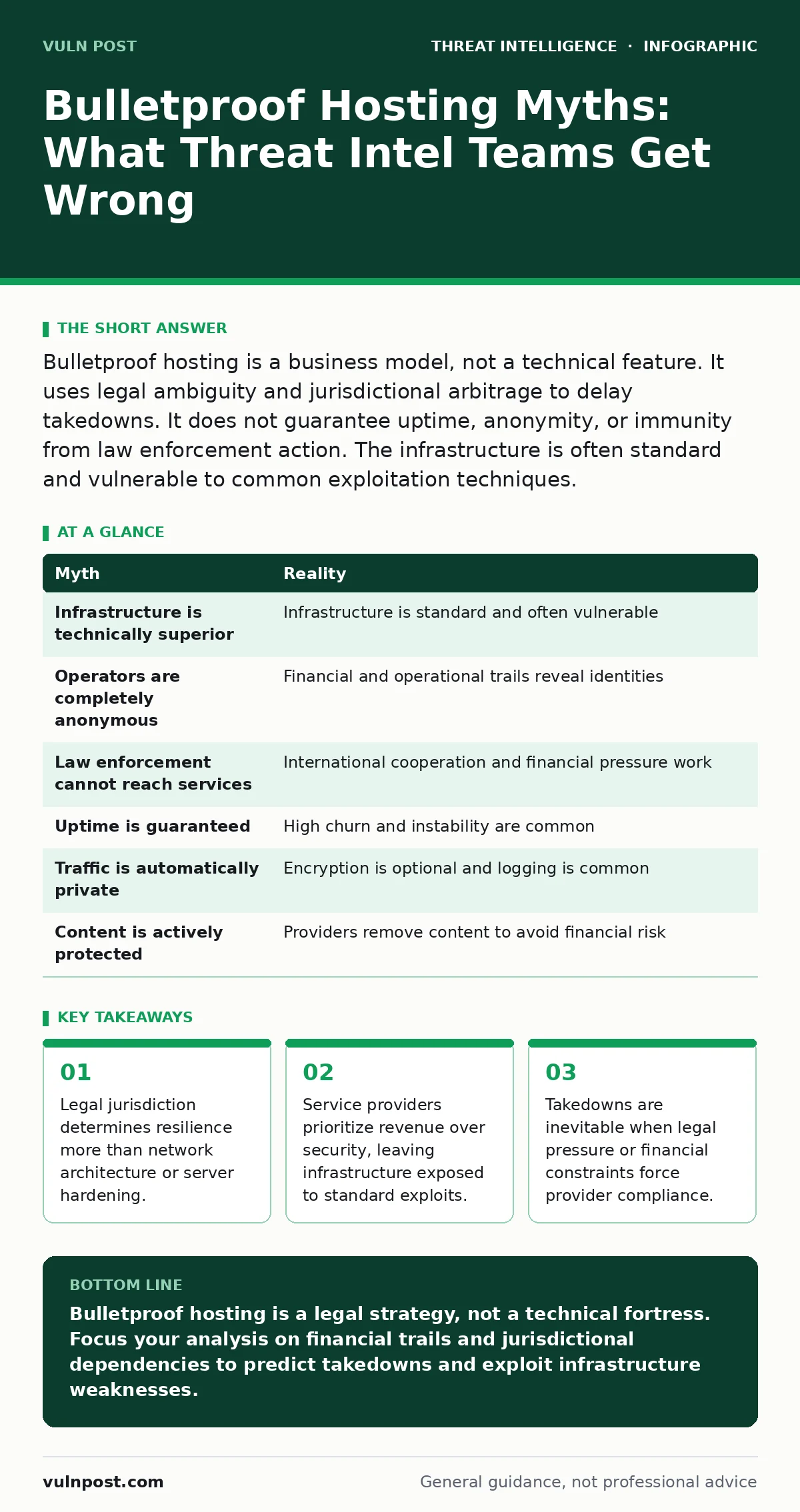
Bulletproof hosting is a business model, not a technical feature. It uses legal ambiguity and jurisdictional arbitrage to delay takedowns. It does not guarantee uptime, anonymity, or immunity from law enforcement action. The infrastructure is often standard and vulnerable to common exploitation techniques.
Myth: The Infrastructure Is Technically Superior
Reality: Bulletproof hosts rarely use specialized hardware or advanced network designs. They operate on standard commercial infrastructure that mirrors typical hosting providers. The perceived resilience comes from legal structures, not engineering excellence.
These providers often use commodity servers and standard routing protocols. They do not possess unique defenses against distributed denial-of-service attacks or intrusion attempts. The architecture is designed for cost efficiency, not security.
The lack of investment in security means these environments are often more vulnerable to privilege escalation attacks than well-managed commercial clouds. Operators focus on legal shields, leaving technical gaps open for exploitation by any actor with basic skills.
Myth: Operators Are Completely Anonymous
Reality: Anonymity is a business feature, not an absolute state. Providers accept cryptocurrency and obscure registration details to protect client identity. However, operational security failures often reveal operator locations and identities.
Financial trails and communication patterns create detectable fingerprints. Even without direct server access, analysts can correlate transaction data with known infrastructure. The promise of total anonymity ignores the reality of digital footprints.
When operators manage multiple services, they often reuse credentials or network segments. This behavior creates linkable data points for threat intelligence teams. The illusion of invisibility breaks down under sustained operational threat intelligence analysis.
Myth: Law Enforcement Cannot Reach These Services
Reality: Jurisdictional barriers delay action, but they do not prevent it. International cooperation frameworks allow law enforcement to request data and seize assets across borders. These processes are slow, but they are effective over time.
Providers in permissive jurisdictions still rely on global internet exchange points and payment processors. Pressure on these upstream dependencies forces compliance. The host may ignore local requests, but global financial systems have no jurisdiction.
The legal process involves warrants, mutual legal assistance treaties, and diplomatic channels. While this takes time, the outcome is often the same as domestic takedowns. The myth of untouchability confuses delay with immunity.
Myth: Uptime Is Guaranteed
Reality: Bulletproof hosts suffer from high churn and instability. Providers frequently change ownership, migrate infrastructure, or cease operations due to legal pressure. The service is fragile, not resilient.
Clients face unexpected downtime when providers pivot to avoid scrutiny. This instability disrupts malicious campaigns and compromises data integrity. The business model prioritizes short-term revenue over long-term reliability.
Infrastructure changes often expose data to new vulnerabilities. Migration processes are rarely secure, leading to data leaks or exposure. The promise of persistent availability is contradicted by the operational reality of the industry.
Myth: All Traffic Is Encrypted and Private
Reality: Encryption is optional and often misconfigured. While providers may offer secure sockets layer connections, they do not enforce them. Many services run on unencrypted protocols by default.
Logs of network traffic are often retained for billing or dispute resolution. These logs can be accessed by authorities or leaked during infrastructure changes. The assumption of privacy ignores standard logging practices.
Analysts can often capture plaintext data if they have access to the network segment. The lack of strict security policies means that sensitive information is rarely protected by default. Privacy is a feature, not a guarantee.
See also: Threat Actor Naming Conventions: What Small Teams Need to Know · Domain Fronting Mistakes: 6 Ways Your Network Gets Bypassed
Myth: Content Is Automatically Protected
Reality: Providers do not actively defend content against removal. They rely on passivity and legal loopholes to avoid liability. This passive stance does not equate to active protection against takedowns.
When legal threats become credible, providers remove content to protect their business. The threshold for action varies, but financial risk is the primary driver. Content protection is contingent on the provider's willingness to absorb legal costs.
This dynamic creates a false sense of security for clients. They assume the host will fight for them, but the host fights only for its own survival. The relationship is transactional, not protective.
| Myth | Reality |
|---|---|
| Infrastructure is technically superior | Infrastructure is standard and often vulnerable |
| Operators are completely anonymous | Financial and operational trails reveal identities |
| Law enforcement cannot reach services | International cooperation and financial pressure work |
| Uptime is guaranteed | High churn and instability are common |
| Traffic is automatically private | Encryption is optional and logging is common |
| Content is actively protected | Providers remove content to avoid financial risk |
The focus on legal arbitrage leaves technical security neglected. This creates opportunities for defensive teams to exploit standard vulnerabilities. Understanding the business model reveals the true weaknesses.
Key takeaways
- Legal jurisdiction determines resilience more than network architecture or server hardening.
- Service providers prioritize revenue over security, leaving infrastructure exposed to standard exploits.
- Takedowns are inevitable when legal pressure or financial constraints force provider compliance.
Bulletproof hosting is a legal strategy, not a technical fortress. Focus your analysis on financial trails and jurisdictional dependencies to predict takedowns and exploit infrastructure weaknesses.
Frequently asked questions
How do I identify bulletproof hosting infrastructure?
Look for providers in jurisdictions with weak cyber laws, those accepting only cryptocurrency, and those with histories of hosting illicit content. High turnover and poor security practices are also indicators.
Can I take down bulletproof hosted services?
Direct takedowns are difficult. Focus on upstream dependencies like payment processors, domain registrars, and internet exchange points. Legal pressure on these entities often forces removal.
Are bulletproof hosts safe for legitimate use?
No. The lack of security investment and high risk of takedowns make them unsuitable for any data requiring integrity or availability. The legal ambiguity also poses compliance risks.
How does this relate to nation-state cyber attacks?
Nation-state actors may use similar infrastructure for deniability. Understanding the limitations of bulletproof hosting helps attribute activities based on infrastructure reuse and operational security failures.
How this guide was produced: written by the Vuln Post editorial team with AI assistance, checked against the public references listed below, and reviewed when the facts change. See our editorial policy or report an error.