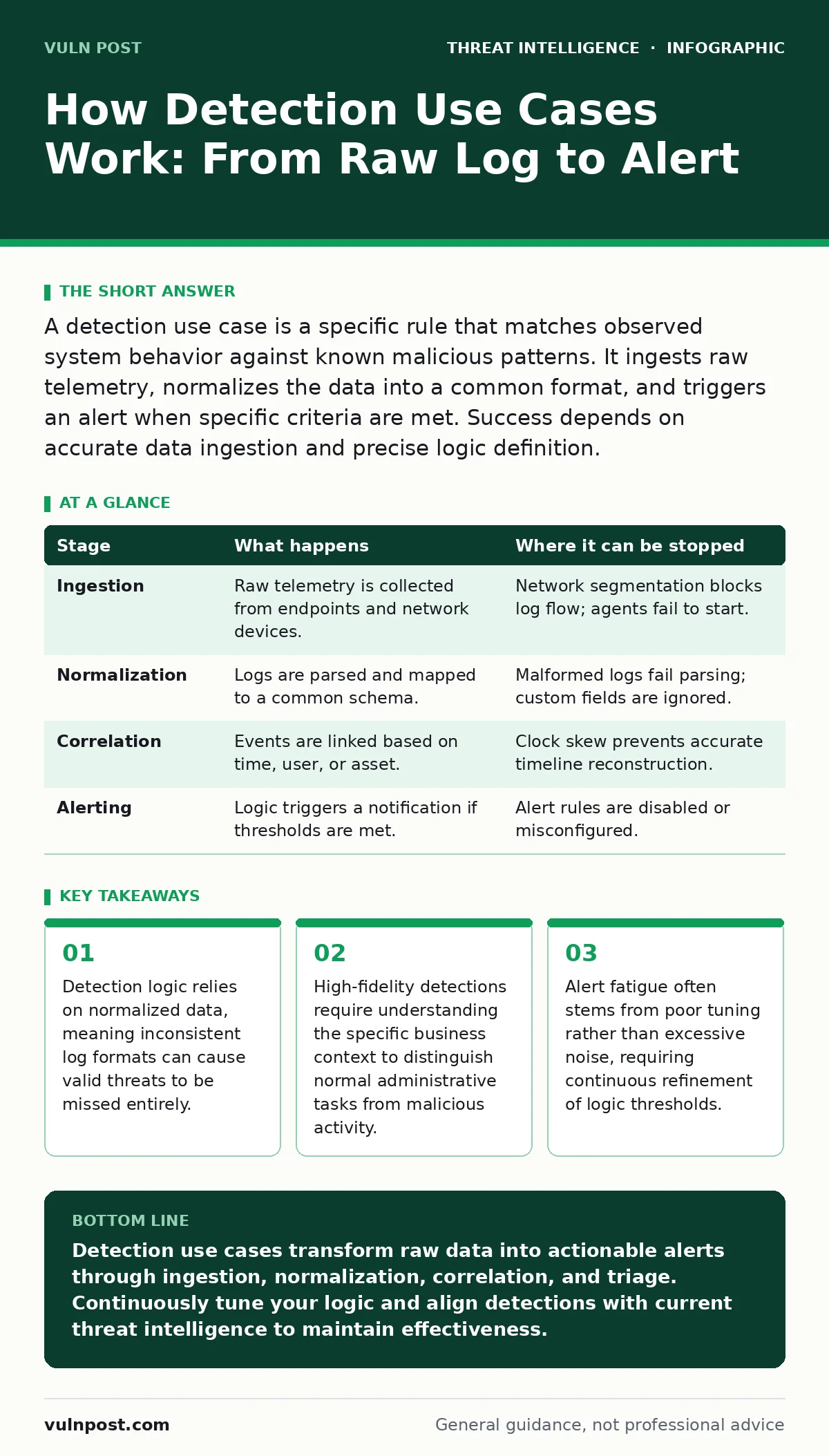
A detection use case is a specific rule that matches observed system behavior against known malicious patterns. It ingests raw telemetry, normalizes the data into a common format, and triggers an alert when specific criteria are met. Success depends on accurate data ingestion and precise logic definition.
The Anatomy of a Detection Rule
A detection use case is not merely a filter; it is a structured hypothesis about how an adversary behaves within your environment. You define specific conditions that, when met, indicate a potential security incident. This process transforms raw machine data into actionable intelligence. Without this structure, security tools generate noise rather than clarity.
The value of a use case lies in its specificity. Generic rules that flag any login failure create overwhelming noise. Specific rules that flag three failed logins followed by a successful login from a new geographic location provide context. You must understand the behavior you are hunting before you can write the logic to catch it.
Stage 1: Data Ingestion and Collection
The first stage involves gathering telemetry from endpoints, networks, and cloud services. This data arrives in various formats, sizes, and frequencies. Your security information and event management (SIEM) system must receive this stream without dropping packets. If data is lost here, no amount of sophisticated logic can recover it.
Collection points include firewalls, identity providers, and endpoint detection and response agents. Each source provides a different view of system activity. You must ensure that all critical assets are emitting logs to the central repository. Gaps in coverage create blind spots that attackers exploit during defense evasion techniques.
| Stage | What happens | Where it can be stopped |
|---|---|---|
| Ingestion | Raw telemetry is collected from endpoints and network devices. | Network segmentation blocks log flow; agents fail to start. |
| Normalization | Logs are parsed and mapped to a common schema. | Malformed logs fail parsing; custom fields are ignored. |
| Correlation | Events are linked based on time, user, or asset. | Clock skew prevents accurate timeline reconstruction. |
| Alerting | Logic triggers a notification if thresholds are met. | Alert rules are disabled or misconfigured. |
Stage 2: Normalization and Enrichment
Raw logs are rarely usable in their native format. Different vendors use different field names for the same concept. Normalization maps these fields to a common schema, such as OpenC2 or custom taxonomies. This step ensures that a "source IP" in one log matches a "src_ip" in another.
Enrichment adds context to the raw data. You might append threat intelligence feeds or internal asset tags to the log entry. This turns an anonymous IP address into a known malicious actor or a critical server. Without enrichment, you lack the context needed to prioritize alerts.
Stage 3: Correlation and Logic Application
This is the core of the detection use case. You apply logic to the normalized data to find patterns. Simple logic might look for a single event, such as a process termination. Complex logic correlates multiple events over time, such as a PowerShell script downloading a file and then executing it.
Correlation engines group events by common identifiers, such as user ID or host IP. This allows you to see the sequence of actions. If you only look at individual events, you miss the narrative of the attack. The logic must account for legitimate administrative actions to reduce false positives.
Stage 4: Alert Generation and Triage
When the logic conditions are met, the system generates an alert. This alert is not the final verdict; it is a request for human attention. The alert contains the relevant data points that triggered the rule. Analysts review these alerts to determine if they represent a true threat.
Triage involves validating the alert. Analysts check for known false positives, such as scheduled maintenance tasks. If the alert is valid, it becomes a ticket for investigation. If it is invalid, the logic is tuned to prevent future noise. This feedback loop is critical for maintaining detection efficacy.
See also: How Adversary Emulation Works: Mechanics, Limits, and Detection · Sigma Rules: Fix 6 Common Misunderstandings in Detection Logic
Limits of Static Detection Logic
Static rules have inherent limitations. They only detect what you have already defined. If an adversary uses a novel technique, your static rules will not catch it. This is why you must complement static detections with behavioral analysis and threat hunting.
Another limit is the reliance on accurate data. If the underlying logs are incomplete or inaccurate, the detection logic fails. You cannot detect what you do not see. Regular audits of data sources are necessary to ensure coverage.
Tuning and Continuous Improvement
Detection use cases require constant tuning. As your environment changes, so does the baseline of normal behavior. New software deployments or changes in user behavior can trigger false positives. You must update your logic to reflect these changes.
Reviewing closed alerts helps identify patterns in false positives. If a rule triggers frequently for a specific application, you may need to whitelist that application or adjust the threshold. This process reduces alert fatigue and allows analysts to focus on genuine threats.
Integration with Broader Security Operations
Detection use cases do not exist in isolation. They feed into incident response processes and threat intelligence platforms. When an alert is confirmed, the findings can update your threat intelligence, improving future detections. This creates a cycle of continuous improvement.
Understanding operational threat intelligence helps you prioritize which use cases to build. If intelligence indicates a rise in Active Directory attacks, you should prioritize detections related to privilege abuse and lateral movement. Aligning detection efforts with current threats maximizes your security posture.
Key takeaways
- Detection logic relies on normalized data, meaning inconsistent log formats can cause valid threats to be missed entirely.
- High-fidelity detections require understanding the specific business context to distinguish normal administrative tasks from malicious activity.
- Alert fatigue often stems from poor tuning rather than excessive noise, requiring continuous refinement of logic thresholds.
Detection use cases transform raw data into actionable alerts through ingestion, normalization, correlation, and triage. Continuously tune your logic and align detections with current threat intelligence to maintain effectiveness.
Frequently asked questions
How do I reduce false positives in detection rules?
Review closed alerts to identify recurring false positives. Adjust thresholds, add exclusion filters for known legitimate activities, and enrich data with context to improve accuracy.
What is the difference between a detection rule and a use case?
A detection rule is the specific logic that triggers an alert. A use case is the broader scenario or hypothesis that the rule is designed to detect, including the context and response procedures.
How often should I update my detection use cases?
Update use cases whenever your environment changes or new threat intelligence emerges. Regular reviews, such as quarterly, help ensure coverage remains aligned with current risks.
Can automated tools replace human analysts in triage?
Automation can handle initial triage and enrichment, but human analysts are needed for complex investigations. Automation reduces noise, allowing analysts to focus on high-value threats.
How this guide was produced: written by the Vuln Post editorial team with AI assistance, checked against the public references listed below, and reviewed when the facts change. See our editorial policy or report an error.