
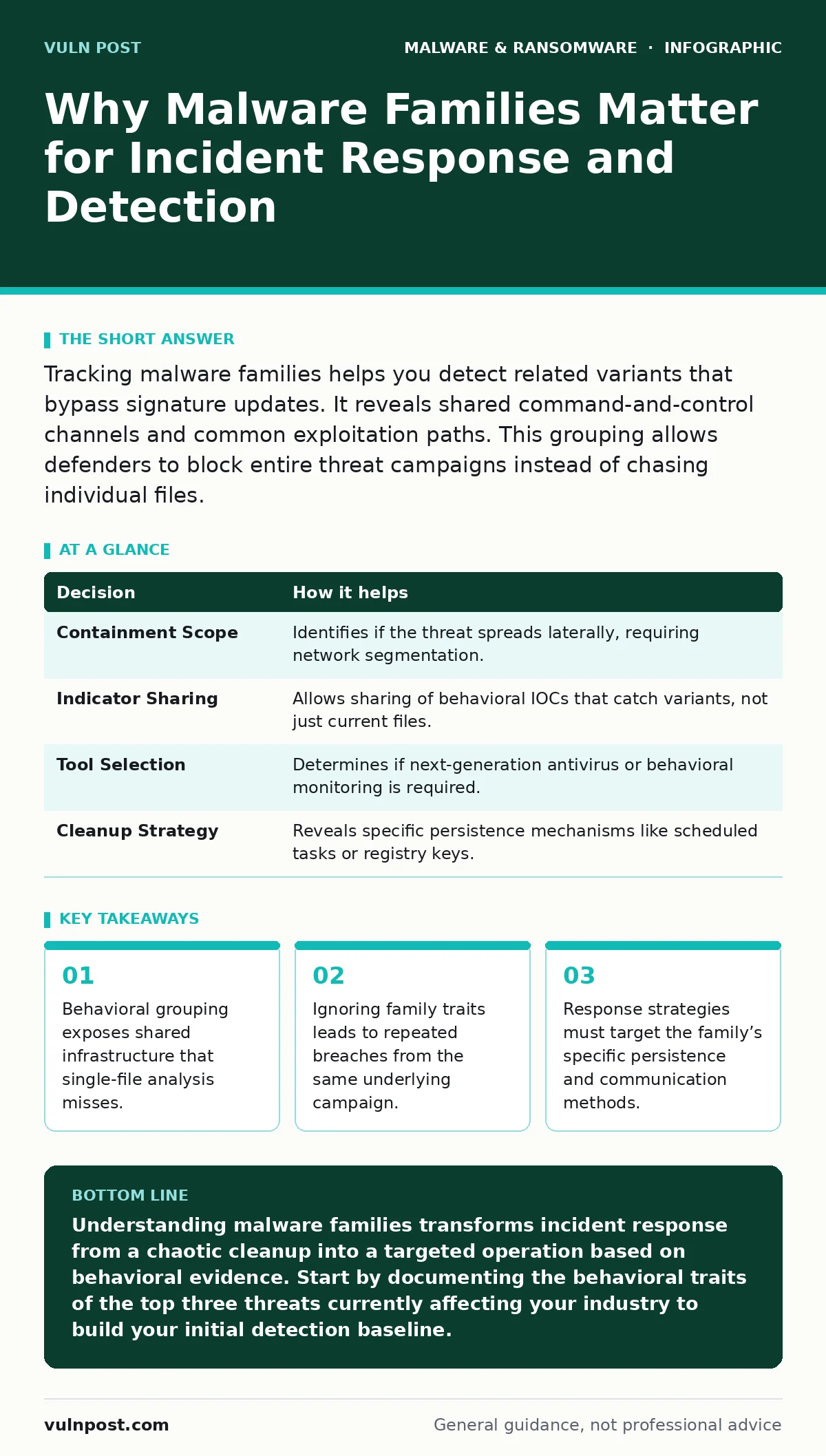
Tracking malware families helps you detect related variants that bypass signature updates. It reveals shared command-and-control channels and common exploitation paths. This grouping allows defenders to block entire threat campaigns instead of chasing individual files.
The Limits of File Hashing
Most defenders start with a file hash. A hash is a unique string of characters that represents a specific file. If the file changes even slightly, the hash changes completely. This works well for known, static threats. It fails immediately against polymorphic malware.
Polymorphic malware rewrites its own code every time it infects a new host. The functionality remains identical, but the hash is different. If your detection relies solely on hashes, you are blind to these variants. You are looking for a specific fingerprint when the attacker has changed their face.
This is where the concept of a malware family becomes necessary. A family groups malware by its behavior, structure, and intent, not its binary signature. This approach allows you to see the forest instead of just one tree.
Defining Family Characteristics
A malware family is defined by consistent traits. These traits include how the malware communicates with its controller, how it persists on a system, and how it spreads. For example, a family might always use a specific encryption algorithm for data exfiltration.
Another trait might be a unique method of hiding process memory. Even if the code is rewritten, the underlying logic remains. Analysts look for these behavioral fingerprints. They examine the network traffic patterns and the system calls made during execution.
This requires moving beyond static analysis. Static analysis looks at the code without running it. You need to observe the malware in action to see these traits. This is where dynamic malware analysis becomes a critical tool for identifying the true nature of the threat.
The Operational Impact on Detection
When you understand the family, you can write detection rules that catch variants. Instead of alerting on one specific file name, you alert on a specific sequence of system calls. You monitor for the unique network beacon pattern associated with that family.
This reduces noise. You are not alerting on every unknown executable. You are alerting on executables that behave like known malicious families. This precision allows security operations teams to focus their limited resources on high-fidelity alerts.
It also helps with retrospective hunting. If you discover a new variant today, you can search your logs for the behavioral indicators of its family from months ago. You might find that the attacker has been inside your network for a long time.
Decision Making in Incident Response
Knowing the family informs every step of your response. It dictates how you contain the threat and what you prioritize for eradication. Without this context, you are guessing. With it, you are acting on evidence.
Consider the decision to isolate a host. If the malware family is known to spread via lateral movement over specific protocols, you block those protocols. If the family relies on external command-and-control servers, you sinkhole those domains.
The following table illustrates how family intelligence drives specific decisions.
| Decision | How it helps |
|---|---|
| Containment Scope | Identifies if the threat spreads laterally, requiring network segmentation. |
| Indicator Sharing | Allows sharing of behavioral IOCs that catch variants, not just current files. |
| Tool Selection | Determines if next-generation antivirus or behavioral monitoring is required. |
| Cleanup Strategy | Reveals specific persistence mechanisms like scheduled tasks or registry keys. |
The Cost of Ignoring Families
Ignoring malware families leads to a cycle of reactive cleanup. You remove the symptom, not the disease. The attacker returns with a variant that has a new hash. Your tools do not see it. The breach repeats.
This creates a hidden cost. Your team spends hours analyzing each new variant. They do not realize they are fighting the same enemy. They miss the opportunity to block the entire campaign.
This gap is particularly dangerous with sophisticated threats. These threats often use modular components. One module steals credentials, another encrypts files. If you only block the encryption module, the credential theft continues. You have secured your data but lost your access.
See also: Malicious Documents: The Step-by-Step Execution Chain · DFIR Training Myths That Weaken Incident Response Capabilities
Leveraging Behavioral Analysis
To build effective defenses, you must analyze behavior. This means observing what the malware does, not just what it is. You look for anomalies in process creation, file access, and network connections.
Teams use sandboxed environments to detonate samples safely. They observe the actions without risking production systems. This reveals the family’s tactics, techniques, and procedures. These procedures are often consistent across variants.
This approach complements traditional tools. It does not replace them. It adds a layer of understanding that allows you to anticipate attacker moves. You can adjust your software restriction policies to block the specific behaviors used by the family.
Integrating Family Intelligence
Integrating this intelligence into your workflow requires discipline. You must document the behavioral traits of each family you encounter. You must update your detection rules to reflect these traits.
You should also consider the source of your samples. Not all samples are representative. Some are decoys designed to waste your time. Focus on samples that show full functionality.
This process helps you build a knowledge base. Over time, you recognize patterns. You see how families evolve. You adapt your defenses before the next variant arrives. This proactive stance is the difference between surviving and thriving in a hostile environment.
Building a Resilient Posture
Resilience comes from understanding the attacker’s playbook. Malware families provide that understanding. They give you a framework for analysis and response.
By focusing on families, you move from reactive to proactive. You stop chasing hashes and start hunting behaviors. You block entire campaigns instead of individual files.
This shift requires investment in analysis capabilities. It requires training your team to think in terms of behavior. But the payoff is significant. You reduce your dwell time. You limit the impact of breaches. You gain a strategic advantage in the ongoing battle.
Remember that no single tool solves this. You need a combination of detection, analysis, and response. You need to integrate insights from multiple sources. You need to stay curious and adaptive.
Key takeaways
- Behavioral grouping exposes shared infrastructure that single-file analysis misses.
- Ignoring family traits leads to repeated breaches from the same underlying campaign.
- Response strategies must target the family’s specific persistence and communication methods.
Understanding malware families transforms incident response from a chaotic cleanup into a targeted operation based on behavioral evidence. Start by documenting the behavioral traits of the top three threats currently affecting your industry to build your initial detection baseline.
Frequently asked questions
How do I identify the family of a new malware sample?
Analyze its behavior in a sandbox, looking for unique network patterns, persistence methods, and encryption algorithms that match known families.
Can a single malware sample belong to multiple families?
Yes, modular malware may combine components from different families, requiring analysis of each module’s distinct behavior and origin.
Why do traditional antivirus tools miss family variants?
Traditional tools rely on static signatures or hashes, which change with every variant, whereas family analysis focuses on consistent behavioral traits.
How often should I update my family-based detection rules?
Update them whenever you observe new variants or changes in the family’s tactics, techniques, and procedures during your analysis cycles.
How this guide was produced: written by the Vuln Post editorial team with AI assistance, checked against the public references listed below, and reviewed when the facts change. See our editorial policy or report an error.