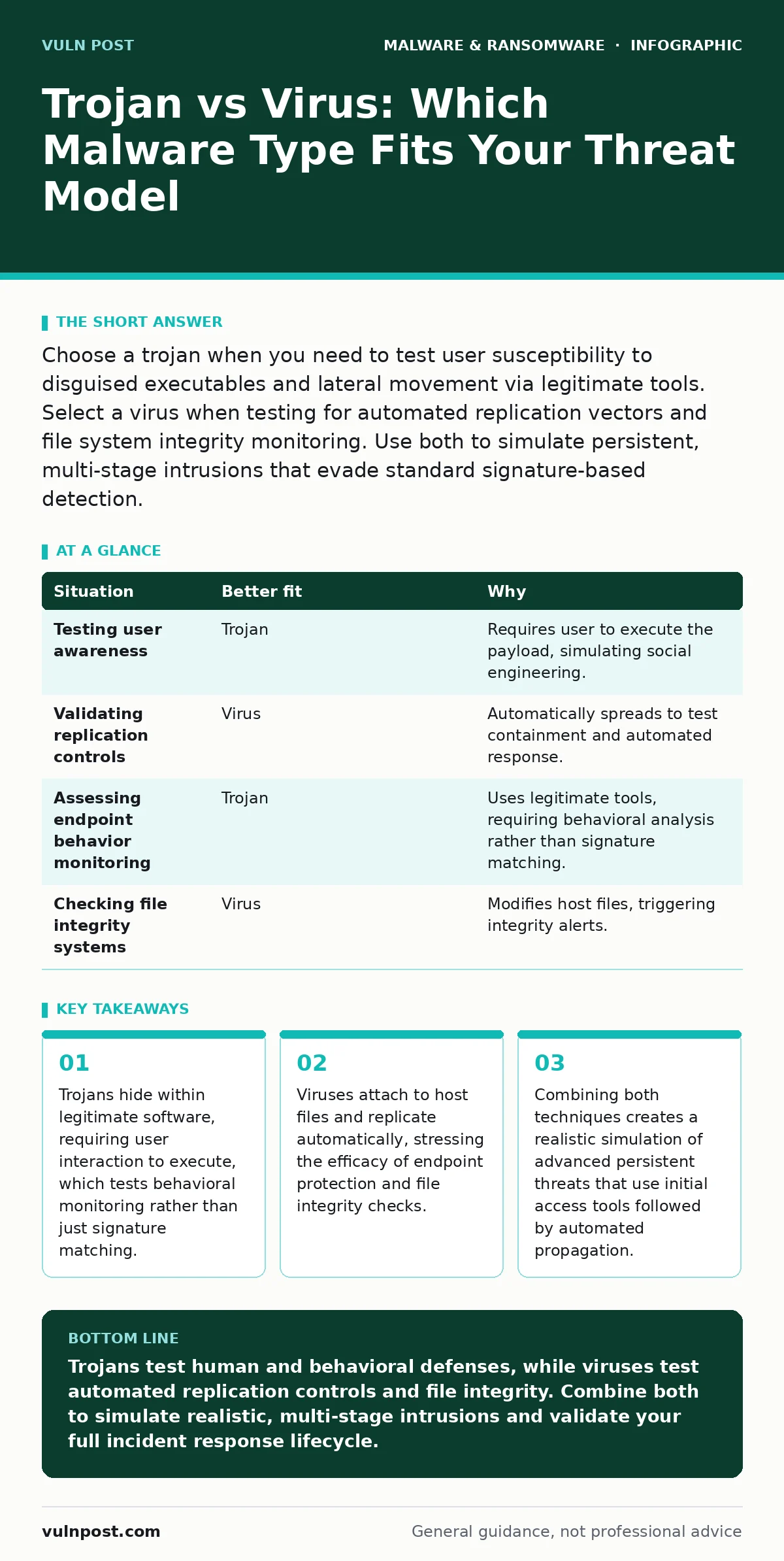
Choose a trojan when you need to test user susceptibility to disguised executables and lateral movement via legitimate tools. Select a virus when testing for automated replication vectors and file system integrity monitoring. Use both to simulate persistent, multi-stage intrusions that evade standard signature-based detection.
Does the Threat Rely on Human Action?
The primary distinction lies in execution. A Trojan masquerades as legitimate software but contains hidden malicious code. It does not replicate itself. It requires a user to download and run it. This makes it a tool for testing social engineering defenses.
A virus attaches itself to a host program or file. It replicates when the host executes. It spreads automatically without further user intervention after the initial infection. This tests your automated detection and containment capabilities.
If your goal is to measure how well staff recognize suspicious payloads, the Trojan is the correct choice. It forces the security operations team to detect the anomaly in behavior, not just the signature.
Is Automatic Propagation Required?
Viruses are self-replicating. They seek out other executable files or documents to infect. This behavior creates a rapid expansion of the threat footprint. It tests the speed of your incident response and the effectiveness of your network segmentation.
Trojans do not spread on their own. They remain static until manually deployed or triggered by a command-and-control server. This limits the blast radius to the initial host. It allows for more controlled testing of lateral movement techniques.
When you need to validate that your next-generation antivirus solutions can stop automatic replication, a virus simulation is necessary. Trojans will not trigger these specific replication-based alerts.
What Is the Primary Evasion Mechanism?
Trojans evade detection by hiding in plain sight. They often use legitimate system tools for command execution. This technique is known as living off the land. It bypasses traditional signature databases because the binaries are trusted.
Viruses often modify file structures or append code to existing executables. This changes file hashes and sizes. Modern endpoint detection and response platforms flag these structural anomalies.
If your defense strategy relies heavily on file hashing and integrity monitoring, a virus will test those controls directly. A Trojan will bypass them, forcing you to rely on process monitoring and network traffic analysis.
Scenario Comparison
| Situation | Better fit | Why |
|---|---|---|
| Testing user awareness | Trojan | Requires user to execute the payload, simulating social engineering. |
| Validating replication controls | Virus | Automatically spreads to test containment and automated response. |
| Assessing endpoint behavior monitoring | Trojan | Uses legitimate tools, requiring behavioral analysis rather than signature matching. |
| Checking file integrity systems | Virus | Modifies host files, triggering integrity alerts. |
When to Use Both Together
Advanced threats rarely use a single technique. They often begin with a Trojan for initial access. Once inside, they deploy viral mechanisms to spread laterally. This combination tests the full lifecycle of an intrusion.
Using both requires careful orchestration. The Trojan establishes persistence and credentials. The virus component then uses those credentials to move across the network. This simulates a sophisticated adversary.
This approach validates your dynamic malware analysis capabilities. It ensures that your sandboxing solutions can detect both the initial deceptive payload and the subsequent replication behavior.
See also: Malicious Documents: The Step-by-Step Execution Chain · How Adversary Emulation Works: Mechanics, Limits, and Detection
Integration with Defensive Strategies
Your testing must align with your broader security framework. For instance, software restriction policies may block the execution of the Trojan if it is not signed. This highlights gaps in your application whitelisting.
Golden images provide a known good state for your systems. Comparing infected systems against these images helps identify the changes made by the virus. This is critical for recovery planning.
Review your antivirus quarantine procedures. Ensure that quarantined files are not automatically restored. This prevents the virus from re-infecting the system after the test concludes.
Understanding Malware Evolution
Malware is not static. New malware families emerge constantly, blending features of Trojans and viruses. Some threats act as Trojans initially but gain viral capabilities after establishing a foothold.
Your defenses must adapt. Relying on static signatures is insufficient. Behavioral monitoring and anomaly detection are required to catch hybrid threats.
This complexity necessitates regular updates to your detection rules. It also requires continuous training for your security analysts to recognize these hybrid behaviors.
Key takeaways
- Trojans hide within legitimate software, requiring user interaction to execute, which tests behavioral monitoring rather than just signature matching.
- Viruses attach to host files and replicate automatically, stressing the efficacy of endpoint protection and file integrity checks.
- Combining both techniques creates a realistic simulation of advanced persistent threats that use initial access tools followed by automated propagation.
Trojans test human and behavioral defenses, while viruses test automated replication controls and file integrity. Combine both to simulate realistic, multi-stage intrusions and validate your full incident response lifecycle.
Frequently asked questions
Can a Trojan become a virus?
A Trojan can download a virus, but the Trojan itself does not replicate. The distinction remains in their initial behavior and propagation methods.
Is a virus always worse than a Trojan?
Not necessarily. Viruses spread faster but are easier to detect via replication. Trojans are stealthier and can cause targeted damage without spreading.
How do I stop a Trojan?
Use application whitelisting, restrict macro execution, and monitor for unusual process behavior. User training is also critical to prevent initial execution.
Do viruses still exist?
Yes, though many modern threats blend characteristics. Pure viruses are less common but still relevant for testing file integrity and replication controls.
How this guide was produced: written by the Vuln Post editorial team with AI assistance, checked against the public references listed below, and reviewed when the facts change. See our editorial policy or report an error.