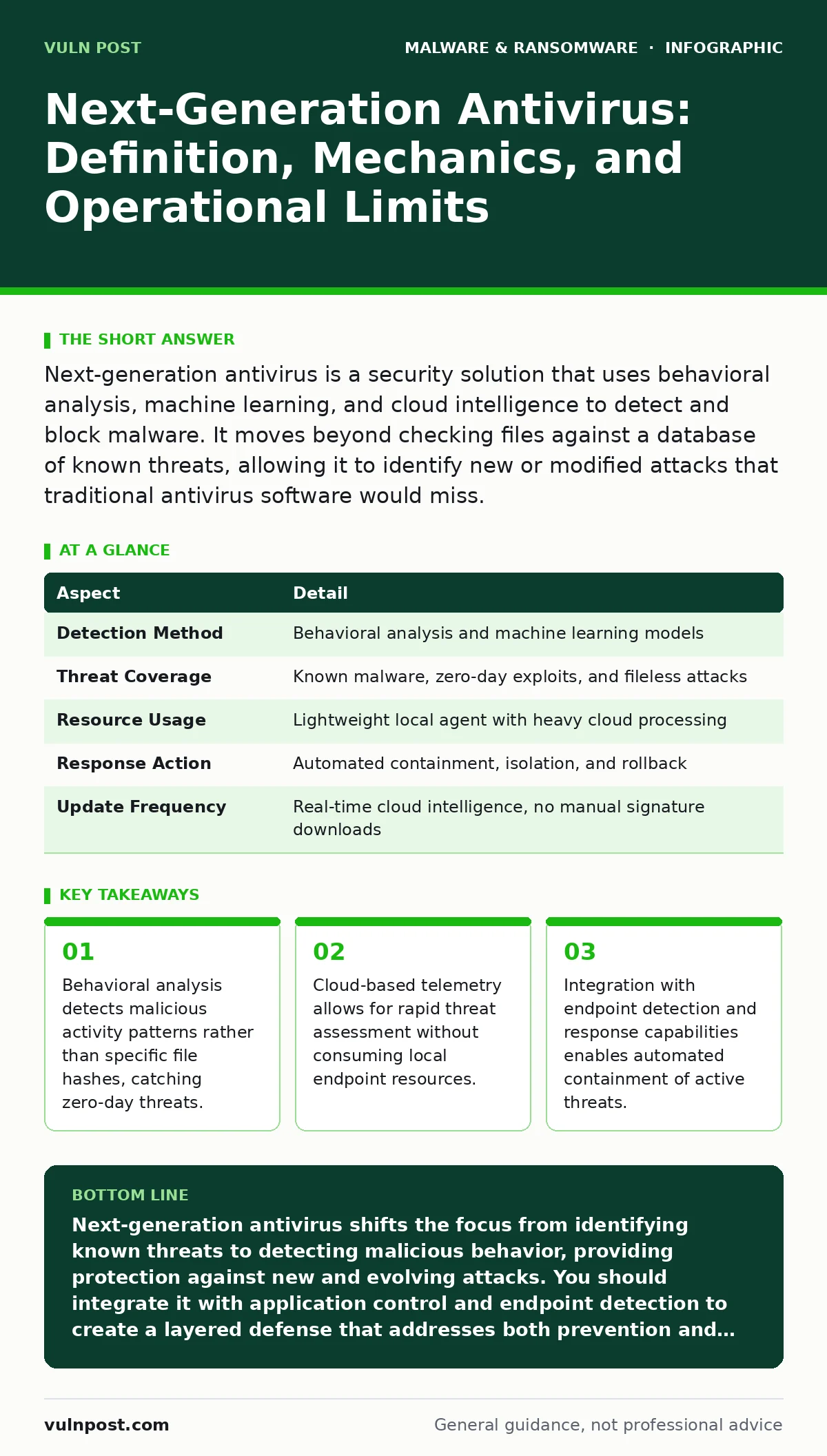
Next-generation antivirus is a security solution that uses behavioral analysis, machine learning, and cloud intelligence to detect and block malware. It moves beyond checking files against a database of known threats, allowing it to identify new or modified attacks that traditional antivirus software would miss.
The Shift from Signatures to Behavior
Imagine a security guard who only lets people in if they have a specific photo on a watchlist. This works well for known criminals, but it fails completely when someone wears a mask or changes their clothes. Traditional antivirus software operates on this same principle. It compares the digital fingerprint, or hash, of a file against a database of known malicious files. If the file matches, it is blocked. If it does not, it is allowed to run.
This approach creates a blind spot for any threat that has never been seen before. Attackers easily bypass this by altering a few bytes in the code. This process, known as obfuscation, changes the file’s hash without changing its function. The guard sees a new face and lets the attacker in. Next-generation antivirus changes the model. Instead of checking the ID card, it watches what the person does once they enter the building.
Core Mechanisms of Detection
Next-generation antivirus relies on three primary mechanisms to identify threats. The first is behavioral analysis. This involves monitoring the actions of a program in real time. The system looks for sequences of actions that are typical of malware, such as a word processor trying to access the system registry or encrypt files.
The second mechanism is machine learning. Algorithms are trained on vast amounts of data to recognize patterns associated with malicious code. These models can identify subtle anomalies in code structure that human analysts might miss. The third mechanism is cloud-based telemetry. Local agents send data to a central cloud service, which has access to a broader view of global threat activity. This allows the local agent to make decisions based on intelligence that it does not store locally.
| Aspect | Detail |
|---|---|
| Detection Method | Behavioral analysis and machine learning models |
| Threat Coverage | Known malware, zero-day exploits, and fileless attacks |
| Resource Usage | Lightweight local agent with heavy cloud processing |
| Response Action | Automated containment, isolation, and rollback |
| Update Frequency | Real-time cloud intelligence, no manual signature downloads |
Solving the Zero-Day Problem
The primary problem next-generation antivirus solves is the inability of traditional tools to stop zero-day exploits. A zero-day exploit is a vulnerability that the software vendor does not know about yet, meaning there is no patch available. Attackers use these vulnerabilities to execute code on your systems.
Traditional antivirus cannot block these attacks because the malicious code has no prior record in the threat database. Next-generation antivirus blocks them by recognizing the intent. If a script attempts to modify critical system files or establish a hidden connection to an external server, the system flags it as suspicious. The decision is based on the action, not the identity of the file.
Integration with Endpoint Detection and Response
Next-generation antivirus does not operate in isolation. It is often integrated with endpoint detection and response, or EDR. While the antivirus component focuses on preventing known and unknown malware, EDR provides deeper visibility into the endpoint environment.
EDR collects detailed telemetry data about processes, network connections, and user activities. This data allows security teams to investigate incidents that bypass initial prevention. If a threat evades the antivirus, EDR can trace its movement across the network. This combination provides both prevention and detection capabilities. It ensures that even if an attacker gets in, their actions are recorded and can be reversed.
Common Misconceptions About Capability
Many organizations believe that next-generation antivirus eliminates the need for other security controls. This is a dangerous assumption. No single tool can stop all attacks. Next-generation antivirus is effective against malware, but it does not protect against social engineering, weak credentials, or misconfigurations.
Another common mistake is assuming that cloud dependency is a weakness. In reality, it is a strength. Local signature databases become outdated quickly. Cloud-based intelligence ensures that every endpoint has access to the latest threat data instantly. However, this does require a stable internet connection. If the connection drops, the local agent must rely on its cached rules, which may be less effective.
See also: Detecting Defense Evasion: Finding Hidden Activity in Logs · Trojan vs Virus: Which Malware Type Fits Your Threat Model
The Role of Application Control
While behavioral analysis is powerful, it can generate false positives. Legitimate software sometimes behaves in ways that resemble malware. For example, a system administration tool might modify registry keys or create new users. To reduce noise, next-generation antivirus often includes application control features.
These features allow you to define explicit rules about which applications are allowed to run. This is similar to software restriction policies, which restrict execution based on file paths or digital signatures. By whitelisting trusted applications, you reduce the attack surface. This ensures that only approved software can execute, regardless of its behavior. This adds a layer of certainty that behavioral analysis alone cannot provide.
Limitations and Edge Cases
Next-generation antivirus has limitations that you must understand. It struggles with fileless malware that operates entirely in memory. Since there is no file on the disk to analyze, traditional scanning methods fail. However, behavioral analysis can still detect the abnormal memory usage or process injection techniques used by fileless malware.
Another edge case is firmware malware. This type of malware resides in the hardware’s firmware, below the operating system. Antivirus software running in the operating system cannot see or interact with the firmware. Protecting against firmware threats requires separate hardware-level security measures. You must treat the firmware as a separate trust boundary.
Complementing Other Defenses
Next-generation antivirus is one layer in a broader defense strategy. It works alongside other controls to provide depth. For instance, malicious documents often serve as the initial vector for attacks. While antivirus can block the payload, email filtering and web gateways can stop the document from reaching the user in the first place.
Additionally, maintaining golden images for your operating systems ensures that you start with a known, clean state. This reduces the baseline noise that antivirus systems must monitor. When you deploy standardized images, you know exactly what software should be present, making it easier to detect anomalies.
Dynamic Analysis and Future Trends
The field is evolving toward more dynamic analysis. Dynamic malware analysis involves running suspicious files in a sandboxed environment to observe their behavior. This is more thorough than static analysis but consumes more resources. Next-generation antivirus platforms are increasingly integrating sandboxing capabilities directly into the endpoint agent.
This allows for deeper inspection of suspicious files without impacting user experience. The agent can quickly determine if a file is malicious by running it in a virtualized space. This approach balances security with performance, ensuring that your systems remain protected without slowing down daily operations.
Key takeaways
- Behavioral analysis detects malicious activity patterns rather than specific file hashes, catching zero-day threats.
- Cloud-based telemetry allows for rapid threat assessment without consuming local endpoint resources.
- Integration with endpoint detection and response capabilities enables automated containment of active threats.
- Traditional signature-based methods remain insufficient against polymorphic malware that changes its code structure.
Next-generation antivirus shifts the focus from identifying known threats to detecting malicious behavior, providing protection against new and evolving attacks. You should integrate it with application control and endpoint detection to create a layered defense that addresses both prevention and response.
Frequently asked questions
Does next-generation antivirus replace traditional antivirus?
Yes, it replaces traditional signature-based antivirus by offering more advanced detection methods. It provides better protection against zero-day threats and fileless malware.
How does next-generation antivirus handle false positives?
It uses machine learning and user feedback to refine its models. You can also whitelist trusted applications to prevent legitimate software from being blocked.
Is next-generation antivirus effective against ransomware?
It is effective at detecting and blocking ransomware behavior, such as mass file encryption. However, it should be part of a broader strategy that includes backups and access controls.
Can next-generation antivirus run on all operating systems?
Yes, most vendors provide agents for Windows, macOS, and Linux. However, the depth of features may vary depending on the operating system.
How this guide was produced: written by the Vuln Post editorial team with AI assistance, checked against the public references listed below, and reviewed when the facts change. See our editorial policy or report an error.