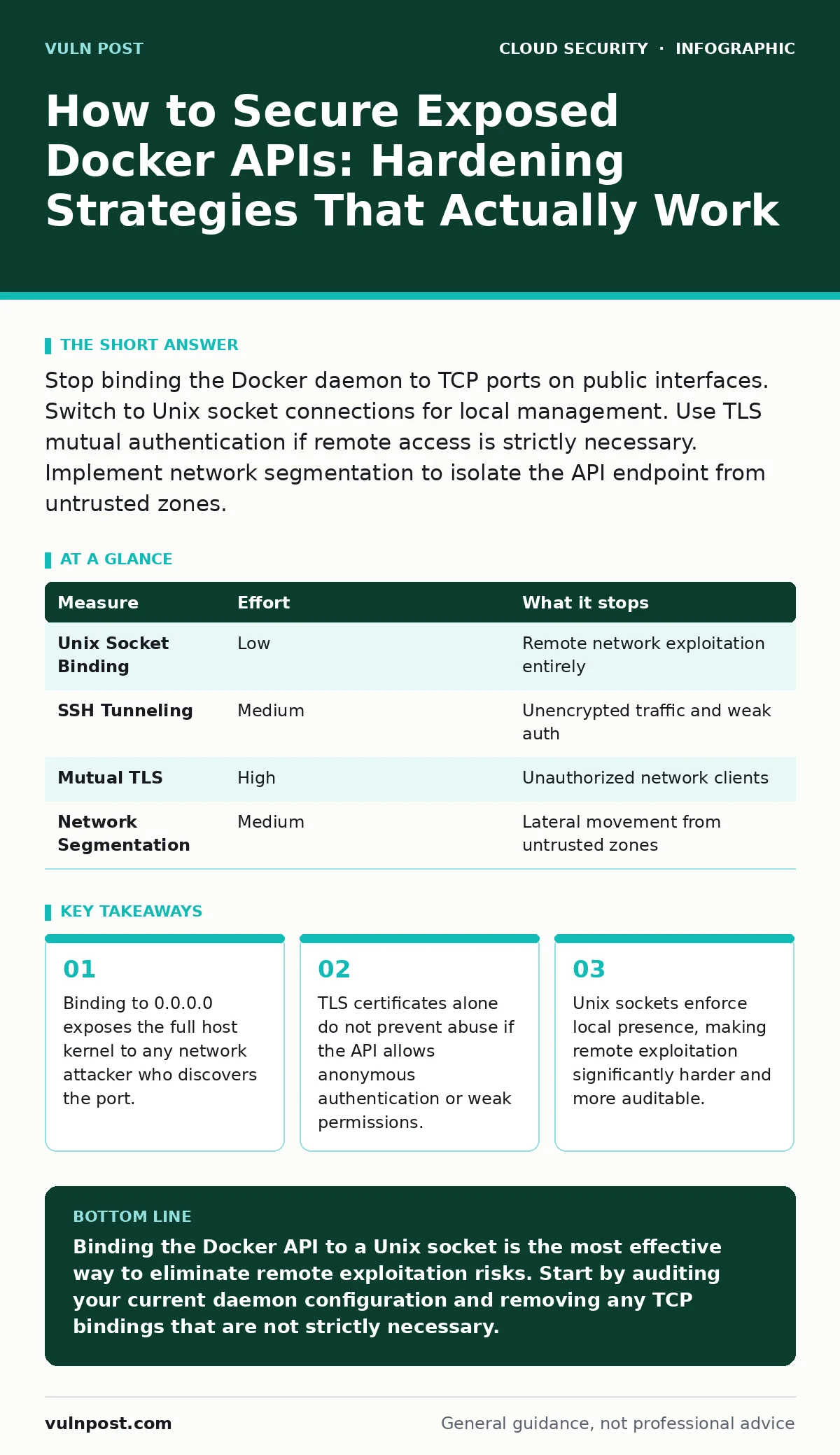
Stop binding the Docker daemon to TCP ports on public interfaces. Switch to Unix socket connections for local management. Use TLS mutual authentication if remote access is strictly necessary. Implement network segmentation to isolate the API endpoint from untrusted zones.
The Hidden Risk of Convenience
Docker APIs provide programmatic control over container creation, networking, and storage. By default, the Docker daemon listens on a Unix socket, which is secure because it requires local file system access. However, many administrators bind this API to a TCP port for remote management or CI/CD integration. This change transforms a local management interface into a public-facing endpoint.
Imagine a developer configures their local machine to accept remote Docker commands for debugging. They forget to restrict the binding to localhost. An attacker on the same network scans for open ports and finds the Docker API. Because the API grants root-equivalent privileges by default, the attacker can now execute commands on the host. This is not a container escape; it is direct host compromise.
The risk extends beyond simple command execution. An exposed API allows an attacker to mount host directories into new containers. This grants read and write access to the entire host file system. From there, they can steal SSH keys, modify system binaries, or install persistent backdoors. The attack surface is the entire operating system, not just the container runtime.
Bind to Unix Sockets First
The most effective prevention measure is to never bind the Docker daemon to a TCP port on a public interface. Instead, rely on Unix domain sockets for all local interactions. Unix sockets are file-based endpoints that only allow processes on the same host to connect. This eliminates the network attack surface entirely.
If you need remote management, use SSH tunneling. SSH provides encrypted transport and strong authentication. By tunneling the Docker API connection over SSH, you inherit SSH’s security controls. The Docker daemon still listens only on the local socket, but the SSH server handles the remote access. This approach adds an authentication layer that the Docker API lacks by default.
This method requires minimal configuration. You simply ensure the dockerd service starts with the default socket binding. Any tool that needs to interact with Docker must run on the host or connect via an SSH tunnel. This reduces the complexity of your security posture by removing the need to manage TLS certificates for the API itself.
Enforce Mutual TLS Authentication
If remote API access is unavoidable, you must implement Transport Layer Security (TLS) with mutual authentication. Standard TLS only encrypts the connection; it does not verify who is connecting. Mutual TLS requires both the client and the server to present valid certificates. This ensures that only authorized clients can interact with the daemon.
Generating and managing certificates adds operational overhead. You must create a Certificate Authority, sign server and client certificates, and distribute them securely. If a client certificate is lost or stolen, an attacker can impersonate that client. Therefore, certificate rotation and revocation processes are critical.
This measure stops unauthorized access from the network. It does not stop an attacker who has already obtained a valid client certificate. It also does not protect against misconfigured permissions within the Docker API itself. Always combine mutual TLS with strict role-based access controls.
Segment the Management Network
Network segmentation isolates the Docker API from untrusted networks. Even if the API is exposed on a TCP port, it should only be accessible from specific management subnets. Firewalls and security groups should deny all other traffic. This limits the blast radius of a compromised network segment.
Imagine your CI/CD pipeline runs in a private subnet. The Docker API is accessible only from this subnet. If an attacker compromises a public-facing web application, they cannot reach the Docker API. This containment strategy prevents lateral movement from application servers to infrastructure management tools.
Segmentation does not protect against insider threats. An attacker with access to the management subnet can still exploit the API. Therefore, segmentation is a defense-in-depth measure, not a standalone solution. It works best when combined with strict access controls and monitoring.
| Measure | Effort | What it stops |
|---|---|---|
| Unix Socket Binding | Low | Remote network exploitation entirely |
| SSH Tunneling | Medium | Unencrypted traffic and weak auth |
| Mutual TLS | High | Unauthorized network clients |
| Network Segmentation | Medium | Lateral movement from untrusted zones |
What Does Not Work
Many administrators rely on firewall rules alone to secure the Docker API. Firewalls can block external access, but they do not prevent internal abuse. If an attacker gains shell access to the host, the firewall is bypassed. The API remains open to any local process.
Another common mistake is using password-based authentication for the Docker API. The Docker daemon does not support password authentication natively. Workarounds often involve reverse proxies or custom scripts, which introduce new vulnerabilities. These solutions are fragile and hard to maintain.
Implement Least Privilege Access
The Docker API grants root privileges by default. This is dangerous because it allows any connected client to perform any action. You should implement least privilege access by using Docker’s built-in authorization plugins or external identity providers. These tools allow you to define fine-grained permissions for different users or services.
For example, a CI/CD pipeline may only need to build images and push them to a registry. It should not be able to stop other containers or mount host directories. By restricting permissions, you limit the impact of a compromised credential. This aligns with the principles of policy as code, where access rules are defined and enforced programmatically.
Regularly audit these permissions. Over time, permissions often creep as new requirements emerge. Remove unused access rights and rotate credentials frequently. This reduces the window of opportunity for attackers who steal credentials.
Monitor for Anomalous Behavior
Exposing the Docker API creates a high-value target. Monitoring is essential to detect abuse. Log all API requests and analyze them for unusual patterns. Look for commands that create privileged containers, mount sensitive host directories, or change network configurations.
Integrate these logs with your security information and event management system. Set alerts for high-risk actions. For instance, an alert should trigger if a new container is created with host networking enabled. This helps you respond quickly to potential breaches.
Monitoring does not prevent attacks, but it reduces dwell time. Early detection allows you to isolate compromised systems and revoke credentials before significant damage occurs. Combine monitoring with incident response plans that address container-specific threats, such as container escape scenarios.
Checklist for Today
- Verify that the Docker daemon is not bound to any TCP port on public interfaces.
- Ensure all remote access uses SSH tunneling or mutual TLS with strict certificate management.
- Review firewall rules to confirm that the Docker API is inaccessible from untrusted networks.
Key takeaways
- Binding to 0.0.0.0 exposes the full host kernel to any network attacker who discovers the port.
- TLS certificates alone do not prevent abuse if the API allows anonymous authentication or weak permissions.
- Unix sockets enforce local presence, making remote exploitation significantly harder and more auditable.
Binding the Docker API to a Unix socket is the most effective way to eliminate remote exploitation risks. Start by auditing your current daemon configuration and removing any TCP bindings that are not strictly necessary.
Frequently asked questions
Can I secure the Docker API with a simple password?
No, the Docker daemon does not support password authentication. You must use TLS certificates or SSH tunneling for secure remote access.
Does binding to localhost protect against all attacks?
No, binding to localhost only prevents remote network access. Local users with socket access can still execute root commands.
How do I manage certificates for mutual TLS?
Use a dedicated Certificate Authority to sign and manage certificates. Implement automated rotation and revocation processes to maintain security.
What is the risk of exposed Docker APIs in cloud environments?
In cloud environments, exposed APIs can lead to full account takeover. Attackers can spin up resources, exfiltrate data, and pivot to other services.
How this guide was produced: written by the Vuln Post editorial team with AI assistance, checked against the public references listed below, and reviewed when the facts change. See our editorial policy or report an error.